Google AI


Modern Australian

Making workers return to the office might not make them any more productive, despite what the NSW premier says

  • Written by: David Hensher AM, Director, Institute of Transport and Logistics Studies, University of Sydney

Making workers return to the office might not make them any more productive, despite what the NSW premier says

Announcing the directive to work “primarily in an approved office”, NSW Premier Chris Minns said overseas studies showed people were less productive when working from home.

“There is a drop in mentorship. There is less of a sense of joint mission,” he said. “This is about building up a culture in the public service.”

Having examined the impacts of working from home since the pandemic started, I am not convinced.

With colleagues from the Institute of Transport and Logistics Studies at The University of Sydney Business School, I have been monitoring the changing incidence of working from home and its relationship to performance since the start of the pandemic.

We have found that workers who take up working from home devote about one third of the time they save by not commuting to extra unpaid work.

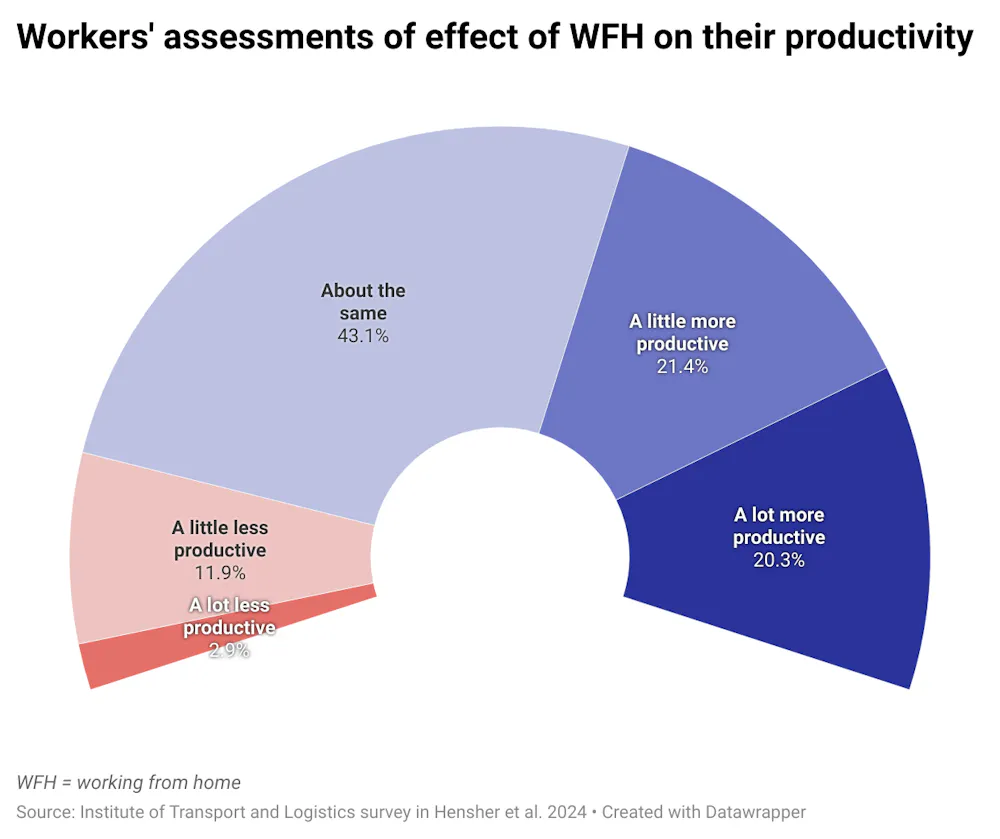
When we asked workers who took up working from home what the new arrangement had done to their productivity, more said it had improved it than made it worse.

About one in five said it had made them “a lot more productive”. Only one in 30 said it had made them “a lot less productive”.
Interestingly, when employers were asked the same question about whether their workers who took up working from home had become more or less productive, the answers were about the same. About one in five said the change had made their workers “a lot more productive”. About one in 20 said it had made them “a lot less productive”. Our findings accord with international evidence. A Stanford University study found that, in the United States, working from home during the pandemic had delivered a 5% increase in productivity. It found much of the gain didn’t show up in conventional measures of productivity because they didn’t take account of the savings in commuting time. Another study assessed the productivity of both remote and on-site call centres at Fortune 500 firms. It found working from home lifted productivity by 8%. Another, which email metadata from North America, Europe and the Middle East, found increases in the number of meetings per person but decreases in the average length of meetings, resulting in less time spent in meetings per day. Our own work has found some face-to-face contact is important, but two to three days per week is all that’s needed to facilitate social interaction, mentoring and sharing of ideas. In Australia, the Productivity Commission found control over working arrangements was important to productivity. It observed: […] workers may be more productive at home because they have better control over their time and enjoy better work-life balance. And it identified better matching of workers to jobs as important. Firms will be able to tap into a larger pool of (more productive) labour. While not strictly a productivity impact, workers have been shown to work longer hours when working from home during the pandemic. Our research offers new evidence on what workers do with the time saved by not commuting. According to the workers who took part in our surveys, the biggest use of that time (almost one-third of that time) was extra unpaid work for their employer. Extra paid work took up another substantial chunk of time (whether for the main employer or not) and household tasks took up about one-quarter of the time. The average commuting time saved by working from home in the Greater Sydney metropolitan area in September 2022 was 9.4 hours per week. This suggests the extra time devoted to extra paid and unpaid work has been substantial. It’s important to consider this in assessments of productivity. It would be unfortunate if the biggest effect of the return-to-the-office mandate was to make workers less generous with their time. Authors: David Hensher AM, Director, Institute of Transport and Logistics Studies, University of Sydney

Read more https://theconversation.com/making-workers-return-to-the-office-might-not-make-them-any-more-productive-despite-what-the-nsw-premier-says-236310

The Fire Safety Checklist Every Australian Short-Stay Host Should Run

Picture an Airbnb guest arriving late, tired, in a place they’ve never been. They don’t know where the exits are, which door leads to the garage, or h...

Better Business Photos Without Misleading Customers: An Australian Guide

A timber dining set looks inviting against a sunny deck, with cushions, lanterns and enough chairs for the whole family. But imagine the retailer sell...

Understanding a dental implant Melbourne Treatment Plan

A dental implant Melbourne patients may consider is one option for replacing a missing tooth, but suitability depends on oral health, bone support a...

How 3PL Logistics Australia Supports Faster and More Efficient Supply Chains

Why Has 3PL Logistics Become Important for Growing Businesses?  Gone are the days when supply chains were simpler and in minimal quantity. Now, the...

Common Skin Concerns and Treatment Options Available in Melbourne

Skin concerns can develop gradually or become noticeable following changes in age, lifestyle, sun exposure or hormonal factors. Pigmentation, rednes...

Why a Code-Compliant Home Can Still Feel Uncomfortable

When people build or renovate a home, they usually expect that meeting current building requirements will also produce a comfortable place to live. ...

Breach of Contract in Business: What Are Your Options?

Contracts are essential to business relationships. They establish expectations, allocate responsibilities and provide a framework for delivering goods...

How Pest Control Companies Can Rank for the Problems Customers Search First

Introduction SEO for Pest Control needs to start with the customer’s problem. Most people do not search for pest services in a neat or technical wa...

What Are the Benefits of Renovating an Older Home in Sydney?

Sydney has plenty of character homes, from Federation cottages to mid-century brick homes. Renovating rather than rebuilding can preserve what makes t...

Pool and Deck Design: How to Plan the Perfect Outdoor Living Space for Your Sydney Home

For many Australians, the backyard is where life happens. Summer barbecues, weekend swims and long evenings outdoors are all part of the lifestyle, ...

Is Solar Pool Heating Worth It? What Sydney Homeowners Should Know

There's nothing quite like a backyard pool on a hot Sydney day. But once autumn rolls in, many pools sit unused for months because the water is simp...

Planning a Luxury House Move: A Week-by-Week Timeline for Prestige Sydney Homes

Selling or buying a prestige home is a major milestone. Whether it's a waterfront residence in Birchgrove, a grand Federation home in Haberfield or ...

Downsizing or Upgrading Your Caravan? Here's How to Sell It Without the Hassle

Selling a caravan can feel like a major task, especially when you are unsure about its value, paperwork, or how to find a buyer. Whether you are dow...

The Best Overseas Adventure Holidays for Australians Who Love the Outdoors

Australia offers no shortage of incredible outdoor experiences, but sometimes the best way to satisfy your sense of adventure is to head overseas. A...

Cape Town Wine Shuttle: Winelands Tasting & Tours

Embark on an unforgettable journey through the picturesque Cape Winelands, where world-class wines and breathtaking scenery await. Our Cape Town Win...

Metal Fabrication: Choosing Metal Fabrication Melbourne Services for Custom Projects

What Modern Metal Fabrication Involves From individual components to complete structures, metal fabrication brings together processes such as desig...

Why Giant Rats Tail Grass Keeps Coming Back After Spraying

Giant Rats Tail Grass (GRT) is one of the most frustrating pasture weeds for farmers and lifestyle property owners. You spray an infested area, see th...

When Custom Cardboard Boxes Make Sense for Your Business

Custom cardboard boxes can be useful when a standard carton does not fit a product, packing method or presentation requirement particularly well. A ...