what to know about the outbreak of this contagious skin condition in hospitals
- Written by Peta-Anne Zimmerman, Senior Lecturer/Program Advisor, Griffith Graduate Infection Prevention and Control Program, Griffith University
Google searches for “NSW scabies outbreak” have spiked over recent days in light of an outbreak of the contagious skin condition in New South Wales.
According to the Illawarra Shoalhaven Local Health District south of Sydney, an initial case was detected at Wollongong Hospital in late July. Since then, at least 11 patients and 23 staff have been diagnosed with scabies across four hospitals in the region.
So what is scabies, and is this outbreak cause for concern?
An itchy rash
Scabies is a skin infestation caused by the Sarcoptes scabiei mite (a type of microscopic insect), which buries underneath skin and lays eggs.
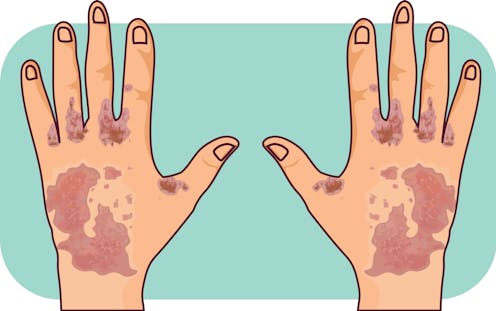
Generally, the symptoms show up as an itchy rash, raised bumps, or bites. You may also see “tracks” on your skin, which might appear as thin, tiny, raised or discoloured lines.
Scabies most commonly appears in folds of the skin, such as between the fingers, under the armpit, or in the groin area. The itch is usually worse at night or after you’ve had a hot shower.
Scabies can look a lot like other rashes, such as eczema, psoriasis, or even just dry skin. So the best thing to do if you think you might have scabies is to go and be assessed by a doctor or other health professional. They will be better able to tell whether or not it’s scabies, and may also take a skin sample to identify it.
How does scabies spread?
Scabies spreads by skin-to-skin contact. It can also spread via towels, bedding and clothes. This is because the mite can survive outside a human for roughly 48 hours.
Once you’ve been exposed to the parasite and it has been transmitted, it can take between two and eight weeks for symptoms to present. This is because it takes time for the mite to enter the skin, lay their eggs there, and for the eggs to hatch, which contributes to the symptoms.
However, you can be a source of transmission even before symptoms appear, which is why scabies can be so difficult to control.
Can it be treated?
It’s important not to scratch scabies. Doing so may spread the newborn mites under your skin, meaning a larger area can become affected. Scratching could also cause a secondary bacterial infection.
The good news is scabies can be treated quite easily once it’s identified. Your doctor will usually recommend a cream or lotion, which will generally be available over the counter. The cream is normally applied to your whole body (staying away from sensitive areas such as the head and neck) once before bed, and then again around a week later. But follow the instructions for use on the product or any guidance from your doctor.
The topical treatment kills the mites and eggs, so it’s safe for someone who has had scabies to mix with other people 24 hours after the initial treatment.
How contacts are managed or treated will be advised by health authorities or professionals. But, given scabies is so contagious, it’s generally recommended that close contacts of known cases receive treatment too, via a single application of the cream or lotion.
If you or someone in your house has scabies, wash any bedding, towels or clothing used in the previous 48 hours in a hot-wash cycle. If you don’t have access to a hot wash, another option is to collect these items into a plastic bag and leave it for a week. The mites will have died by the time you retrieve them.
Scabies is quite common
According to the World Health Organization, at least 200 million people worldwide have scabies at any one time. Scabies can occur anywhere but is most common in areas with high population density.
It’s endemic in some remote communities in Australia, where it predominantly affects Aboriginal and Torres Strait Islander people.
Sometimes, outbreaks will occur in regional and metropolitan areas, as we’re seeing now in NSW.
Outbreaks can spread easily in places like nursing homes, child care centres, detention centres and prisons, where people live or spend time in close quarters.
What about the NSW outbreak?
Information about how the outbreak in NSW started is currently unavailable. It’s unlucky an outbreak has affected hospitals, which have strong infection prevention and control procedures.
Health-care facilities have plans in place to manage an outbreak of this nature if it occurs. Any patient with scabies, or suspected to have it, would likely be put into what we call “contact precautions”. This means they would have their own room and bathroom, and staff looking after them would have to take extra protective measures.
It’s recommended any staff member with scabies should not return to work until 24 hours after they’ve received the appropriate treatment.
The Illawarra Shoalhaven Local Health District also says it’s undertaking extensive contact tracing to identify people who may be at risk.
But even with stringent infection prevention and control procedures and a thorough public health response, the outbreak is likely to take some time to bring under control. This is mainly because of the challenges of diagnosis and the time between when a person is exposed and when symptoms appear.
If you’ve spent time in one of the affected hospitals, or live in the local area, there’s no need to panic. But keep an eye out for any unusual rash, and seek medical attention if symptoms develop.
Authors: Peta-Anne Zimmerman, Senior Lecturer/Program Advisor, Griffith Graduate Infection Prevention and Control Program, Griffith University