

Urban growth is leading to more intense droughts for most of the world’s cities – and Sydney is a case study for areas at risk
- Written by Ian A. Wright, Associate Professor in Environmental Science, Western Sydney University
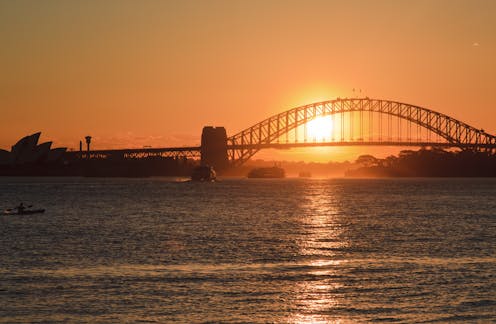
The growth of cities worldwide is contributing to more intense drought conditions in many cities, including Sydney, a new Chinese study has found. This is adding to urban heat and water stress. These important findings point to the need to improve how we design and build cities to make them more liveable and resilient.
The study has used a massive 40 years of weather station data collected from urban and rural areas around the globe. Larger cities and those with less green cover are associated with even greater worsening of drought.
The Greater Sydney region was one of six cities selected from around the world for additional, more detailed model simulations. These explore how urbanisation is making local drought conditions worse in Sydney and the other cities. On January 4 2020, the western Sydney suburb of Penrith was the hottest place on Earth that day. It reached a scorching 48.9°C degrees.
A few parts of the world, such as the US west coast, Mediterranean and South-East Queensland, bucked the global trends. This was attributed to cities that cluster near the coast in areas where the ocean cools the land and sea breezes bring moisture to these cities.
How cities affect heat and moisture levels
This new investigation is highly relevant as more than half of the world’s people (56%) now live in cities.
The study adds to our growing knowledge that urban development has many adverse impacts on the natural environment. We know cities affect local microclimates in many ways. Urban areas have previously been shown to influence cloud development.
And it’s well known urban areas can be hotter than non-urban areas. It’s called the urban heat island effect.
This effect is due to the loss of natural vegetation and its replacement by man-made materials. Buildings, roads, parking areas and other infrastructure absorb the sun’s heat during the day and reflect heat in the day and night, increasing the overall temperature of the city.
Urban development also changes the movement and storage of water in urban catchments. Known as the urban stream syndrome, it’s largely due to the human-made impervious surfaces. Roads, roofs, parking areas, footpaths and other artificial surfaces cover much of our cities.
Impervious surfaces reduce the natural soaking of rainwater into the soil. As a result, these hard man-made surfaces contribute to dry and hot urban soils.
There is a close link between air temperature and the amount of moisture the air can hold. This is a function of physics. As air temperature rises (as it does in urban areas) the air can hold about 7% more water vapour for every 1°C degree increase.
This is having far-reaching effects around the world. One result is that heavy rain and storms are becoming more common and intense.
For a short time after heavy rain, hard urban surfaces transform most of the rain into runoff. This can cause flash flooding in cities. But afterwards the soils and few remaining plants and trees often still need watering to make up for the lack of water soaking into the ground.
Loss of urban plants has big impacts
The new study adds to our knowledge by showing urban areas might also suffer more intense droughts due to the effects of urban development itself. This is linked to higher air temperatures as a result of the urban heat island effect and also to dryer conditions from the closely related urban dry island effect.
Important exceptions were found, including South-East Queensland cities, where urban areas can be strongly influenced by being close to the ocean.
The research highlights the substantial role plants play in urban air temperature and air moisture. This is due to plant evapotranspiration. This process drives their uptake of moisture from the soil.
The water flows through their tissues to their leaves and then is released as water vapour into the surrounding air. As well as providing the plant with nutrients, this process of “evapotranspiration” helps cool the plant. At the same time, evaporating water from the leaves adds moisture to the air and has a natural cooling effect.
The research paper states:
[T]he loss of vegetation often associated with urbanization further decreases urban evapotranspiration, resulting in the intensification of local atmospheric dryness.
Shading by plants, and particularly trees, also has a major influence by cooling air, soil and urban materials.
As urban growth leads to fewer plants and more buildings and artificial surfaces, this reduces the cooling effects from plants. Fewer plants transpiring also results in a loss of air moisture.
What’s the solution for cities?
This research is very complex. But, importantly, it has used real data from a large number of weather stations in cities and surrounding rural areas worldwide. The data used daily rainfall and temperature records collected over four decades (1980-2020).
Analysis of real data has been used to substantiate the theory that urban areas can increase the intensity of droughts.
Why is this important? Many cities are already struggling to provide enough water for their residents. Even mega-cities, such as Mexico City, are approaching “day zero” when they could effectively run out of water.
What can we do about this? We need to apply our knowledge about the broad benefits of urban green spaces. These parks, reserves and gardens are important for urban communities to connect with nature.
This new study shows how important these urban green spaces also are to help reduce the severity of droughts.
Authors: Ian A. Wright, Associate Professor in Environmental Science, Western Sydney University

















