

Dug up in Australia, burned around the world – exporting fossil fuels undermines climate targets
- Written by Bill Hare, Adjunct Professor of Energy, Murdoch University
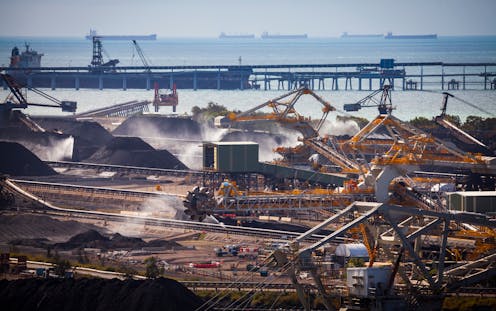
Australia is one of the world’s largest exporters of fossil fuels. While this coal and gas is burned beyond our borders, the climate-warming carbon dioxide (CO₂) emissions affect us all.
My colleagues and I at global research and policy institute Climate Analytics were commissioned to find out just how big Australia’s carbon footprint really is. Our detailed analysis of the nation’s fossil fuel exports and associated emissions is the most comprehensive to date. The report, released today, clearly shows Australia plays a major role in climate change.
We found Australia is the world’s third-largest fossil fuel exporter, after Russia and the United States. But it gets worse when the fuel is used. Australia exports so much coal that our nation is the second-largest exporter of fossil fuel CO₂ emissions.
Unfortunately, just when we need to be cutting emissions, Australia is doubling down on fossil gas extraction mainly for LNG production and export. Federal government policies enabling and/or promoting continued high fossil fuel exports threaten to sabotage international efforts to limit global warming.
Australia’s fossil fuel carbon footprint
Australia’s contribution to global warming can only be understood by considering its fossil fuel exports alongside its domestic emissions.
Our research found Australia’s coal and gas exports were responsible for 1.15 billion tonnes of CO₂ emissions in 2023. An additional 46 million tonnes of CO₂ were emitted domestically in the process of extracting, processing and distributing those fossil fuels purely for export. That takes the total to 1.2 billion tonnes of CO₂ attributable to fossil fuel exports.
In other words, Australia’s global fossil fuel carbon footprint is three times larger than its domestic footprint. Around 80% of the damage is done overseas.
The International Energy Agency has clearly said there should be no new fossil fuel development if the world is to limit warming to 1.5°C – the Paris Agreement’s temperature goal. Yet Australia continues to approve new fossil fuel exploration and production.
Overall, exports of Australian fossil fuels – and hence fossil fuel CO₂ emissions – are expected to continue at close to current levels through to 2035, under current government policies.
Thermal coal exports, which are burned mainly for electricity production, are expected to slightly decline by 2035 from their all-time high in 2023. But exports of metallurgical coal, used in steel-making, and LNG are expected to stay about the same in 2035 as they are today.
Blowing the carbon budget
Between 2023 and 2035, Australia’s fossil fuel exports alone would consume around 7.5% of the world’s estimated remaining global carbon budget of about 200 billion tonnes of CO₂. This is the amount of CO₂ that could still be emitted from 2024 onwards if we are to limit peak warming to 1.5°C with 50% probability.
But rather than decreasing, CO₂ emissions from Australia’s fossil fuel exports are set to increase under current government policies. In other words, in the next 11 years, by 2035, exported fossil fuel CO₂ emissions will exceed by 50% that of the entire 63 year period from 1961 to 2023.
If we include domestic CO₂ emissions from current policies, this means by 2035 Australia, with 0.3% of the world’s population, would consume 9% of the total remaining carbon budget.
Undermining the Paris Agreement
In December, at the COP28 international climate conference in Dubai, governments including Australia agreed on the first “global stocktake” of greenhouse gas emissions. It called for:
transitioning away from fossil fuels in energy systems in a just, orderly and equitable manner, accelerating action in this critical decade, so as to achieve net zero by 2050 in keeping with the science.
The stocktake also called on all countries to align their nationally determined contributions with the 1.5°C limit.
Energy Minister Chris Bowen’s response at the time was to call for Australia to be a “renewable energy superpower”. But his government appears to believe this includes embracing a gas export strategy.
Current government policy is not aligned with Paris Agreement’s 1.5°C limit. Our new report shows the government’s focus on maintaining high levels of fossil fuel exports is completely inconsistent with reducing global CO2 emissions to levels compatible with the 1.5°C goal.
Australia mainly exports fossil fuels to Japan, China, South Korea and India. These countries, which accounted for about 43% of fossil fuel CO₂ emissions in 2022, are also signatories to the Paris Agreement. So they have set 2030 emissions reduction targets and net-zero goals of their own. Continuing to import fossil fuels is incompatible with their own commitments.
Japan’s LNG imports fell 8% in 2023 to their lowest levels since 2009 and are expected to drop by a further 25% by 2030. Given the current energy security and LNG debate, it should be noted Japanese companies on-sold more LNG in 2020–22 than they purchased from Australia.
Thwarting national emissions reduction efforts
Australia’s planned expansion of fossil fuels, notably its gas exports, will add to the country’s domestic emissions and make it harder for it to meet even its own domestic target. That’s because a sizeable chunk of domestic fossil fuel CO₂ emissions (7.5%) comes from processing gas for export.
Our analysis also shows Australia’s plans are completely inconsistent with the global stocktake’s call for a transition away from fossil fuels. The government and gas industry’s arguments that more fossil gas is needed to get to net zero are also at odds with the science.
Time for a fossil fuel phase-out
Australia has a massive interest in the world as a whole decarbonising fast enough to limit warming to 1.5°C.
For example, children born in Australia today face much more extreme heat, floods and other disasters during their lifetimes than previous generations. This exposure can be very substantially reduced by limiting warming to 1.5°C. The choices Australia, as a major fossil fuel exporter, makes now in this critical decade will determine what happens to them.
By failing to initiate an orderly phase-out of fossil fuel exports, Australia also risks undermining its own stated ambition of becoming a renewable energy superpower.
It is in our nation’s interests to develop and implement an orderly exit – just as we are doing for our domestic emissions – working cooperatively with affected communities and overseas buyers. Doing anything less will only hurt us in the end.
Authors: Bill Hare, Adjunct Professor of Energy, Murdoch University

















