The Altar Stone of Stonehenge came from an unexpectedly distant place, new study reveals
- Written by Anthony Clarke, PhD Student in Applied Geology, Curtin University
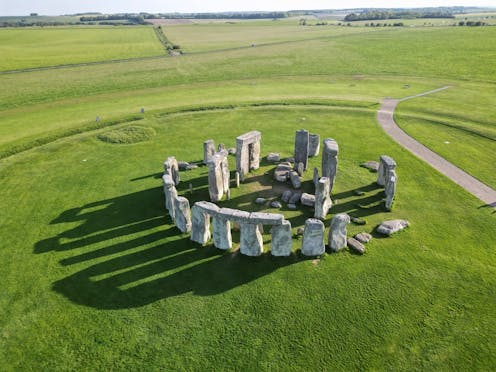
During the solstices, thousands gather at Stonehenge on the Salisbury Plain in England to celebrate the monument’s astronomical alignment. The focal point of these festivities is the Altar Stone – the six-tonne sandstone slab that lies flat at the centre of Stonehenge.
The ancient society that built this monument, from 3,100 to 1,600 BCE, left no written record. But Stonehenge’s building blocks themselves can help us understand it better. These blocks, or megaliths, are divided into two major categories: sarsen stones and bluestones. The Altar Stone is the largest bluestone.
Some bluestones were likely quarried from the Mynydd Preseli in Wales, over 220km away from Stonehenge, while the sarsen stones were locally sourced from the Salisbury Plain.
Meanwhile, the source of the Altar Stone has remained enigmatic. Recent work has raised doubts about the long-held belief that it, too, came from Wales.
So, where is the Altar Stone from? How was it transported to southern England? To answer this, we analysed the Altar Stone’s constituent mineral grains. Our results are now published in the journal Nature – and it looks like the Altar Stone came from Scotland.

The DNA of rocks
At midsummer dawn, the Altar Stone is set ablaze with sunlight. On the shortest day, the setting winter sun casts its dying rays on it. We can imagine a similar scene at Stonehenge in ancient times, when prehistoric Britons used it to welcome the promise of longer spring days and harvests ahead.
However, other than this in-built celestial calendar, how or why the monument was built remains largely unknown.
Humans are made from DNA, which reveals our heritage, ancestors, where our family lived, what we might have eaten, and events we went through.
Much like DNA, the Altar Stone contains a vast array of mineral grains that carry information on their birth (crystallisation) and subsequent history (transport and metamorphism).
 Stonehenge’s exposed megaliths and their source.
Author provided
Stonehenge’s exposed megaliths and their source.
Author provided
In our study, we dated mineral grains called zircon, rutile and apatite in the Altar Stone. As no sampling of the Altar Stone is permitted today, we used thin slices of the stone collected during historical archaeological digs.
Like a DNA test can tell us where our ancestors are from, grains within the Altar Stone have specific ages and chemical characteristics that allow us to pinpoint their source rock. We do this by comparing these details to rocks elsewhere.
 A detailed map of Britain showing the possible sources of the Altar Stone.
Author provided
A detailed map of Britain showing the possible sources of the Altar Stone.
Author provided
Matching characteristics tell us we have found the source of the grains in the Altar Stone: sedimentary rocks within the Orcadian Basin of northeast Scotland provided the closest match.
The Grampian Mountains and the Northern Highlands have shed tiny pieces of rock, or detrital grains, towards the Orcadian Basin since about 400 million years ago. These eroding rocks imparted their unique and traceable “DNA” into the sandstone, which was ultimately selected as the Altar Stone.
The Scottish heart of Stonehenge
Today, northeast Scotland and the Orkney Islands are sparsely populated but this was different in the past. Archaeological sites such as Skara Brae, Maeshowe, and the Ring of Brodgar atop a ritual landscape on Orkney suggest that northeast Scotland was a centre of Neolithic population, culture and trade.
A Scottish origin for the Altar Stone raises fascinating questions about prehistoric Britain’s connectivity and technological capabilities.
A quarried stone tools trade network is found throughout Britain, Ireland and continental Europe. For example, a saddle quern, a large prehistoric stone grinding tool, was discovered in Dorset and determined to be from Normandy, France.
 The Orkney Islands are rich in Neolithic sites, such as the Ring of Brodgar henge.
Pete Stuart/Shutterstock
The Orkney Islands are rich in Neolithic sites, such as the Ring of Brodgar henge.
Pete Stuart/Shutterstock
How did the Altar Stone get to Stonehenge?
Although some believe the Welsh bluestones may have been carried by glaciers towards Stonehenge, this transport seems improbable for the Altar Stone.
During past ice ages, vast ice walls moved northwards from the mountains of Scotland towards the Orcadian Basin – transporting rock even farther away from the Salisbury Plain.
But Neolithic Britons were adept seafarers. They had to be, as prehistoric Britain was heavily forested and formidable mountains, valleys and estuaries would have posed major barriers for southward cargo haulage.
Given these obstacles, overland transport would have proved all but impossible to move the Altar Stone from Scotland to Salisbury Plain. We think it’s likely the builders of Stonehenge shipped the Altar Stone by boat.
It wouldn’t be without precedent. The remains of the Hanson Log Boat provide evidence of transporting shaped sandstone blocks by river as far back as 1500 BC.
The unanswerable question is, why did people pick the Altar Stone? Why transport a drab greenish-grey six-tonne sandstone block over 650km from Scotland?
Humans have long sought the perfect stone for construction. This desire continues today.
American socialite Kim Kardashian spent thousands on lavish Calacatta gold marble from Italy for her Los Angeles mansion. For us, this choice is undoubtedly extravagant, perhaps incomprehensible, given that local stone was available.
Maybe the average Neolithic Briton felt the same about the Altar Stone. Or maybe there was a more mundane reason. Perhaps the rock was suitably fractured, allowing easy quarrying and transport via nearby marine shipping routes.
Authors: Anthony Clarke, PhD Student in Applied Geology, Curtin University