A post-pandemic novel with a fairy tale twist, Julia Phillips’ Bear is a harrowing story of economic hardship
- Written by Tamlyn Avery, Lecturer in American Studies, The University of Queensland
With her second novel Bear, Julia Phillips consolidates her position as a leading novelist of the cartographic margins.
Her first novel Disappearing Earth, a National Book Award finalist and one of the New York Times Book Review’s 10 best books of 2019, was set in Russia’s remote Kamchatka Peninsula; her second brings us to remote San Juan Island in the United States’ Pacific Northwest.
Review: Bear – Julia Phillips (Scribe)
Bear is a post-pandemic novel with a fairy tale twist. It begins as a story of the protagonist’s arrested development. At 29, Sam’s dreams have stalled. She lives with her older sister Elena, as they care for their incapacitated mother, a 51-year-old former nail technician, whose overexposure to solvents has caused her terminal lung cancer.

 Wilhelm and Jacob Grimm – Elisabeth Baumann (1855).
Public domain, via Wikimedia Commons
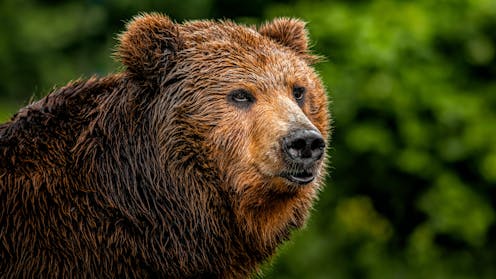
The grizzly alters the course of their lives. Elena and Sam make sense of its extraordinary appearance by interpreting it as a symbol. Both come to believe they are living in a fairy-tale lifted from the pages of the Brothers Grimm, though they read different meanings into the bear.
To Elena, the bear is a miracle. “What’s going on here is not dangerous,” she reasons. “It’s magical. It’s the best thing that has ever happened to us.” Her bear represents an inversion of everything their absent stepfather represented. As a parent, he was supposed to be their protector; instead, he proved abusive, vicious and violent. The bear, by contrast,
swam miles in the wet black night to arrive at their home. Made exception of itself, and of them, to every rule. It was supposed to be gruff but was instead tender. It was supposed to be wild but behaved like it was tamed. It came to Elena on the path as gentle as a suitor.
To Sam, the bear represents the opposite: danger, violence, chaos, instability. Its appearance symbolises her growing distance from her sibling, a breaking up of their unbreakable sisterhood – the one solace she could cling to and rely on in her otherwise dreary existence.
Man or bear?
Elena’s strange relationship to the bear gradually reveals that her adulthood has not stalled to the same degree as Sam’s. She is not on board with Sam’s plan to escape. Her group of friends, her secret boyfriend, and her increasingly close relationship to the grizzly reveal themselves as threats to Sam, who is wholly dependent on her sister.
The protagonists thus grapple with reconciling two bears: the real bear on their doorstep, wild, mysterious, untamed, powerful; and the bear as a metaphor and symbol of all the discontents they struggle to keep at bay. The novel openly alludes to fairy tales (in particular, Snow White and Rose Red) and their Freudian tropes, which can sometimes become cloying – for example, when Sam imagines her sister as a little girl lost in the woods pursued by a big bad monster.
Wilhelm and Jacob Grimm – Elisabeth Baumann (1855).
Public domain, via Wikimedia Commons
The grizzly alters the course of their lives. Elena and Sam make sense of its extraordinary appearance by interpreting it as a symbol. Both come to believe they are living in a fairy-tale lifted from the pages of the Brothers Grimm, though they read different meanings into the bear.
To Elena, the bear is a miracle. “What’s going on here is not dangerous,” she reasons. “It’s magical. It’s the best thing that has ever happened to us.” Her bear represents an inversion of everything their absent stepfather represented. As a parent, he was supposed to be their protector; instead, he proved abusive, vicious and violent. The bear, by contrast,
swam miles in the wet black night to arrive at their home. Made exception of itself, and of them, to every rule. It was supposed to be gruff but was instead tender. It was supposed to be wild but behaved like it was tamed. It came to Elena on the path as gentle as a suitor.
To Sam, the bear represents the opposite: danger, violence, chaos, instability. Its appearance symbolises her growing distance from her sibling, a breaking up of their unbreakable sisterhood – the one solace she could cling to and rely on in her otherwise dreary existence.
Man or bear?
Elena’s strange relationship to the bear gradually reveals that her adulthood has not stalled to the same degree as Sam’s. She is not on board with Sam’s plan to escape. Her group of friends, her secret boyfriend, and her increasingly close relationship to the grizzly reveal themselves as threats to Sam, who is wholly dependent on her sister.
The protagonists thus grapple with reconciling two bears: the real bear on their doorstep, wild, mysterious, untamed, powerful; and the bear as a metaphor and symbol of all the discontents they struggle to keep at bay. The novel openly alludes to fairy tales (in particular, Snow White and Rose Red) and their Freudian tropes, which can sometimes become cloying – for example, when Sam imagines her sister as a little girl lost in the woods pursued by a big bad monster.
 Illustration to Snow White and Rose Red by the Brothers Grimm – Josephine Pollard (1883).
Public domain, via Wikimedia Commons
All fairy tales must have a villain. Sam and Elena initially cast the young, stylish State Department biologist Madeline Pettit in that role. Pettit cautions them to stay away from the bear, for their own good as well as the bear’s. They refuse to listen, resenting her for intruding on their life, but more so for drawing attention to the wedge the bear has already driven between them.
Their mother’s ex-boyfriend also fits the villainous stereotype of wicked stepparent. But despite being built up as a source of volatility, violence and domestic discord, he only plays a background role in the story and never develops into a fully realised character.
His memory, rather than his presence, is a source of repression that legitimises the sisters’ determination to escape into a world of fantasy. When they encounter him at a family funeral, Sam actually mutters: “He’s even scarier than the bear” – an echo of recent online hypothetical debates about whether a woman, faced with a strange man and a bear in a forest, would “choose the bear”. Many women, Elena included it would seem, would indeed choose the bear.
Protective hostility
While Bear is Phillips’s second novel, it feels less evenly developed and intricate than her first, which wove together multiple narrative voices. It is written in the third person, much of it assuming the straightforward style of young adult fiction, befitting its protagonist’s worldview. But the novel’s tight focalisation through the unforgiving Sam, who misreads not only the bear but also almost all other characters, renders the first two-thirds of the novel somewhat confining.
The protective hostility Sam projects makes her unlikable, even if the reader can empathise with her hardships, but Phillips risks her protagonist becoming altogether unsympathetic by emphasising Sam’s growing dislike of the novel’s most captivating element: the bear.
What would it be like if Moby-Dick was not narrated by Ishmael, who opens the reader to the mystery and beauty of the natural world beyond the human, but by the vengeful Ahab, who seeks to destroy the whale and all the possibilities it represents?
While Sam is by no means an Ahab, she plots to destroy the bear. The novel wades into murky territory by focusing on her hostility to the creature, whom the reader is given no real cause to hate, rather than Elena’s wondrous view, or even Madeline’s environmentalist one.
While it is difficult to sit with Sam’s misjudgements, her unlikability stems from her desperation to escape her reality by retreating into fairy-tale delusions. In the novel’s tense final pages, Sam and Elena’s dispute reaches its peak in an ultimate encounter with the grizzly. These are the most philosophically profound pages in the book. The ending is a powerful meditation on human nature and the stories and fictions we tell ourselves to endure.
The ultimate villain
Bear is most interesting as a commentary on the enigmas of our relationships under late capitalism. It explores the pressures of family life, hardship, loss, broken dreams and our fragile relationship to nature.
These themes are contextually anchored in the heightened uncertainties and disconnections of the pandemic, which laid bare the pressures of a society where the economy is driven by greed, without any consideration for nature or human thriving. The novel depicts a world where labour has been subdivided into a precarious workforce with limited rights, and where the healthcare and welfare systems neglect the poorest and most vulnerable members of society.
The rhythm of the sisters’ lives depends entirely on their companies’ schedules. Sam cannot take proper time off to grieve or care for her mother without going further into debt. Her mother’s unpaid medical bills threaten to bankrupt the family. The bank wants to repossess their house, robbing Sam of her one imaginary ticket off the island.
Illustration to Snow White and Rose Red by the Brothers Grimm – Josephine Pollard (1883).
Public domain, via Wikimedia Commons
All fairy tales must have a villain. Sam and Elena initially cast the young, stylish State Department biologist Madeline Pettit in that role. Pettit cautions them to stay away from the bear, for their own good as well as the bear’s. They refuse to listen, resenting her for intruding on their life, but more so for drawing attention to the wedge the bear has already driven between them.
Their mother’s ex-boyfriend also fits the villainous stereotype of wicked stepparent. But despite being built up as a source of volatility, violence and domestic discord, he only plays a background role in the story and never develops into a fully realised character.
His memory, rather than his presence, is a source of repression that legitimises the sisters’ determination to escape into a world of fantasy. When they encounter him at a family funeral, Sam actually mutters: “He’s even scarier than the bear” – an echo of recent online hypothetical debates about whether a woman, faced with a strange man and a bear in a forest, would “choose the bear”. Many women, Elena included it would seem, would indeed choose the bear.
Protective hostility
While Bear is Phillips’s second novel, it feels less evenly developed and intricate than her first, which wove together multiple narrative voices. It is written in the third person, much of it assuming the straightforward style of young adult fiction, befitting its protagonist’s worldview. But the novel’s tight focalisation through the unforgiving Sam, who misreads not only the bear but also almost all other characters, renders the first two-thirds of the novel somewhat confining.
The protective hostility Sam projects makes her unlikable, even if the reader can empathise with her hardships, but Phillips risks her protagonist becoming altogether unsympathetic by emphasising Sam’s growing dislike of the novel’s most captivating element: the bear.
What would it be like if Moby-Dick was not narrated by Ishmael, who opens the reader to the mystery and beauty of the natural world beyond the human, but by the vengeful Ahab, who seeks to destroy the whale and all the possibilities it represents?
While Sam is by no means an Ahab, she plots to destroy the bear. The novel wades into murky territory by focusing on her hostility to the creature, whom the reader is given no real cause to hate, rather than Elena’s wondrous view, or even Madeline’s environmentalist one.
While it is difficult to sit with Sam’s misjudgements, her unlikability stems from her desperation to escape her reality by retreating into fairy-tale delusions. In the novel’s tense final pages, Sam and Elena’s dispute reaches its peak in an ultimate encounter with the grizzly. These are the most philosophically profound pages in the book. The ending is a powerful meditation on human nature and the stories and fictions we tell ourselves to endure.
The ultimate villain
Bear is most interesting as a commentary on the enigmas of our relationships under late capitalism. It explores the pressures of family life, hardship, loss, broken dreams and our fragile relationship to nature.
These themes are contextually anchored in the heightened uncertainties and disconnections of the pandemic, which laid bare the pressures of a society where the economy is driven by greed, without any consideration for nature or human thriving. The novel depicts a world where labour has been subdivided into a precarious workforce with limited rights, and where the healthcare and welfare systems neglect the poorest and most vulnerable members of society.
The rhythm of the sisters’ lives depends entirely on their companies’ schedules. Sam cannot take proper time off to grieve or care for her mother without going further into debt. Her mother’s unpaid medical bills threaten to bankrupt the family. The bank wants to repossess their house, robbing Sam of her one imaginary ticket off the island.