Watch a star get destroyed by a supermassive black hole in the first simulation of its kind
- Written by Daniel Price, Professor of Astrophysics, Monash University
Giant black holes in the centres of galaxies like our own Milky Way are known to occasionally munch on nearby stars.
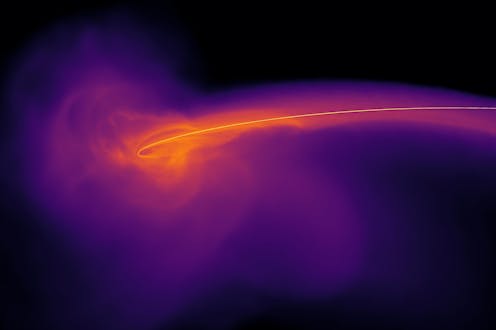
This leads to a dramatic and complex process as the star plunging towards the supermassive black hole is spaghettified and torn to shreds. The resulting fireworks are known as a tidal disruption event.
In a new study published today in the Astrophysical Journal Letters, we have produced the most detailed simulations to date of how this process evolves over the span of a year.
A black hole tearing apart a sun
American astronomer Jack G. Hills and British astronomer Martin Rees first theorised about tidal disruption events in the 1970s and 80s. Rees’s theory predicted that half of the debris from the star would remain bound to the black hole, colliding with itself to form a hot, luminous swirl of matter known as an accretion disc. The disc would be so hot, it should radiate a copious amount of X-rays.

But to everyone’s surprise, most of the more than 100 candidate tidal disruption events discovered to date have been found to glow mainly at visible wavelengths, not X-rays. The observed temperatures in the debris are a mere 10,000 degrees Celsius. That’s like the surface of a moderately warm star, not the millions of degrees expected from hot gas around a supermassive black hole.
Even weirder is the inferred size of the glowing material around the black hole: several times larger than our Solar System and expanding rapidly away from the black hole at a few percent of the speed of light.
Given that even a million-solar-mass black hole is just a bit bigger than our Sun, the huge size of the glowing ball of material inferred from observations was a total surprise.
While astrophysicists have speculated the black hole must be somehow smothered by material during the disruption to explain the lack of X-ray emissions, to date nobody had been able to show how this actually occurs. This is where our simulations come in.
A slurp and a burp
Black holes are messy eaters – not unlike a five-year-old with a bowl of spaghetti. A star starts out as a compact body but gets spaghettified: stretched to a long, thin strand by the extreme tides of the black hole.
As half of the matter from the now-shredded star gets slurped towards the black hole, only 1% of it is actually swallowed. The rest ends up being blown away from the black hole in a sort of cosmic “burp”.
Simulating tidal disruption events with a computer is hard. Newton’s laws of gravity don’t work near a supermassive black hole, so one has to include all the weird and wonderful effects from Einstein’s general theory of relativity.
But hard work is what PhD students are for. Our recent graduate, David Liptai, developed a new do-it-Einstein’s-way simulation method which enabled the team to experiment by throwing unsuspecting stars in the general direction of the nearest black hole. You can even do it yourself.
Spaghettification in action, a close up of the half of the star that returns to the black hole.The resultant simulations, seen in the videos here, are the first to show tidal disruption events all the way from the slurp to the burp.
They follow the spaghettification of the star through to when the debris falls back on the black hole, then a close approach that turns the stream into something like a wriggling garden hose. The simulation lasts for more than a year after the initial plunge.
It took more than a year to run on one of the most powerful supercomputers in Australia. The zoomed-out version goes like this:
Zoomed-out view, showing the debris from a star that mostly doesn’t go down the black hole and instead gets blown away in an expanding outflow.What did we discover?
To our great surprise, we found that the 1% of material that does drop to the black hole generates so much heat, it powers an extremely powerful and nearly spherical outflow. (A bit like that time you ate too much curry, and for much the same reason.)
The black hole simply can’t swallow all that much, so what it can’t swallow smothers the central engine and gets steadily flung away.
When observed like they would be by our telescopes, the simulations explain a lot. Turns out previous researchers were right about the smothering. It looks like this:
The same spaghettification as seen in the other movies, but as would be seen with an optical telescope [if we had a good-enough one]. It looks like a boiling bubble. We’ve called it the “Eddington envelope”.The new simulations reveal why tidal disruption events really do look like a solar-system-sized star expanding at a few percent of the speed of light, powered by a black hole inside. In fact, one could even call it a “black hole sun”.
Authors: Daniel Price, Professor of Astrophysics, Monash University