Rafts of garbage, kelp and other debris could transport alien invaders to a warming Antarctica
- Written by Hannah Dawson, Postdoctoral Research Associate in oceanography, University of Tasmania
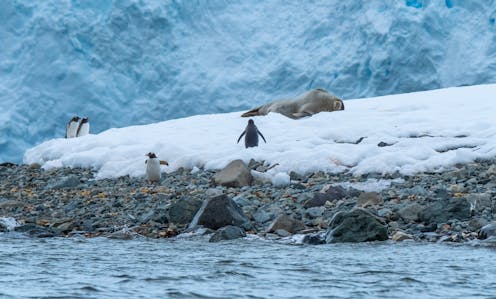
The remote icy wilderness at the bottom of the world is exposed to pollution and foreign organisms on floating ocean debris.
Recognising the threat to Antarctica’s remote coastline and unique marine ecosystems, we wanted to find out where this material is coming from. It turns out it’s travelling further than you might think.
Using ocean modelling techniques, we show floating objects such as kelp, plastic and other debris can drift to Antarctica from South America, South Africa, Australia and New Zealand.
Our new research shows Antarctica’s coastlines more connected to land in the Southern Hemisphere than previously thought. Cold and icy conditions may have prevented foreign organisms from colonising Antarctic waters to date. But these conditions are changing rapidly.

Antarctica’s unique environment
Antarctica’s coastal waters are extremely cold and mostly covered by sea ice. Yet these waters are also home to a surprisingly wide range of unique species found nowhere else on Earth.
In recent years, some non-native species have been found in Antarctic waters. They can arrive on ships, either in ballast water or encrusted onto ship hulls, or on drifting ocean debris.
Some of these species, including kelp, are known to drift from islands just north of the Antarctic continent. But it’s been unclear whether species can reach Antarctica from further afield, until now.
 We simulated the pathways of rafting debris such as kelp and driftwood.
Ceridwen Fraser/University of Otago
We simulated the pathways of rafting debris such as kelp and driftwood.
Ceridwen Fraser/University of Otago
Why does this matter?
In a warming world, Antarctica is one of the few refuges for slow-growing, cold-water specialist species. If foreign species were to successfully establish in the cold polar waters, they could compete with native species and dramatically change marine ecosystems.
Aside from a small number of research stations and tourist hotspots, much of Antarctica’s coastline remains untouched. The arrival of foreign species and other human-made debris threatens this unique wilderness.
The amount of plastic and other debris in the ocean is increasing each year. This could mean more non-native species are finding ways to hitch a ride to the icy continent.
Identifying the sources of drift objects rafting to Antarctica helps us better understand the risks to native species.
Southern Ocean circulation
Antarctica is encircled by a giant ocean current – the Antarctic Circumpolar Current – which flows eastward around the icy continent, separating it from warmer waters to the north.
The strength of this strong eastward flow and the associated sharp oceanographic fronts was previously thought to isolate the polar continent from drifting objects to the north. Yet the Antarctic Circumpolar Current is also eddy-rich and subject to powerful storm systems. Both provide possible pathways for these objects to cross.
 The major Southern Ocean currents.
Shutterstock/Rainer Lesniewski
The major Southern Ocean currents.
Shutterstock/Rainer Lesniewski
Virtually generated drifters
Previously, rafts reaching Antarctic waters have been genetically tested to reveal their source location. These analyses confirmed kelp could drift from sub-Antarctic islands including South Georgia and the Kerguelen Islands.
But not all objects can be tested this way, and only a small fraction of the Antarctic coastline is visited by scientists each year. Scaling up such an approach to determine all possible source locations is not feasible.
Instead, we turned to ocean modelling. We considered the known source locations around the Southern Ocean islands and also landmasses further north, such as Australia, New Zealand, South America and South Africa.
Both ocean currents and surface waves control the drift of objects across the Southern Ocean towards Antarctica. So both of these influences were factored in to our model.
In our virtual world, we released millions of drift objects into the ocean and watched them move around the globe.
We tracked these objects for three model years or until they arrived at the Antarctic coastline – whichever came first.
These simulations revealed floating objects can drift to Antarctica not only from the sub-Antarctic islands, but also from New Zealand, Tasmania, South America and South Africa.
Only a tiny fraction of the simulated particles actually make it to Antarctica, but they do so every year. This suggests floating objects are regularly arriving at Antarctic coastlines, and have done for some time.
But as the world warms and ice melts, any invasion of foreign organisms may be more successful.
Warmer waters and lower sea ice spells trouble
The modelling allows us to assess which regions of the Antarctic coastline are most at risk from these rafting non-native species.
Concerningly, most of the simulated rafts arrive at the tip of the Antarctic Peninsula. This region has relatively warm ocean temperatures where the coastline is ice-free for long periods each year.
Cold ocean temperatures and abrasive sea ice present a natural barrier to foreign invaders seeking homes around Antarctica. But with little sea ice at the tip of the Antarctic Peninsula, there’s a greater chance non-native species will settle in.
Sample pathways of drift objects as they cross the Southern Ocean towards Antarctica.What does this mean for the future?
Antarctic sea ice has shown a dramatic decline in recent years. In addition, the Antarctic Peninsula has already warmed more rapidly than most places around Antarctica, with record high temperatures in recent years.
Dwindling sea ice and a warming Antarctic coastline means remote species could have more opportunities to colonise the icy continent. If this were to happen, we could see dramatic shifts in some Antarctic coastal ecosystems.
Authors: Hannah Dawson, Postdoctoral Research Associate in oceanography, University of Tasmania