Colourful fruit-like fungi and forests ‘haunted by species loss’ – how we resolved a 30-year evolutionary mystery
- Written by Jamie Wood, Senior Lecturer in Ecology and Evolution, University of Adelaide
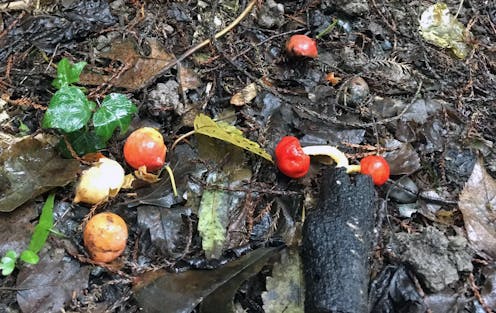
Most fungi need only wind or water to disperse their spores. But some, including truffles, need a little help from animals.
Usually, truffles and truffle-like fungi (which don’t belong to the truffle genus, but are otherwise similar) are dull-coloured and grow underground.
They use scent to attract mammals, which eat them and disperse the spores across the landscape in their dung. This ancient truffle-mammal relationship is why truffle pigs and truffle dogs (and many humans) love eating these fungi.
But Aotearoa New Zealand had no native land mammals to disperse truffles. Our new study resolves a 30-year mystery about whether fruit-eating birds might instead have taken this role.
NZ’s unusually colourful truffle-like fungi
In most ecosystems, truffles are eaten by small mammals, especially rodents and marsupials, which are critical for fungal dispersal and forest health.
In the 1990s, mycologist Ross Beever noticed something odd about truffle-like fungi growing in New Zealand.
Many had brightly coloured fruiting bodies which emerged above the forest floor, essentially mimicking fallen fruit. Because of New Zealand’s lack of mammals (with the exception of bats), Beever hypothesised that these characteristics had evolved to attract birds as spore dispersers because they rely more on vision than scent to find food.
Beever and his colleague Teresa Lebel detailed this fascinating hypothesis elegantly in 2014, but it remained untested for three decades.
Using colour to draw attention
In our research, we asked whether New Zealand really has more brightly coloured truffle-like fungi or whether we are simply paying more attention to them and under-appreciating the dull ones. And we investigated if there was a link between their distribution and fruit-eating birds.
First, we gathered information about the colour and habit (above or below ground) of 479 truffle-like fungus species from around the world. We then obtained more than 24,000 locations for these species from the Global Biodiversity Information Facility database.
These data were analysed alongside environmental factors (such as precipitation and temperature) and biological aspects (such as forest cover and the presence of fruit-eating birds) that might help explain any spatial patterns.
While colourful truffle-like fungi are also found in South and Central America and Australia, our results confirmed New Zealand has a much greater proportion compared to other landmasses. This is especially true for red and blue coloured species.
We also found that, across the world, regions with more fruit-eating birds also had more colourful truffle-like fungi.
Birds, truffle-like fungi and trees
Until recently, birds were thought to have a limited role in dispersing truffle-like fungi.
But this changed in 2021, when a study of faecal samples from two fruit-eating bird species from Patagonia (Chucao tapaculo and Black-throated huet-huet) found DNA and spores from a wide range of fungi, including truffle-like fungi.
The research team also observed both bird species uncovering truffles on the forest floor, thereby demonstrating the important role birds could have in fungal dispersal.
A further finding of the Patagonian study was that many of the truffle-like fungi detected in the faecal samples are part of the underground network of fungi-plant root interactions known as mycorrhiza.
In New Zealand, most colourful truffle-like fungi are also mycorrhizal with locally dominant forest trees such as beeches and podocarps. These fungi make it easier for the trees to access water and mineral nutrients from the soil. Therefore, birds that eat truffle-like fungi may not only be important for the fungi themselves, but for entire forest ecosystems.
A legacy of extinction
The results of our study support the idea that colourful truffle-like fungi are adapted for bird dispersal, and that they are more common in New Zealand than elsewhere in the world.
Yet, paradoxically, the number of observed instances of local birds eating truffle-like fungi can be counted on one hand. Why is this? The answer may lie in New Zealand’s legacy of extinction.
Around one third of all bird species on the mainland and offshore islands have become extinct since the first human settlers arrived during the 13th century. Many more have had their populations reduced to the point of functional extinction. Among these are many large birds known to have eaten fruit, including nine species of moa and kākāpō.
In 2018, a study of DNA from ancient dung of moa and kākāpō found evidence these birds once ate mycorrhizal truffle-like fungi. The loss of such birds from New Zealand’s forests represents the end of millions of years of co-evolution with fungi.
These bird-adapted fungi may now remain as ghosts of past mutualisms – the association between organisms of two different species in which each benefits – much like the large tropical fruit once eaten by gomphotheres, an extinct group related to modern elephants.
How will our forest trees cope with the loss of these bird-fungus interactions, which help facilitate plant growth on bare soils? Can introduced animal species act as surrogate dispersers for native fungi?
The implications for forests, haunted by species loss, remain unknown. With continued research and conservation efforts, however, we can better understand and support the balance of our forest ecosystems to ensure the rich and unique biodiversity of New Zealand’s forests endures for generations to come.
Authors: Jamie Wood, Senior Lecturer in Ecology and Evolution, University of Adelaide