

Who was Hannibal? How one brilliant general almost brought Ancient Rome to its knees
- Written by Darius von Guttner Sporzynski, Historian, Australian Catholic University
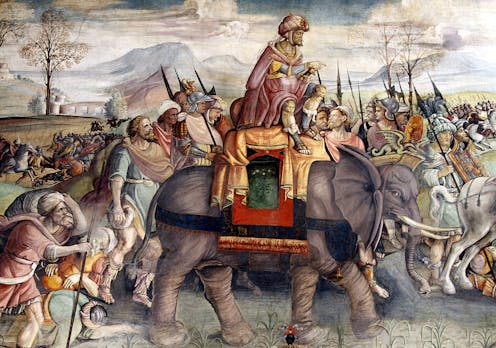
He lived and died more than 2,000 years ago but Hannibal is remembered as one of history’s most formidable military commanders and as “Rome’s greatest enemy”.
His daring crossing of the Alps, with an army that included war elephants, shines as evidence to his tactical brilliance.
The Carthaginian general’s innovative military strategies in his struggle against Rome give us a glimpse into why his fame endures.
An early hostility toward Rome
Hannibal Barca was born in 247 BCE in Carthage, an ancient city in Northern Africa, in what is now Tunisia.
His father is credited with instilling in Hannibal a hostility towards Rome, a deep-seated drive that would shape much of his military career.
Hannibal’s leadership qualities and the understanding of military tactics were honed through his experiences in the Carthaginian army.
Hannibal first came into prominence in 219 BCE when the Carthaginian army under his command attacked the city of Saguntum (in modern Spain), triggering the Second Punic War with Rome.
Then came his cunning stratagem that brought his army into Italy all the way from Spain. Hannibal led his troops through the Alps in 218 BCE, catching the Romans off guard.
What’s more, he brought a contingent of war elephants ready for battle.

These elephants were trained to instil fear in the enemy during combat.
In the series of battles with the Romans, Hannibal proved he was capable of undertaking seemingly impossible feats to achieve strategic advantages.
In the Battle of the Trebia (218 BCE) Hannibal lured the Romans into an ambush on the Trebia River.
More victories soon followed. In both the Battle of Lake Trasimene and the Battle of Cannae Hannibal’s army inflicted devastating casualties on the significantly larger Roman forces.
Hannibal’s threat to Rome stemmed from his innovative tactics, psychological warfare, and his ability to exploit Roman leadership’s overconfidence, their rigid adherence to established war tactics, and their initial tendency to underestimate the power and speed of Hannibal’s cavalry.
Hannibal forced Rome to rethink its military strategies and adapt in ways that would ultimately shape the future of the Roman Empire.
Master of strategy
Hannibal’s tactical acumen was unparalleled. He consistently outmanoeuvred Roman armies, employing strategies that took advantage of the terrain and the element of surprise.
His victory at the Battle of Cannae (216 BCE) is illustrative of his tactical genius.
By executing a double envelopment manoeuvre, Hannibal managed to encircle and annihilate the Romans. Hannibal’s clever use of the cavalry allowed him to outflank the Roman infantry.
A year later, he adapted his strategy to a different terrain and used the fog at the Battle of Lake Trasimene to conceal his troops. The effect was a devastating ambush of the Romans.
The news of massive casualties delivered a profound psychological blow to Rome.
Psychological warfare
Hannibal understood the power of psychological warfare.
He knew fear undermined the confidence of Roman soldiers and their leaders.
The phrase “Hannibal is at the gates” became a Roman proverb, reflecting the pervasive horror he instilled in his opponents.
Hannibal’s use of psychological strategies extended to his own troops as well.
To maintain high morale and discipline he ensured his soldiers were well fed and shared in their hardships, sleeping on the ground wrapped in a blanket.
His leadership proved inspirational.
Exploiting Roman weaknesses
Hannibal was adept at identifying the weaknesses in Roman military and political structures. The Roman practice of alternating command between two consuls proved to be a vulnerability that Hannibal exploited.
On several occasions, he timed his attacks to coincide with the consulship of less experienced in command, leading to disastrous defeats for Rome.
Hannibal employed spies and gathered intelligence paid for by silver from Carthaginian-controlled mines in Spain. The information allowed him to anticipate Roman movements and counter their strategies.
Hannibal’s campaigns had lasting effects on Rome. His prolonged presence in Italy, despite never capturing Rome itself, forced the Romans to adapt their military strategies and organisation of their armies.
The Roman military became more flexible and began to place greater emphasis on cavalry and intelligence gathering. They learned from the very tactics that had caused them so much trouble. This led to Rome’s eventual victory in the Second Punic War.
Hannibal’s legacy
Hannibal’s legacy extends beyond his immediate impact on Rome. His military strategies and tactics continue to be studied in military academies around the world.
His ability to conduct successful campaigns with limited resources and his innovative use of terrain and psychological warfare remain relevant for military leaders today.
Commanders such as Julius Caesar, Napoleon, and George S. Patton drew inspiration from Hannibal’s methods, demonstrating the timeless nature of his military genius.
 An engraving by Dutch artist Cornelis Cort depicts the battle between Scipio and Hannibal at Zama.
The Metropolitan Museum
An engraving by Dutch artist Cornelis Cort depicts the battle between Scipio and Hannibal at Zama.
The Metropolitan Museum
Hannibal’s downfall
Despite his victories against the Romans, Hannibal did not conquer the city of Rome, allowing the Romans to regroup. His position was weakened because his troops lacked reinforcements and supplies from Carthage.
When the Romans adopted a strategy of attrition, avoiding large-scale battles with the Carthaginian general, Hannibal’s army was cut off from supply lines.
At the Battle of Zama in modern-day Tunisia (in 202 BCE) Hannibal was defeated by the young Roman general Scipio Africanus. Scipio used Hannibal’s own tactics against him, marking the end of the Second Punic War.
Hannibal’s career never recovered. Hannibal took his own life in 183 BCE to avoid capture by the Romans.
A long legacy
Hannibal remains a towering figure in military history, not only for his bold campaigns and tactical brilliance but also for his ability to challenge and adapt to the formidable Roman war machine.
His fame as a master strategist continues to captivate and inspire today.
Authors: Darius von Guttner Sporzynski, Historian, Australian Catholic University

















