

women's masturbation in early England
- Written by: Paige Donaghy, PhD Student, The University of Queensland
In our sexual histories series, authors explore changing sexual mores from antiquity to today.
In the 18th and 19th centuries, masturbation was thought of as a “disease”, capable of causing psychological or physical damage like blindness or insanity. This medical and moral panic surrounding masturbation can still shape beliefs today.
Little is known about the history of women’s solo sex, in particular, partly because the study of women’s history is itself a relatively recent development. Still, an exception is the historical period known as early modern England (between 1500 – 1800).
Descriptions of women’s masturbation in this period, especially from 1600 – 1700, are seemingly everywhere: in poetry, literature, theatre, popular ballads, diaries, pornographic texts, midwifery guides and medical books.
Typically, women in early modern England were expected to be pious and chaste, and erotic behaviour was deemed appropriate only within the space of heterosexual marriage. Despite this, there was both a cultural and medical understanding that women experienced sexual desire and pleasure.
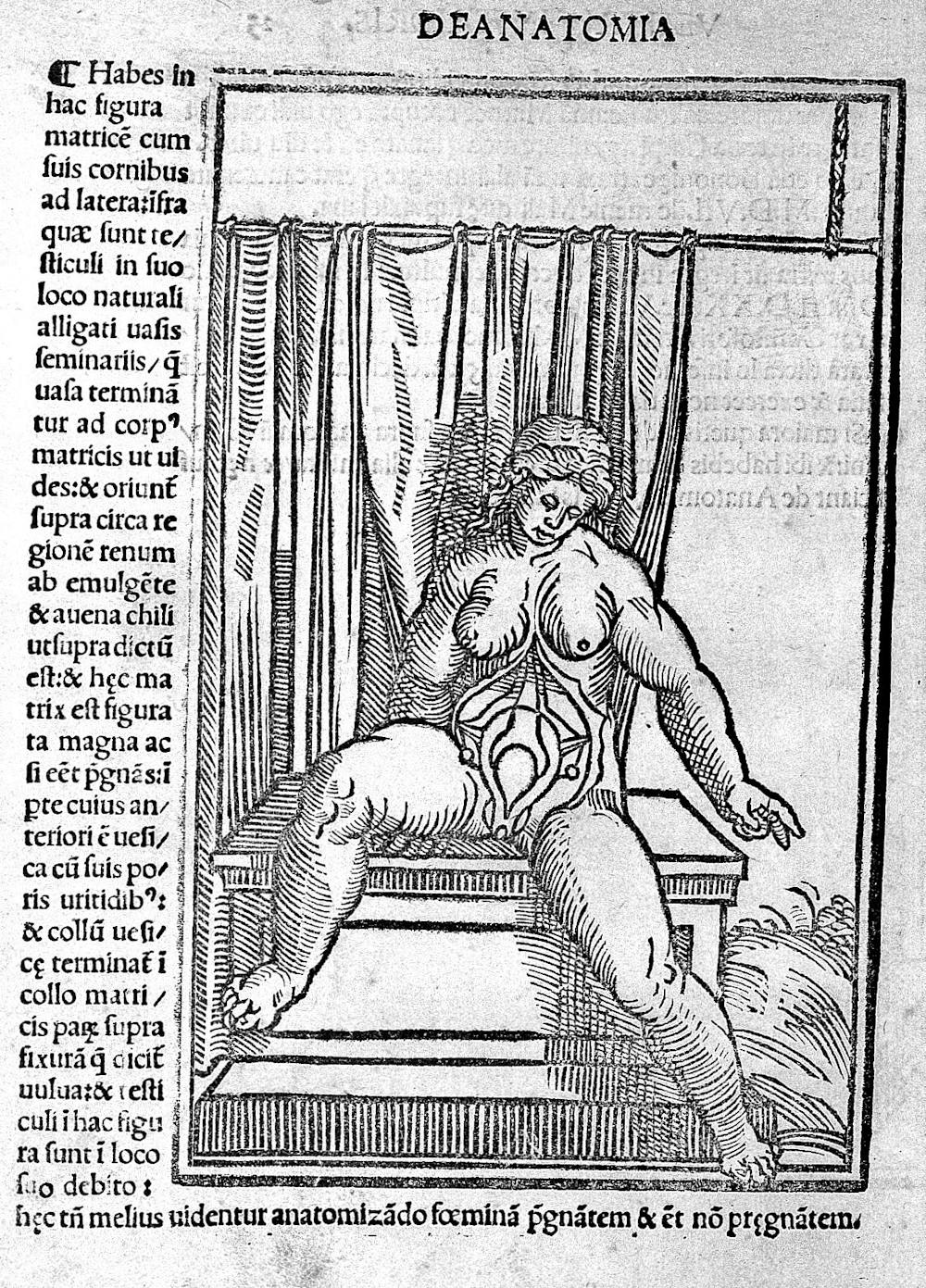 Picture of a woman’s uterus, Berengarius, 1523.
Wellcome Collection, CC BY
Picture of a woman’s uterus, Berengarius, 1523.
Wellcome Collection, CC BY
In medical texts it was suggested that in order for conception to occur, a woman had to experience an orgasm, preferably at the same time as the man. Advice given in the English translation of French surgeon Ambroise Paré’s medical treatise suggested that: “when the husband commeth into his wive’s chamber hee must entertaine her with all kinde of dalliance” and give her “wanton kisses with wanton words and speeches”. This would help the woman to orgasm and would better the chances of pregnancy.
Medical texts also promoted the idea that unmarried women could suffer physical ailments because of a lack of sexual activity. It was widely believed that women had their own type of semen, or “female seed”, which contributed to procreation. A build up of this seed, due to lack of sexual release, could cause a range of disorders, like “madness from the womb”.
Descriptions of masturbation
These medical ideas were also prominent within broader society, where virgins and widows were viewed as particularly lustful women. Representations of unmarried women’s sexual desires were often humorous, like the ballad “The Maids Complaint For Want of a Dil Doul [dildo]”, published around 1680.
The poem describes a young woman’s quest for a “dil doul”, or a lover to take her “maiden-head”, to cure her of the “strange fancies” that came into her mind at night.
Such texts indicate a familiarity with women’s sexuality, but the most common descriptions of women’s masturbation appear in medical and midwifery texts. This is interesting because towards the end of the 1600s, these texts were increasingly aimed toward female readers and female midwives. This may suggest that medical authors had some knowledge that women did masturbate, and that their female readership would recognise such behaviour.
For example, English physician Nicholas Culpeper’s 1662 edition of his Directory for Midwives refers to young women’s masturbation. In a discussion on whether the hymen was the “sign of virginity”, he believed that the hymen:
is not to be found in all Virgins, because some are very lustful, and when it itcheth, they put in their finger or some other thing, and break the membrane.
Culpeper also noted that while some virgins might experience bleeding during the consummation of marriage, if they did not bleed, the women should “not be censured as unchaste” because:
If the girl was wanton afore, and by long handling, hath dilated the part or broke it, there is no blood after copulation.
Here, Culpeper is directly referring to the masturbatory practices of young women experiencing sexual desires or an “itch”, and their possible masturbation by penetrating themselves with their fingers or “other things”. Culpeper describes these women as “wanton” or “lustful”, which were terms often used to insult women who acted beyond the bounds of acceptable sexuality.
Yet in this context, Culpeper does not appear to use them with the same intention. He encourages the reader not to “censure” or scold women who did not bleed as being unchaste, because of their prior masturbatory acts, suggesting an acceptance or knowledge that women masturbated.
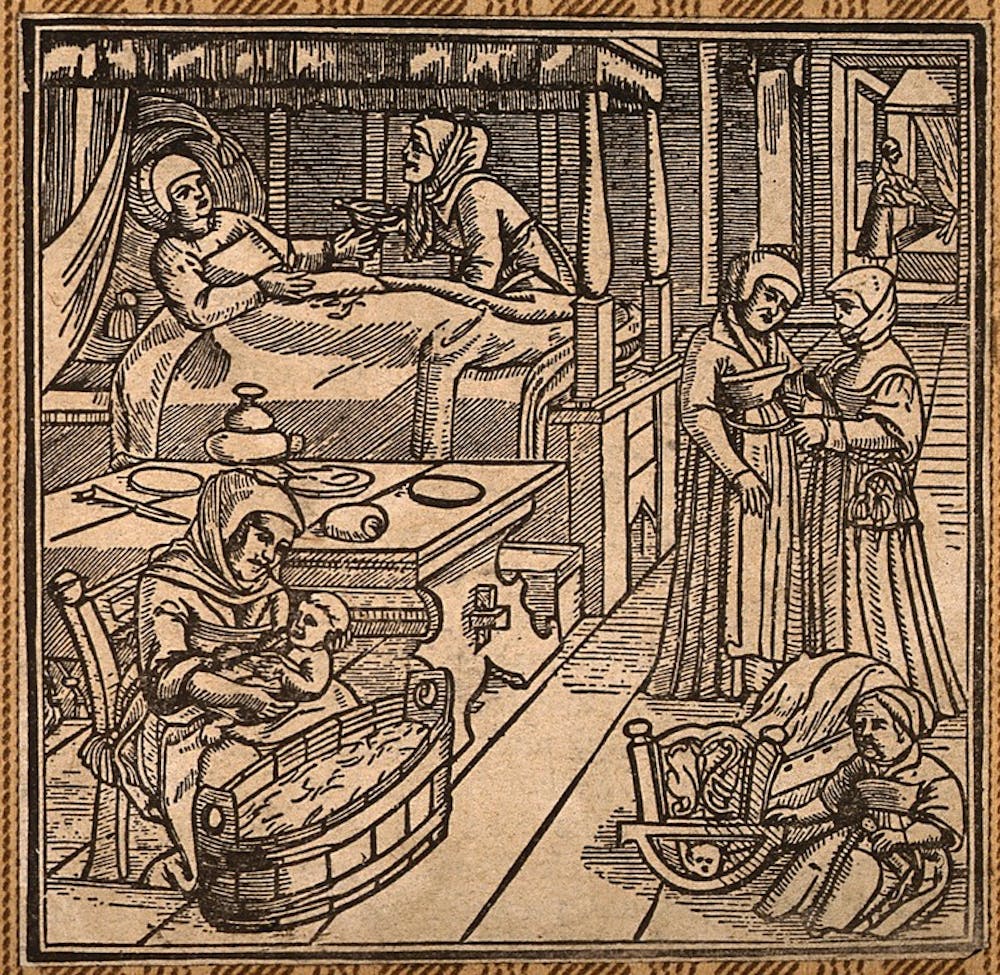 A 16th century woodcut depicting a woman in bed recovering from childbirth, a midwife washes the baby while another attendant looks after the mother.
Wellcome Collection., CC BY
A 16th century woodcut depicting a woman in bed recovering from childbirth, a midwife washes the baby while another attendant looks after the mother.
Wellcome Collection., CC BY
Other medical, midwifery guides, directly aimed at female readers, depicted masturbation in much more explicit language. Scottish physician James MacMath wrote in 1694 how:
lascivious virgins, and widows, wholly intent to lustful cogitations [thoughts], and much in thinking of breasts, milks, and their sucking, wantonly rubbing, tickling, and their sucking thereof, may have got milk in them.
MacMath’s description of how non-pregnant women may produce “milk” through breast-related masturbation again uses words typically aimed at scolding overly sexual women. Despite this, the passage is one of many throughout his book that refers to masturbation, suggesting that such practices were commonplace.
Lessons for us today
Revisiting the historical records of women’s masturbation allows us to consider how women may have performed their sexual desires. But it also allows us to examine attitudes to women’s masturbation in this period, and trace how these attitudes transform with time.
In Australia, discussion about solitary sex remains stifled: the Victorian government Better Health website continues to assure the public that masturbation does not cause “blindness, mental health issues, [or] sexual perversion”.
Myths and taboos about masturbation appear to still affect Australian women in particular. In 2013, the Australian Study of Health and Relationships found that out of a study of 20,000 Australians, with nearly equal male and female participants, only one-third of women reported masturbating in the 12 months prior to the study interview, compared to two-thirds of men.
By exploring and discussing the long history of women’s masturbation, these taboos can be overcome, and women’s sexual desires and pleasure can be discussed openly and unashamedly.
Authors: Paige Donaghy, PhD Student, The University of Queensland


















