Pacific nations say Australia must end new fossil fuel projects
- Written by Liam Moore, Lecturer in International Politics and Policy, James Cook University
This week, one of the world’s largest fossil fuel exporters went to a meeting of island states strongly affected by human-induced climate change.
Or, in more conventional language, Australian leaders attended the annual Pacific Islands Forum in Tonga.
Since 1971, this forum has been the top diplomatic meeting for Pacific nations, including Australia and New Zealand. Security was on the agenda this year, against a backdrop of geopolitical manoeuvring and unrest in New Caledonia. But one issue made its presence felt above all else: climate change.
At the forum’s opening, United Nations Secretary-General António Guterres made that clear:
There is an enormous injustice in relation to the Pacific and it’s the reason I am here […] The small islands don’t contribute to climate change but everything that happens because of climate change is multiplied here.
Australia is walking a difficult line at the summit. Pointing to our domestic green energy progress isn’t enough. Our neighbours are focused on Australia’s emergence as the world’s second largest exporter of fossil fuel emissions and steady opening of more gas and coal fields. Even as Australia’s climate and migration pact with Tuvalu came into effect, Tuvalu’s climate change minister, Maina Talia, called for an end to the “immoral and unacceptable” acts of opening new mines, continuing fossil fuel subsidies and exporting fossil fuels.
Australian leaders hope to co-host the world’s top climate talks in 2026 in partnership with Pacific Island nations. While some Pacific leaders are opposed to co-hosting without an Australian pledge to end new goal and gas projects, others see it as a way Australia can show it is truly part of the “Pacific family”.

What happened at the forum?
A big-ticket item at this year’s forum was the Falepili Union, a pact between Australia and Tuvalu signed last year and coming into effect at the forum. Minister for International Development and the Pacific, Pat Conroy, claimed it was the
most significant agreement between Australia and one of its Pacific partners since the agreements for Papua New Guinea’s independence in 1975.
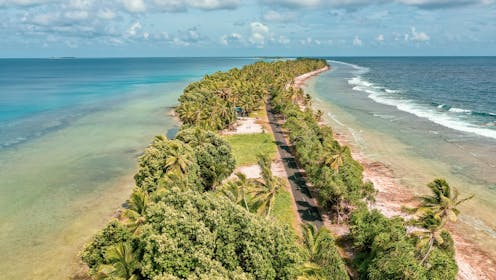
The pact allows 280 Tuvaluans a year to move to Australia, whilst committing Australia to funding climate adaptation work and disaster response efforts on the islands. Significantly, the treaty also states Australia will recognise the statehood of Tuvalu — even if it were to be submerged due to climate change.
In return, Tuvalu and Australia will agree “together” on any arrangements involving Tuvalu’s security or defence. Effectively, this gives Australia the extraordinary ability to block any actions of Tuvalu it feels do not serve its regional interests. This is significant, as China seeks to expand its influence in the Pacific.
At the leaders forum on Thursday, the joint bid to host the 31st United Nations climate conference is expected to be discussed. It’s not guaranteed, as Türkiye has also put in a bid. Pacific leaders have made it clear they will push hard for Australia to go beyond efforts to cut local emissions.
What else might we see?
Analysts have been closely watching how New Zealand leaders approach the forum. While New Zealand has very strong connections to the Pacific and has been actively supporting climate adaptation work in many Pacific nations, the new right wing government is showing signs of backing away from domestic climate efforts.
At the forum, New Zealand’s Deputy Prime Minister and Foreign Minister, Winston Peters, drew attention for downplaying the human role in changing the climate and claiming some Pacific islands are actually growing.
Are island nations united? Not on everything. But on climate, they have learned the power of speaking with a united voice. In recent years, Pacific nations have become the new face of climate diplomacy. At the 2022 Sharm el-Sheikh climate talks in Egypt, Pacific nations were visible and effective in their push to secure better promises of funding to cover loss and damage done by climate change.
Pacific expert George Carter this week described the effective Pacific approach: inviting Australia to be more active as a member of the Pacific family while at the same time pressing us to cut reliance on fossil fuels.
Pacific leaders have consistently said they are willing to take their allegiances elsewhere if high-level rhetoric does not turn into action. In 2019, former Fijian Prime Minister Frank Bainimarama claimed climate reluctance by Australia’s Morrison government would push Pacific nations closer to China.
This is because adapting to sea level rise is expensive, and Pacific nations are small.
Vanuatu, for instance, was the first nation to figure out how much climate adaption would cost them. The answer: A$260 million by 2030 just to respond to loss and damage. To phase out fossil fuels and decarbonise the nation in addition to adaptation projects would cost $1.75 billion — a staggering amount for a small country.
Vanuatu is already the world’s most disaster-prone nation. Rising to the challenge of protecting shorelines and relocating villages comes on top of that.
Fiji has completed six climate-related community relocations to date. According to the government, 42 more need immediate help and another 800 will need assistance soon. Without external funding, the need will soon dwarf what the government can offer.
 Fiji has already begun relocation of villages away from rising seas – but the demand far exceeds what the government can pay for.
Mick Tsikas/AAP
Fiji has already begun relocation of villages away from rising seas – but the demand far exceeds what the government can pay for.
Mick Tsikas/AAP
What’s next?
For the Pacific, climate change is everything. When Guterres talked about moving away from fossil fuels, many observers took that to be a comment aimed at Australia.
It’s unlikely Australia can keep the Pacific onside with bilateral pacts, regional policing initiatives or by pointing to domestic efforts to go green and achieve net-zero later. For the Pacific, the future is now. Climate change is lapping at their shores, and future promises are worth very little.
Authors: Liam Moore, Lecturer in International Politics and Policy, James Cook University