Seismic echoes reveal a mysterious ‘donut’ inside Earth’s core
- Written by Hrvoje Tkalčić, Professor, Head of Geophysics, Director of Warramunga Array, Australian National University
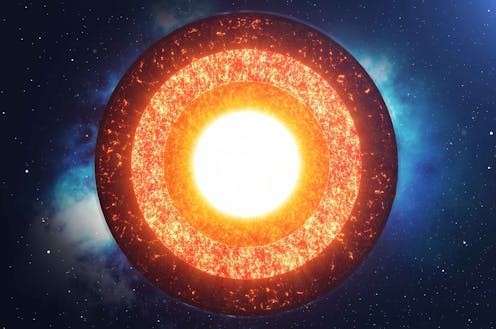
About 2,890 kilometres beneath our feet lies a gigantic ball of liquid metal: our planet’s core. Scientists like me use the seismic waves created by earthquakes as a kind of ultrasound to “see” the shape and structure of the core.
Using a new way of studying these waves, my colleague Xiaolong Ma and I have made a surprising discovery: there is a large donut-shaped region of the core around the Equator, a few hundred kilometres thick, where seismic waves travel about 2% slower than in the rest of the core.
We think this region contains more lighter elements such as silicon and oxygen, and may play a crucial role in the vast currents of liquid metal running through the core that generate Earth’s magnetic field. Our results are published today in Science Advances.
The ‘coda-correlation wavefield’
Most studies of the seismic waves created by earthquakes look at the big, initial wavefronts that travel around the world in the hour or so after the quake.
We realised we could learn something new by looking at the later, fainter part of these waves, known as the coda – the section that brings a piece of music to its end. In particular, we looked at how similar the coda recorded at different seismic detectors were, several hours after they began.
In mathematical terms, this similarity is measured by something called correlation. Together, we call these similarities in the late parts of earthquake waves the “coda-correlation wavefield”.
By looking at the coda-correlation wavefield, we detected tiny signals stemming from multiple reverberating waves we wouldn’t otherwise see. By understanding the paths these reverberating waves had taken and matching them with signals in the coda-correlation wavefield, we worked out how long they had taken to travel through the planet.
We then compared what we saw in seismic detectors closer to the poles with results from nearer the Equator. Overall, the waves detected closer to the poles were travelling faster than those near the Equator.

We tried out many computer models and simulations of what conditions in the core could create these results. In the end, we found there must be a torus – a donut-shaped region – in the outer core around the Equator, where waves travel more slowly.
Seismologists have not detected this region before. However, using the coda-correlation wavefield lets us “see” the outer core in more detail, and more evenly.
Previous studies concluded that waves moved more slowly everywhere around the “ceiling” of the outer core. However, we have shown in this study that the low-velocity region is only near the Equator.
The outer core and the geodynamo
Earth’s outer core has a radius of around 3,480km, which makes it slightly bigger than the planet Mars. It consists mainly of iron and nickel, with some traces of lighter elements such as silicon, oxygen, sulfur, hydrogen and carbon.
The bottom of the outer core is hotter than the top, and the temperature difference makes the liquid metal move like water in a pot boiling on the stove. This process is called thermal convection, and we think the constant movement should mean all the material in the outer core is quite well mixed and uniform.
But if everywhere in the outer core is full of the same material, seismic waves should travel at about the same speed everywhere, too. So why do these waves slow down in the donut-shaped region we found?
We think there must be a higher concentration of light elements in this region. These may be released from Earth’s solid inner core into the outer core, where their buoyancy creates more convection.
Why do the lighter elements build up more in the equatorial donut region? Scientists think this could be explained if more heat is transferred from the outer core to the rocky mantle above it in this region.
There is also another planetary-scale process at work in the outer core. Earth’s rotation and the small solid inner core make the liquid of the outer core organise itself in long vertical vortices running in a north–south direction, like giant waterspouts.
The turbulent movement of liquid metal in these vortices creates the “geodynamo” responsible for creating and maintaining Earth’s magnetic field. This magnetic field shields the planet from harmful solar wind and radiation, making life possible on the surface.
A more detailed view of the makeup of the outer core – including the new-found donut of lighter elements – will help us better understand Earth’s magnetic field. In particular, how the field changes its intensity and direction in time is crucial for life on Earth and the potential habitability of planets and exoplanets.
Authors: Hrvoje Tkalčić, Professor, Head of Geophysics, Director of Warramunga Array, Australian National University
Read more https://theconversation.com/seismic-echoes-reveal-a-mysterious-donut-inside-earths-core-237489