Worried about your trees after the windstorms? Here are 7 signs you might be at risk
- Written by Gregory Moore, Senior Research Associate, School of Ecosystem and Forest Sciences, The University of Melbourne
Winter has ended dramatically across Australia’s southern states, as fierce winds and storms usher in spring.
Over the weekend, intense winds from a powerful cold front brought down trees, damaged powerlines, brought flooding rains and caused power outages for thousands of people. Gusts nearing 200 kilometres per hour were recorded in Tasmania. In southern New South Wales, a woman died after a tree fell on her holiday park cabin.
As southerners inspect the damage today, many of us will be looking anxiously at the trees we live next to – and wondering if they, too, could fall.
The good news is there are things you can do to make sure the trees near you are still safe.
These tips aren’t just for windstorm safety. As the climate changes, tree dieback is becoming more common. This year, we’ve seen large-scale dieback in south-west Western Australia and Tasmania. It’s increasingly important to keep tabs on large trees near you.
#1: Look down
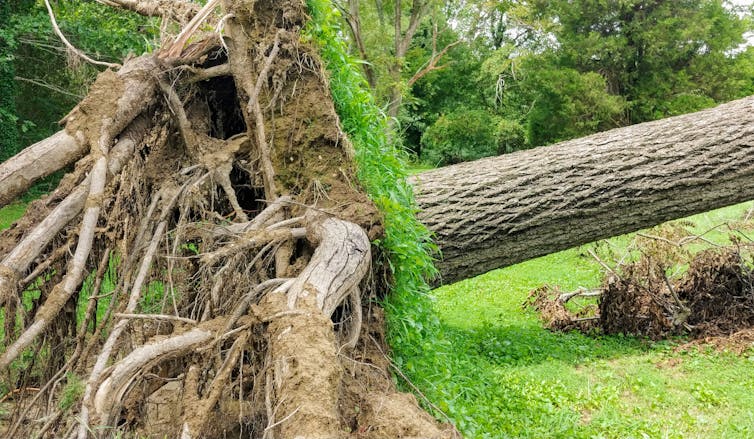
When a whole tree falls over and pulls out its roots, it’s known as whole tree failure or “windthrow”. If this happens, it can be a major threat to you or your house.
There are often warning signs a tree might topple over even before a storm hits. On a windy day, look at the tree you’re worried about. Is there any sign of movement at the base of the tree and its visible roots? If so, call an arborist to come as quickly as possible to assess the risk.

#2. Look up
If large, dead branches are attached to the trunk, that’s dangerous. These branches – “hangers” – can be blown loose and be carried surprisingly far from the tree in strong winds. They’re also more likely to break during storms and strong winds than healthy branches.
To reduce your risk, it’s important to have these dead branches removed. The bigger the dead branch, the higher the risk. But small dead branches in a canopy are normal. These pose much less threat and can usually be left there.
#3. Inspect the junctions
Not all limb attachments are healthy or strong. If the place where the limb is attached looks damaged, it could mean the junction is weak and could fail. To check, look for signs of damage – loose bark, resin or sap on the bark or branch, or bark which has become much darker than usual.
Some junctions are riskier than others. Trunks and branches with steep V-shape junctions, or with fallen bark built up between them, are more likely to break during storms.
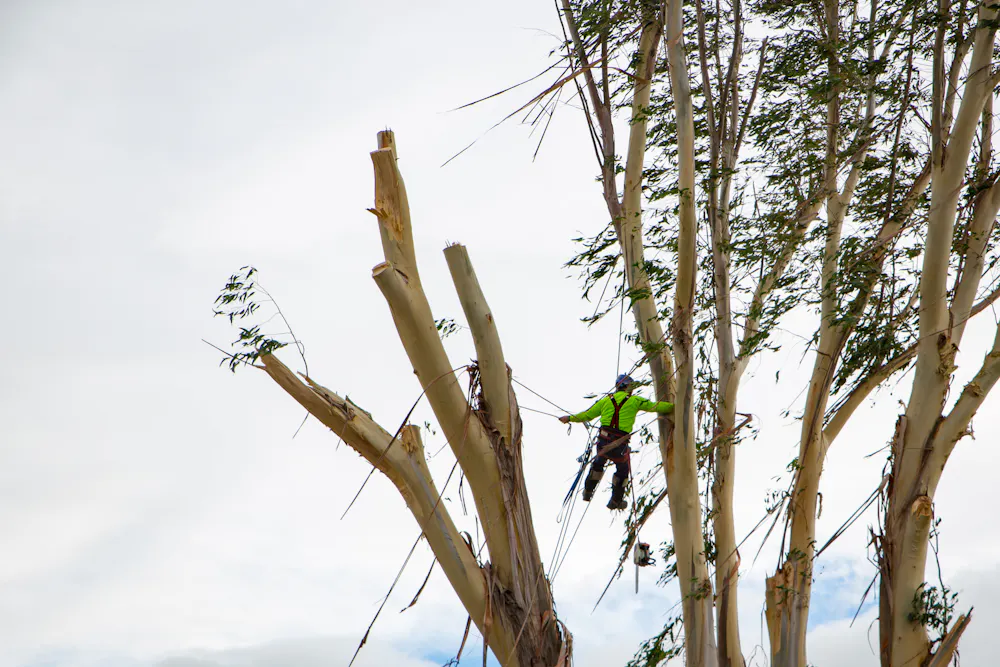 When do you call in the arborists?
Sheryl Watson/Shutterstock
When do you call in the arborists?
Sheryl Watson/Shutterstock
#4. Look for changes in leaf colour and coverage
If your tree rapidly loses foliage colour or suffers dieback of branches and canopy, this can also be a warning sign. These changes show us the tree is stressed and its health is getting worse. Sick trees are more vulnerable to storm damage.
Look for yellow and brown leaves, dead shoot tips and large branch dieback from their tips and dead patches on large limbs.
#5. Check the roots
Let’s say an excavator accidentally cuts one of your tree’s major structural roots with a diameter 100 mm or bigger. If this happens, it could risk the entire tree. Roots can also be damaged if the soil around them become compacted or waterlogged. These situations can weaken a tree from below.
To spot these issues, look for evidence of trenches where workers have cut through roots. Even when covered over, trenches will usually seem lower than the surrounding soil. Look for where soil has been compacted by vehicles or regular foot traffic. For waterlogging, look to see if water pools around trunks and under trees.
Root damage can be harder to spot, but damage underground can also trigger branch breakage or whole tree failure.
#6. Double check your lopped trees
If your tree has been badly pruned or lopped, it can become a threat. Poor work can trigger the growth of poorly attached shoots around the cuts or branch stubs. These shoots are more likely to fall during strong winds.
When the shoots are small, they don’t matter. But they can grow very quickly. Once more than 150 mm in diameter or ten metres long, they pose real risks.
Look for branching shoots which look different. Their branch attachment may look strange, or there may be multiple shoots from the same place on the trunk or stem. These shoots often grow almost vertically and grow at a much faster rate than normal branches.
#7. Check your canopy
If a large old trees dies or falls over, it can leave a large gap that changes local wind speed and intensity.
When trees are removed along roads, tracks and from around properties, canopy cover falls and wind speeds generally increase. This can be a real problem for your other trees, as they’re now enduring stronger winds than they were used to. It’s sensible to monitor your remaining trees in these circumstances.
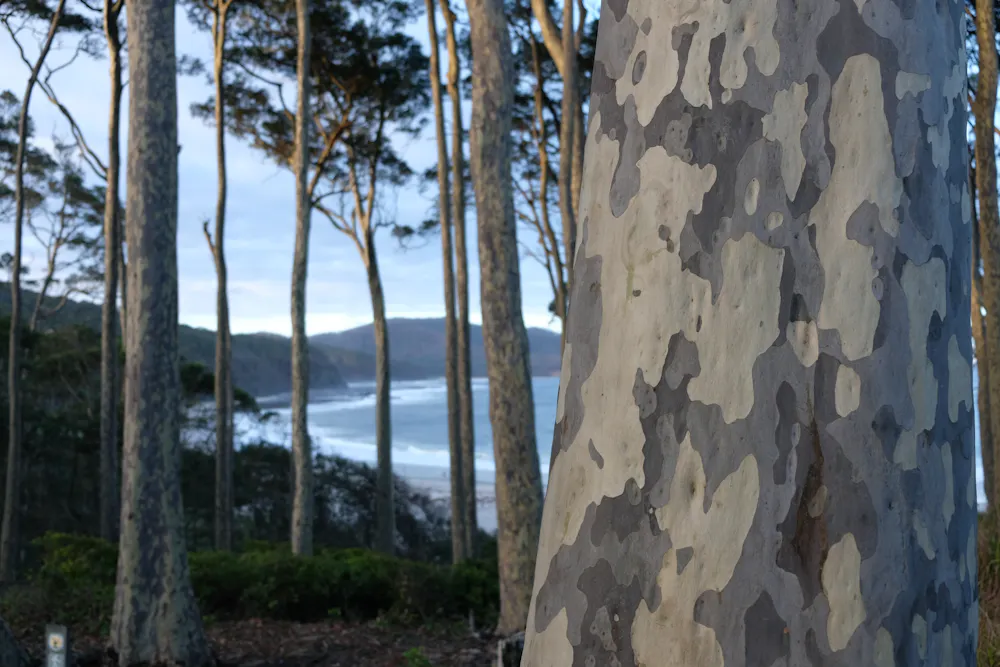 If a large old tree falls, trees around it are exposed to stronger winds.
Sierra Fairfield-Smith/Shutterstock
If a large old tree falls, trees around it are exposed to stronger winds.
Sierra Fairfield-Smith/Shutterstock
Stormy future
Intense winds are projected to arrive more often in many parts of Australia as the climate keeps changing. This, in turn, will affect the trees we live close to.
It’s becoming more common to see householders pushing to remove large trees to reduce risk. But this comes with new challenges. With big trees gone, the wind speed near you will increase.
Big trees also offer unmatched cooling in summer. And while tree horror stories make the news, the vast majority of trees remain safely anchored in the ground during intense storms.
It’s entirely understandable to get anxious about big trees near your home. But rather than reaching for the chainsaw, it’s worth booking in regular tree inspections by a qualified arborist every three to five years to give reassurance or take action to reduce the risk.
Authors: Gregory Moore, Senior Research Associate, School of Ecosystem and Forest Sciences, The University of Melbourne