Why are Australians so reluctant to change our constitution?
- Written by Helen Irving, Professor Emerita, Sydney Law School, University of Sydney
The proposal for an Indigenous Voice to Parliament was the first attempt to add Indigenous recognition to the Australian Constitution. Despite what appeared to be encouraging early opinion polls, support declined as the campaign proceeded. The result, as we know, was a resounding failure.
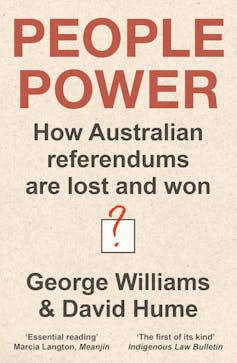
The referendum, “put with the aim of uniting Australians, instead prov[ed] to be one of the nation’s most divisive polls”, write the authors of People Power, a richly researched, grand narrative of Australia’s referendum history.
Review: People Power: How Australian Referendums are Lost and Won – George Williams and David Hume (UNSW Press)
Only eight out of 45 constitutional referendums have succeeded in Australia. Why are we so reluctant to change our constitution? Much ink has been spilled in attempting to answer this question.
The latest attempt, George Williams and David Hume’s revised edition of their 2010 book, with significant new material (covering plebiscites, state and territory referendums and, of course, the 2023 Voice referendum), goes further than most.
The authors’ claim that the book is “the only full history of constitutional change in Australia” is accurate. But, appearing as it does just before the first anniversary of the Voice referendum, the analysis of that event is bound to be the book’s main attraction.
What happened to The Voice?
How much, then, will eager readers learn about what went wrong or what can be done to improve the prospect of future success, specifically for Indigenous constitutional recognition?
One new chapter, “The Long Road to the Voice Referendum”, narrates the complex steps leading to 2023, including the work of multiple Indigenous and expert committees over many years and several changes of government.
People Power considers the Voice result in this context, exploring the historical reasons for referendum success as well as for failure. The authors have, however, given themselves an extra burden.
People Power is also, even predominantly, a work of advocacy: its overall message is that constitutional change is desirable and should be encouraged. With this in mind, it identifies four “pillars of referendum success”. But the history of referendums in Australia doesn’t always align with what the authors advance as essential for success.

Bipartisanship can’t hurt
The first pillar – bipartisan support for the referendum proposal – would seem obvious, even incontestable, though the historical record offers no guarantee that the Voice referendum would have succeeded if the Coalition had joined Labor in the Yes campaign.
Still, bipartisanship can’t hurt. But what does it tell us anyway, other than that wide support increases the chances of success? We still need an explanation of what attracts wide support in the first place. Even the legendary 1967 Indigenous referendum, which achieved a “Yes” vote of more than 90%, throws little light on last year’s Voice result.
Williams and Hume describe the government initiatives and changes in popular attitudes leading to 1967. These included extending the Commonwealth franchise to all Aboriginal Australians in 1962, and the revelations by the Sydney University students’ 1965 “Freedom Ride” of widespread discrimination against Indigenous people in rural New South Wales.
But the authors devote relatively little attention to the referendum itself. This is surprising, until we think about the sort of precedent it offers.
 Bill Onus, president of the Victorian Aborigines Advancement League, in the march for the Aboriginal rights referendum in 1967.
National Gallery of Australia
Bill Onus, president of the Victorian Aborigines Advancement League, in the march for the Aboriginal rights referendum in 1967.
National Gallery of Australia
The 1967 referendum was and remains surrounded by myths: that it gave Indigenous Australians “citizenship” or the right to vote, or “rights” generally, or allowed Indigenous people to be counted in Australia’s census. These are inspiring claims, but none is accurate.
Consider, then, the third “pillar” for referendum success – “popular education”. The people need constitutional knowledge and sound information about proposals if they are to support change, the authors explain. In 1967, however, many misunderstood what they were voting for. Perhaps they would have voted Yes anyway, had they been accurately informed, but this counterfactual is not explored.
People Power says nothing about the voters’ misunderstandings. The reality – that the referendum gave the Commonwealth power to make special laws for the “Aboriginal race” and for Aboriginal people to be included in calculating, among other things, numbers of state representatives in the federal parliament – is hard to explain in rousing terms.
Factual information about the constitution does not make easy reading. Even lawyers, Williams and Hume acknowledge, can find it hard to understand.
Popular ownership of proposed change
Back to the second pillar: “popular ownership” of the proposed change. This will be achieved, the authors write, through opportunities for participation in national debate, consultation and deliberation, taking the proposal out of the hands of the “elite”. This was missing in the failed republic referendum in 1999, they explain.
 Was it also missing in 2023? Here we encounter an important inconsistency in the book’s reasoning. Williams and Hume treat “No” as having been the wrong answer. The voters, they write, were misled by misinformation and “scaremongering” on the part of organised political opponents.
A successful referendum could have been achieved, it appears, if the people had been truly engaged in the process. Above all, Williams and Hume write, referendums “should be based upon a willingness to trust the people”.
Who, then, are the people whose exercise of “people power” should lead to constitutional change? They are an idealised, abstract “people” – not the people who actually voted, who opposed the Voice for whatever reason.
The real people were not trusted: they suffered, the authors seem to suggest, from a type of false consciousness, thinking that voting No represented their true interests, when it didn’t. We still don’t know why people voted as they did, but to suggest they were motivated by ignorance or, as some claimed after the event, mean-spiritedness, explains little, if anything.
What is a ‘sound and sensible proposal’?
The fourth of the “pillars” is “sound and sensible proposals”. This, surely, is self-evident, but it is also contingent. What is sensible at one time may no longer look sensible at another. But once entrenched in the constitution, it will be hard to correct.
Take, for example, one of the last successful proposals to alter the constitution, which mandated retirement at 70 for Federal Court judges. This seemed so sensible in 1977 that it was carried without a No case and passed with a Yes vote of just over 80%. Yet it now appears, to some at least, both ageist and wasteful of many years of judicial service on the part of fully competent individuals after their 70th birthday.
Constitutional defeats may also appear in a different light over time. The narrow failure of the 1951 referendum to ban the Communist Party, which won 49.44% of the national vote (but passed in only three states), was much lamented by the government of the day. Now, it appears a victory for human rights in Australia.
Was it also missing in 2023? Here we encounter an important inconsistency in the book’s reasoning. Williams and Hume treat “No” as having been the wrong answer. The voters, they write, were misled by misinformation and “scaremongering” on the part of organised political opponents.
A successful referendum could have been achieved, it appears, if the people had been truly engaged in the process. Above all, Williams and Hume write, referendums “should be based upon a willingness to trust the people”.
Who, then, are the people whose exercise of “people power” should lead to constitutional change? They are an idealised, abstract “people” – not the people who actually voted, who opposed the Voice for whatever reason.
The real people were not trusted: they suffered, the authors seem to suggest, from a type of false consciousness, thinking that voting No represented their true interests, when it didn’t. We still don’t know why people voted as they did, but to suggest they were motivated by ignorance or, as some claimed after the event, mean-spiritedness, explains little, if anything.
What is a ‘sound and sensible proposal’?
The fourth of the “pillars” is “sound and sensible proposals”. This, surely, is self-evident, but it is also contingent. What is sensible at one time may no longer look sensible at another. But once entrenched in the constitution, it will be hard to correct.
Take, for example, one of the last successful proposals to alter the constitution, which mandated retirement at 70 for Federal Court judges. This seemed so sensible in 1977 that it was carried without a No case and passed with a Yes vote of just over 80%. Yet it now appears, to some at least, both ageist and wasteful of many years of judicial service on the part of fully competent individuals after their 70th birthday.
Constitutional defeats may also appear in a different light over time. The narrow failure of the 1951 referendum to ban the Communist Party, which won 49.44% of the national vote (but passed in only three states), was much lamented by the government of the day. Now, it appears a victory for human rights in Australia.
 The 1951 referendum to ban the Communist Party in Australia was narrowly defeated. This ASIO photograph shows Communists marching in a 1966 May Day rally.
ASIO/National Archives of Australia
Attractive new proposals
People Power may not be the last word on Australia’s referendums, but it invites readers to consider such matters critically and with a genuine respect for history. It is also commendably respectful – indeed laudatory – of the democratic foundations of the Commonwealth in the successful referendums in the 1890s, when the voters in each Australian colony were asked whether they agreed to federate under the proposed newly drafted constitution.
The proposal for a standing Constitutional Commission and decennial Constitutional Conventions is attractive.
The Constitutional Commission, Williams and Hume explain, would be a small body composed of former parliamentarians, local government representatives, constitutional experts and members of the broader Australian community. It would review proposals for constitutional change, promote debate, and support constitutional education.
Constitutional Conventions, composed of community representatives, would debate recommendations from the Constitutional Commission and other sources, providing “a much-needed means of regular community engagement in constitutional reform, as well as a focal point for education”.
This proposal, along with reforms to the referendum process promoted by the authors, including campaign literature and funding, deserve serious attention (although, surprisingly, there is no mention of the Irish example, where something similar has been successfully trialled).
The authors conclude wistfully that “at the very least”, the Voice referendum “demonstrated what a fundamental rethink is required before Australians again go to the polls to vote on constitutional change”. When the opportunity for such a rethink arises, People Power will surely be at the top of the participants’ reading list.
Authors: Helen Irving, Professor Emerita, Sydney Law School, University of Sydney
The 1951 referendum to ban the Communist Party in Australia was narrowly defeated. This ASIO photograph shows Communists marching in a 1966 May Day rally.
ASIO/National Archives of Australia
Attractive new proposals
People Power may not be the last word on Australia’s referendums, but it invites readers to consider such matters critically and with a genuine respect for history. It is also commendably respectful – indeed laudatory – of the democratic foundations of the Commonwealth in the successful referendums in the 1890s, when the voters in each Australian colony were asked whether they agreed to federate under the proposed newly drafted constitution.
The proposal for a standing Constitutional Commission and decennial Constitutional Conventions is attractive.
The Constitutional Commission, Williams and Hume explain, would be a small body composed of former parliamentarians, local government representatives, constitutional experts and members of the broader Australian community. It would review proposals for constitutional change, promote debate, and support constitutional education.
Constitutional Conventions, composed of community representatives, would debate recommendations from the Constitutional Commission and other sources, providing “a much-needed means of regular community engagement in constitutional reform, as well as a focal point for education”.
This proposal, along with reforms to the referendum process promoted by the authors, including campaign literature and funding, deserve serious attention (although, surprisingly, there is no mention of the Irish example, where something similar has been successfully trialled).
The authors conclude wistfully that “at the very least”, the Voice referendum “demonstrated what a fundamental rethink is required before Australians again go to the polls to vote on constitutional change”. When the opportunity for such a rethink arises, People Power will surely be at the top of the participants’ reading list.
Authors: Helen Irving, Professor Emerita, Sydney Law School, University of SydneyRead more https://theconversation.com/why-are-australians-so-reluctant-to-change-our-constitution-237956