

NZ's environmental watchdog challenges climate policy on farm emissions and forestry offsets
- Written by: Ivan Diaz-Rainey, Associate Professor of Finance & Director, Climate and Energy Finance Group, University of Otago
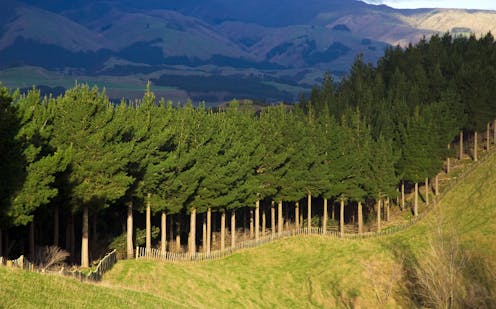
The greenhouse gases methane and nitrous oxide, from burping and urinating livestock, account for about half of New Zealand’s total emissions. These agricultural emissions have been the elephant in the room of New Zealand climate policy for some time.
A report released by the Parliamentary Commissioner for the Environment (PCE) this week suggests New Zealand should treat biological emissions differently from carbon dioxide emissions. It also says afforestation is a risky approach to combating climate change if planting trees is used to offset carbon emissions.
The report threatens to turn environmental policy and its principal policy tool, the New Zealand Emissions Trading Scheme (NZ ETS), on its head.
Read more: A new approach to emissions trading in a post-Paris climate
Emissions trading in New Zealand
New Zealand’s Emissions Trading Scheme, established by Helen Clark’s Labour administration in 2008, was meant to be a bold first in the world. It was going to cover all greenhouse-gases and all sectors and include forestry as an emissions sink. Critically, it was to include agriculture and the related biological emissions.
But the election of John Key’s National administration in 2009, with their rural electorate, meant agriculture never entered the scheme and was therefore “given a free ride” in the decade or so since. To put this “free ride” into context, the rest of the economy could buy cheap, and in some cases dubious, international carbon units for the bulk of that period.
After international trading was stopped, they could buy relatively cheap domestic forestry units. In truth, it was never much of a free ride for agriculture since no one was working particularly hard to mitigate anyhow.
The PCE report challenges the scheme’s architecture. It makes a number of recommendations. First, it suggests that biological emission should be treated differently to carbon dioxide emissions, with a zero target on carbon dioxide and a much lower but unspecified target for biological emissions.
The second recommendation is to no longer allow forestry sinks to be used to offset carbon dioxide emission, but to continue using them to offset biological emission.
This shifts the burden of mitigation away from biological emissions in agriculture towards carbon dioxide emissions from energy use and transport.
The PCE’s recommendations
The report provides an alternative vision to the “all gasses and all sectors” flexibility envisioned for the original NZ ETS. It differentiates between carbon dioxide and biological emissions since carbon dioxide is a long-lived greenhouse gas, but biological emissions include the long-lived nitrous oxide and the shorter-lived but potent methane.
The recommendation that afforestation sinks should no longer be used to offset carbon dioxide emissions represent a radical departure. It is likely to be opposed by foresters and those not wanting to create too much uncertainty in the NZ ETS. These are fair points that must be balanced against the logic behind the recommendation.
Using afforestation to mitigate carbon dioxide emissions is risky because forests may burn down (especially in a warming world) and release the carbon again. Commercial plantation forests only hold the carbon until the next harvesting cycle, and ultimately the land available for tree planting is limited and may crowd out other land uses.
Using afforestation to tackle carbon dioxide reductions also means we do not work hard enough to decarbonise the economy in more fundamental ways, including switching to electric vehicles, building houses for passive solar heating and making process heat renewable.
The search for cross-party consensus
Overall, the report signals a fundamentally different approach to climate policy from that envisioned for the NZ ETS over a decade ago. Differentiating carbon and biological emissions is sensible both from a science and a political expediency perspective.
The latter is particularly important if we are to have a political consensus behind the proposed Zero Carbon Act. Ultimately, the opposition National party will not back anything that unduly affects its agricultural electorate. Reducing reliance on carbon sinks also seems sensible as it pushes the cost of mitigation into the future, imposing it on future generations.
Read more: A fresh start for climate change mitigation in New Zealand
Does this mean a free ride for agriculture once more? Probably not, but the devil will be in the detail. What the reduction targets for biological emissions should be is not clear. The report cites a range of between 22% to 48% by 2050 as potentially feasible with investment in research and development.
The degree to which afforestation can be used to offset agricultural emissions also needs to be thought about. Unlimited forestry offsets could lead to landscapes that are either planted in trees or relatively intensive dairy farming, with little else in between. This is undesirable as it could lead to changes in biological diversity and water quality and ultimately damage New Zealand’s green and clean brand.
Clearly, there needs to be strong incentives to reduce biological emissions beyond the offset option that push towards more sustainable forms of farming. There is a strong case to limit offsets for agriculture as well, but this might depress the forestry sector.
Finally, to remove the carbon offset option from the market immediately or in the next few years would be unfair to foresters and companies that have been planning to use offsets based on the current architecture. A transition period would be needed to lessen the regulatory shock.
Authors: Ivan Diaz-Rainey, Associate Professor of Finance & Director, Climate and Energy Finance Group, University of Otago


















