Witness 1.8 billion years of tectonic plates dance across Earth’s surface in a new animation
- Written by Alan Collins, Professor of Geology, University of Adelaide
Using information from inside the rocks on Earth’s surface, we have reconstructed the plate tectonics of the planet over the last 1.8 billion years.
It is the first time Earth’s geological record has been used like this, looking so far back in time. This has enabled us to make an attempt at mapping the planet over the last 40% of its history, which you can see in the animation below.
The work, led by Xianzhi Cao from the Ocean University in China, is now published in the open-access journal Geoscience Frontiers.
Plate tectonics over the last 1.8 billion years of Earth history.A beautiful dance
Mapping our planet through its long history creates a beautiful continental dance — mesmerising in itself and a work of natural art.
It starts with the map of the world familiar to everyone. Then India rapidly moves south, followed by parts of Southeast Asia as the past continent of Gondwana forms in the Southern Hemisphere.
Around 200 million years ago (Ma or mega-annum in the reconstruction), when the dinosaurs walked the earth, Gondwana linked with North America, Europe and northern Asia to form a large supercontinent called Pangaea.
Then, the reconstruction carries on back through time. Pangaea and Gondwana were themselves formed from older plate collisions. As time rolls back, an earlier supercontinent called Rodinia appears. It doesn’t stop here. Rodinia, in turn, is formed by the break-up of an even older supercontinent called Nuna about 1.35 billion years ago.
Why map Earth’s past?
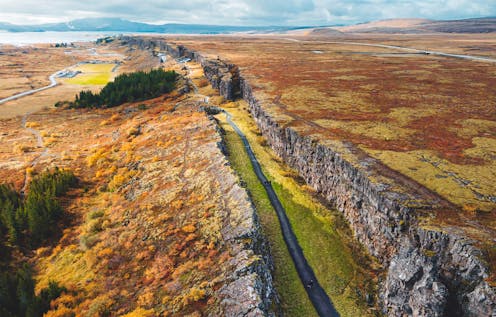
Among the planets in the Solar System, Earth is unique for having plate tectonics. Its rocky surface is split into fragments (plates) that grind into each other and create mountains, or split away and form chasms that are then filled with oceans.
Apart from causing earthquakes and volcanoes, plate tectonics also pushes up rocks from the deep earth into the heights of mountain ranges. This way, elements which were far underground can erode from the rocks and end up washing into rivers and oceans. From there, living things can make use of these elements.
Among these essential elements is phosphorus, which forms the framework of DNA molecules, and molybdenum, which is used by organisms to strip nitrogen out of the atmosphere and make proteins and amino acids – building blocks of life.
Plate tectonics also exposes rocks that react with carbon dioxide in the atmosphere. Rocks locking up carbon dioxide is the main control on Earth’s climate over long time scales – much, much longer than the tumultuous climate change we are responsible for today.

A tool for understanding deep time
Mapping the past plate tectonics of the planet is the first stage in being able to build a complete digital model of Earth through its history.
Such a model will allow us to test hypotheses about Earth’s past. For example, why Earth’s climate has gone through extreme “Snowball Earth” fluctuations, or why oxygen built up in the atmosphere when it did.
Indeed, it will allow us to much better understand the feedback between the deep planet and the surface systems of Earth that support life as we know it.
So much more to learn
Modelling our planet’s past is essential if we’re to understand how nutrients became available to power evolution. The first evidence for complex cells with nuclei — like all animal and plant cells — dates to 1.65 billion years ago.
This is near the start of this reconstruction and close to the time the supercontinent Nuna formed. We aim to test whether the mountains that grew at the time of Nuna formation may have provided the elements to power complex cell evolution.
Much of Earth’s life photosynthesises and liberates oxygen. This links plate tectonics with the chemistry of the atmosphere, and some of that oxygen dissolves into the oceans. In turn, a number of critical metals – like copper and cobalt – are more soluble in oxygen-rich water. In certain conditions, these metals are then precipitated out of the solution: in short, they form ore deposits.
Many metals form in the roots of volcanoes that occur along plate margins. By reconstructing where ancient plate boundaries lay through time, we can better understand the tectonic geography of the world and assist mineral explorers in finding ancient metal-rich rocks now buried under much younger mountains.
In this time of exploration of other worlds in the Solar System and beyond, it is worth remembering there’s so much about our own planet we are only just beginning to get a glimpse of.
There are 4.6 billion years of it to investigate, and the rocks we walk over contain the evidence for how Earth has changed over this time.
This first attempt at mapping the last 1.8 billion years of Earth’s history is a leap forward in the scientific grand challenge to map our world. But it is just that – a first attempt. The next years will see considerable improvement from the starting point we have now made.
The author would like to acknowledge this research was largely done by Xianzhi Cao, Sergei Pisarevsky, Nicolas Flament, Derrick Hasterok, Dietmar Muller and Sanzhong Li; as a co-author, he is just one cog in the research network. The author also acknowledges the many students and researchers from the Tectonics and Earth Systems Group at The University of Adelaide and national and international colleagues who did the fundamental geological work this research is based on.
Authors: Alan Collins, Professor of Geology, University of Adelaide