Methane emissions are at new highs. It could put us on a dangerous climate path
- Written by Pep Canadell, Chief Research Scientist, CSIRO Environment; Executive Director, Global Carbon Project, CSIRO
The goal of the 2021 Global Methane Pledge is bold: cut methane emissions by 30% by the end of the decade. This is to buy us vital time to work on cutting carbon dioxide emissions. Over 150 nations have now signed up to the pledge – representing more than half of the world’s emissions of an extremely potent but short-lived greenhouse gas.
To put the pledge into action, many leaders announced policies to cut methane. However, the latest research shows global methane emissions are still rising rapidly. Atmospheric concentrations are now growing faster than at any other time since global record-keeping began about 40 years ago.
These findings are published today in our fourth global methane budget, in a paper and pre-print research undertaken through the Global Carbon Project, with contributions from 66 research institutions around the world.
Natural sources of methane include decaying organic matter in wetlands. But humans have supercharged methane emissions. We tracked changes in all major sources and sinks of this potent greenhouse gas and found humans are now responsible for two-thirds or more of all global emissions.
This is a problem, but we can improve upon it. Cutting methane emissions is one of the best and only short-term levers we can pull to slow the rate of climate change.

Why is methane so important?
After carbon dioxide, methane is the second most important greenhouse gas contributing to human-driven global warming.
Although human activities emit much less methane than carbon dioxide in real terms, methane has a hidden punch – it’s 80 times as effective as CO₂ in trapping heat in the first two decades after it reaches the atmosphere.
Since the pre-industrial era, the world has heated up by 1.2°C (taken as an average of the past 10 years). Methane is responsible for about 0.5°C of warming, according to the latest reports by the Intergovernmental Panel on Climate Change (IPCC).
In the atmosphere, methane rapidly mixes with oxygen and converts into carbon dioxide and water. By contrast, carbon dioxide is a much more stable molecule and will stay in the atmosphere, trapping heat, for thousands of years until absorbed by ocean and plants.
The combination of short lifespan and extreme potency make methane an excellent candidate for efforts to rapidly tackle climate change.
 Heat, waterlogged ground and microbes eating organic matter make tropical wetlands such as Brazil’s Pantanal region a natural source of methane.
Crowley Production/Shutterstock
Heat, waterlogged ground and microbes eating organic matter make tropical wetlands such as Brazil’s Pantanal region a natural source of methane.
Crowley Production/Shutterstock
Methane is not slowing
In the early-to-mid-2000s, methane emissions growth rates actually fell. Analyses suggest it was driven by a combination of reduced fossil fuels emissions and chemical changes in the atmosphere’s capacity to destroy methane.
Since then, however, methane has surged. Methane emissions from human activities increased by 50-60 million tonnes per year over the two decades to 2018-2020 – a 15-20% increase.
This doesn’t mean atmospheric methane goes up by the same amount, as methane is constantly being broken down.
During the 2000s, an extra 6.1 million tonnes of methane entered the atmosphere each year. By the 2010s, the rate of growth was 20.9 million tonnes. In 2020, growth hit 42 million tonnes. Since then, methane has been added even more rapidly. Growth rates are now higher than any previously observed year.
 This graph shows yearly increases in global atmospheric methane. Red lines indicate the average for the decade. Data from the Kennaook/Cape Grim Baseline Air Pollution Station in Tasmania.
CSIRO, CC BY-NC-ND
This graph shows yearly increases in global atmospheric methane. Red lines indicate the average for the decade. Data from the Kennaook/Cape Grim Baseline Air Pollution Station in Tasmania.
CSIRO, CC BY-NC-ND
Where does the methane come from?
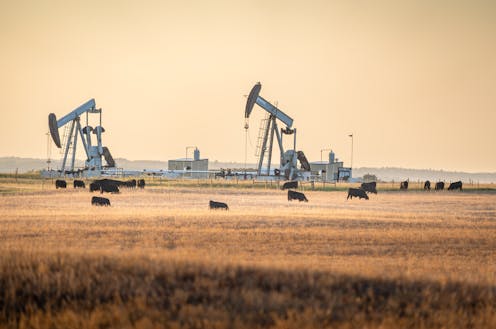
Human activities such as farming livestock, coal mining, extracting and handling natural gas, growing rice in paddies, and putting organic waste in landfills contribute about 65% of all methane emissions. Of this, agriculture (livestock and rice paddies) contributes 40%, fossil fuels 36%, and landfills and wastewater 17%.
Methane emissions from fossil fuels are now comparable to livestock emissions. The fastest growing contributors are from landfill and fossil fuels (think natural gas escaping during extraction and processing).
Our impact is even higher when we account for indirect emissions such as the leaching of organic matter into waterways and wetlands, the construction of reservoirs, and the impacts of human-driven climate change on wetlands.
In 2020, human activities led to emissions of between 370 and 384 million tonnes of methane.
The remaining emissions come from natural sources, primarily the decomposition of plant matter in wetlands, rivers, lakes, and water-saturated soils. Tropical wetlands are particularly large emitters. The world’s large areas of permafrost (permanently frozen ground) also produce methane, but at relatively low rates. As permafrost melts due to higher temperatures, this is changing.
Regional contributions and trends
Who emits most? By volume, the top five nations in 2020 were China (16%), India (9%), the United States (7%), Brazil (6%) and Russia (5%). The fastest-growing areas are China, South Asia, Southeast Asia, and the Middle East.
European nations have begun to lower their emissions over the last two decades, due to efforts to cut emissions from landfill and waste, followed by smaller cuts in fossil fuels and farming. Australia may also be lowering emissions mainly from farming and waste.
 Europe’s methane emissions have begun to fall, due to work done to stop emissions from landfills and waste. Pictured is a methane collector atop a landfill in Sicily, Italy, in 2012.
newphotoservice/Shutterstock
Europe’s methane emissions have begun to fall, due to work done to stop emissions from landfills and waste. Pictured is a methane collector atop a landfill in Sicily, Italy, in 2012.
newphotoservice/Shutterstock
What does this mean for net zero?
Unchecked methane emissions are bad news. Recent observed atmospheric concentrations of methane are consistent with climate scenarios with up to 3°C of warming by 2100.
To keep global temperatures well-below 2°C – the goal of the 2015 Paris Agreement – means cutting methane emissions as rapidly as possible. Methane has to be cut almost in half (45%) by 2050 to achieve that goal.
It’s not an impossible problem. We now have have methods of rapidly cutting methane for every sector.
The oil and gas sector could cut their emissions 40% at no net cost, according to the International Energy Agency.
In agriculture, we can achieve rapid reductions by feed additives to reduce methane belched from cows, sheep, goats and buffalo, and by mid-season drainage in rice paddies.
Capturing landfill methane and using it for energy production or heat is now well established.
Three years ago, the world committed to slash methane emissions. Our findings show that we need to rapidly accelerate solutions across the globe to address and reduce methane emissions.
Authors: Pep Canadell, Chief Research Scientist, CSIRO Environment; Executive Director, Global Carbon Project, CSIRO