

Migrants want to live in the big cities, just like the rest of us
- Written by: Dr. Sajeda Tuli, Fulbright Scholar, Institute for Governance and Policy Analysis, University of Canberra
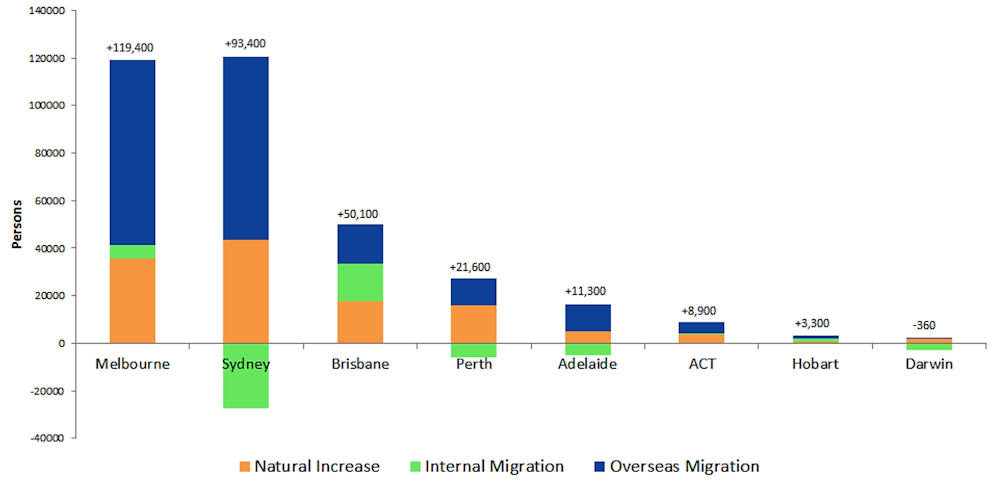
Migration is getting increasing attention in Australia, with the Morrison government recently putting the focus on settling migrants in regional areas to ease pressure on the capital cities. Newly released statistics show 79% of Australian population growth was in the capital cities in 2017-18. The population of these cities grew by 307,800, a 1.9% increase.
This was nearly twice the growth rate of non-capital-city areas, which gained only 83,200 people – although many regional areas would welcome more people to revitalise struggling towns.
The chart below shows growth in capital city populations from international and internal migration, as well as natural increase (births minus deaths).
BREAKDOWN OF CAPITAL CITY POPULATION GROWTH 2017-18
 ABS, 3218.0 - Regional Population Growth, Australia, 2017-18, CC BY
Many towns would welcome migrants because they are agents of development, contributing to economic growth and prosperity. According to the International Organisation for Migration, if current trends continue, there could be 405 million international migrants globally by 2050 in the world.
Like other OECD countries, Australia uses skilled migration to overcome skill shortages and sustain economic growth. The proportion of skilled migrants in the immigration intake more than doubled from 29.1% in 1993-1994 to 68% in 2005-2006.
The latest data continue a longer-term trend of migrants settling in our biggest cities. They are attracted by demand for their skills and the economic opportunities the cities offer.
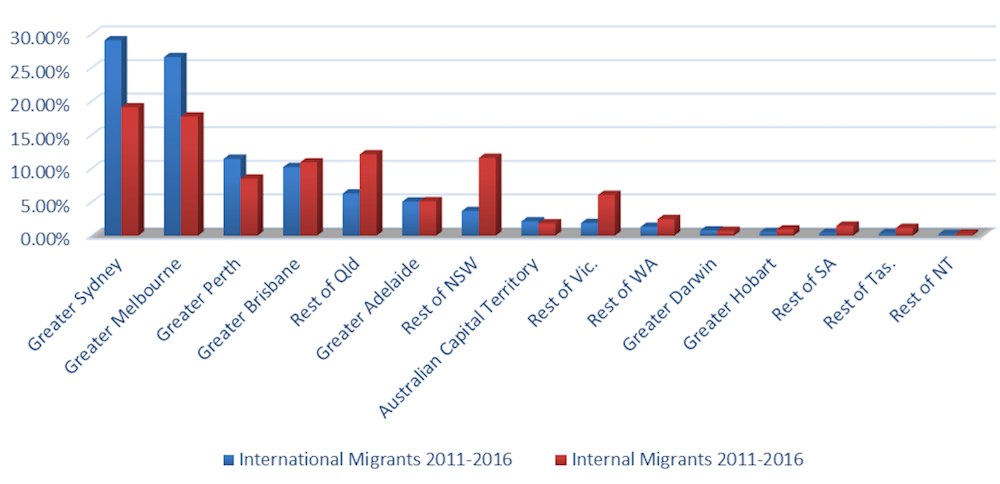
Australia received 1,379,055 international migrants between 2011-2016, of whom nearly 50% were high-skilled or semi-skilled. The chart below shows 85.52% of them settled in the greater capital cities, which also attracted many internal migrants from elsewhere in Australia. Greater Sydney and Greater Melbourne, the nation’s top two global cities, received more than 50% of migrants.
Only 14.1% of international migrants settled outside the capital cities. Outside these cities, internal people movement was greater than international.
MIGRANT DISTRIBUTION IN CAPITAL CITIES AND REST OF AUSTRALIA 2011-16
ABS, 3218.0 - Regional Population Growth, Australia, 2017-18, CC BY
Many towns would welcome migrants because they are agents of development, contributing to economic growth and prosperity. According to the International Organisation for Migration, if current trends continue, there could be 405 million international migrants globally by 2050 in the world.
Like other OECD countries, Australia uses skilled migration to overcome skill shortages and sustain economic growth. The proportion of skilled migrants in the immigration intake more than doubled from 29.1% in 1993-1994 to 68% in 2005-2006.
The latest data continue a longer-term trend of migrants settling in our biggest cities. They are attracted by demand for their skills and the economic opportunities the cities offer.
Australia received 1,379,055 international migrants between 2011-2016, of whom nearly 50% were high-skilled or semi-skilled. The chart below shows 85.52% of them settled in the greater capital cities, which also attracted many internal migrants from elsewhere in Australia. Greater Sydney and Greater Melbourne, the nation’s top two global cities, received more than 50% of migrants.
Only 14.1% of international migrants settled outside the capital cities. Outside these cities, internal people movement was greater than international.
MIGRANT DISTRIBUTION IN CAPITAL CITIES AND REST OF AUSTRALIA 2011-16
 Author provided
Read more:
Settling migrants in regional areas will need more than a visa to succeed
Why is growth concentrated in a handful of cities?
Migrants are just following the same trend as the non-migrant population in Australia. Australia is a highly urbanised country and most people live in or near its major cities.
At the time of the last census in 2016, two-thirds of the population lived in the capital cities, which is where 66% of employment was located. Outside those metropolitan areas, some big regional cities such as Newcastle, Wollongong and Geelong also have a significant share of employment.
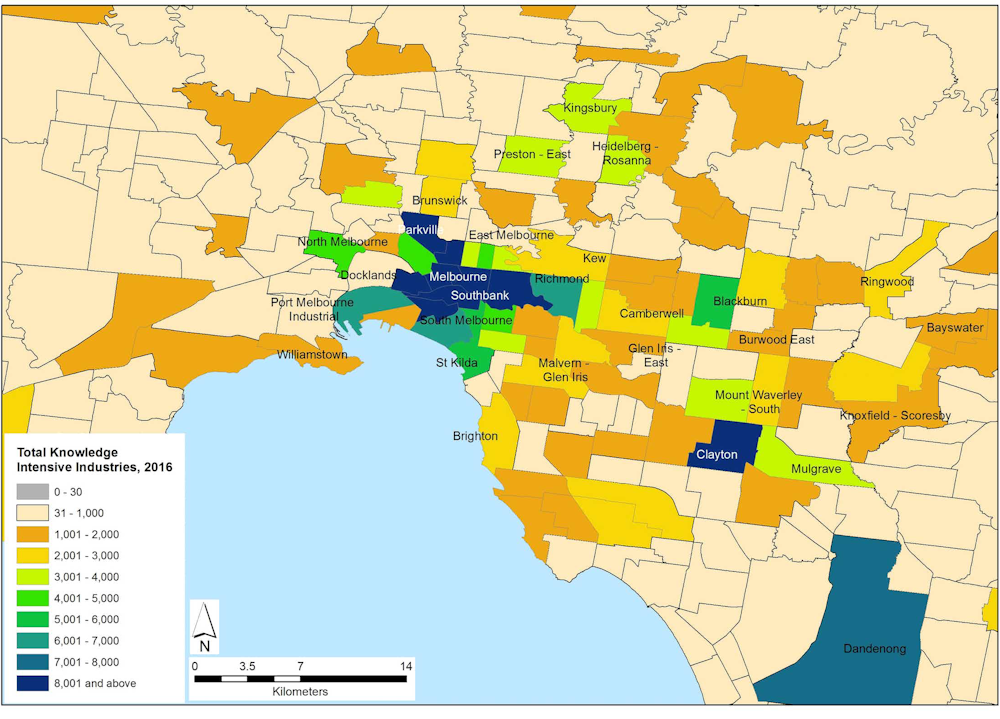
The chart below shows the concentration of knowledge industry workers in Greater Melbourne. They are concentrated in the inner Melbourne area. Most major Australian cities follow the same trend.
DISTRIBUTION OF KNOWLEDGE INDUSTRY WORKERS IN MELBOURNE
Author provided
Read more:
Settling migrants in regional areas will need more than a visa to succeed
Why is growth concentrated in a handful of cities?
Migrants are just following the same trend as the non-migrant population in Australia. Australia is a highly urbanised country and most people live in or near its major cities.
At the time of the last census in 2016, two-thirds of the population lived in the capital cities, which is where 66% of employment was located. Outside those metropolitan areas, some big regional cities such as Newcastle, Wollongong and Geelong also have a significant share of employment.
The chart below shows the concentration of knowledge industry workers in Greater Melbourne. They are concentrated in the inner Melbourne area. Most major Australian cities follow the same trend.
DISTRIBUTION OF KNOWLEDGE INDUSTRY WORKERS IN MELBOURNE
 Created by author from ABS Census 2016 data
According to the 2016 Census, the majority of skilled migrants, 63%, are settling in the greater capital cities. They are simply following the employment.
The big cities offer diverse opportunities, similar jobs to advance their careers and a lifestyle for them and their families. These are the main reasons the big cities are the main destinations of these large numbers of skilled migrants.
Asian-born migrants dominate current migration intakes. In the past, migrants were mostly from Europe and the UK. Migrants are reshaping Australia and we are becoming truly multicultural.
Read more:
How Australian cities are adapting to the Asian Century
In addition, migration is significantly reducing the rate of population ageing in Australia. According to the 2016 Census, more than 85% of migrants are of working age, compared to 65% of existing Australian residents.
In future, Australia will face significant skills shortages, which means skilled migration will be important for Australia’s economic development. Since most knowledge jobs are concentrated in the major cities, skilled migrants will continue to concentrate there too.
Therefore, migration and skilled migrants are important for Australian cities at present and will be into the future. They are contributing to demographic balance, meeting skills shortages and enhancing economic prosperity.
Read more:
The government is right – immigration helps us rather than harms us
Why is regional Australia failing to attract migrants?
Although the government has policies in place to meet skill shortages in regional Australia, lack of employment choice and diversity are still a problem in these areas. Therefore, a qualified migrant doctor or engineer will likely go where they might have more opportunities after they finish any mandatory period of living in a regional or designated area.
Migrants, especially international migrants, follow the jobs. Internal migrants are more likely to follow family and lifestyle. These drivers need to be understood if we hope to shift settlement patterns.
If regional Australia is to be made more attractive to migrants, we need to diversify employment opportunities, improve amenity, services and infrastructure, and most importantly ensure migration policies focus on the nature and needs of the regional economy. This requires research to identify which regional cities have capacity to grow. Migrants along with the rest of Australia will follow the opportunities and lifestyle there.
Read more:
Forcing immigrants to work in regional areas will not boost regional economies in the long run
Created by author from ABS Census 2016 data
According to the 2016 Census, the majority of skilled migrants, 63%, are settling in the greater capital cities. They are simply following the employment.
The big cities offer diverse opportunities, similar jobs to advance their careers and a lifestyle for them and their families. These are the main reasons the big cities are the main destinations of these large numbers of skilled migrants.
Asian-born migrants dominate current migration intakes. In the past, migrants were mostly from Europe and the UK. Migrants are reshaping Australia and we are becoming truly multicultural.
Read more:
How Australian cities are adapting to the Asian Century
In addition, migration is significantly reducing the rate of population ageing in Australia. According to the 2016 Census, more than 85% of migrants are of working age, compared to 65% of existing Australian residents.
In future, Australia will face significant skills shortages, which means skilled migration will be important for Australia’s economic development. Since most knowledge jobs are concentrated in the major cities, skilled migrants will continue to concentrate there too.
Therefore, migration and skilled migrants are important for Australian cities at present and will be into the future. They are contributing to demographic balance, meeting skills shortages and enhancing economic prosperity.
Read more:
The government is right – immigration helps us rather than harms us
Why is regional Australia failing to attract migrants?
Although the government has policies in place to meet skill shortages in regional Australia, lack of employment choice and diversity are still a problem in these areas. Therefore, a qualified migrant doctor or engineer will likely go where they might have more opportunities after they finish any mandatory period of living in a regional or designated area.
Migrants, especially international migrants, follow the jobs. Internal migrants are more likely to follow family and lifestyle. These drivers need to be understood if we hope to shift settlement patterns.
If regional Australia is to be made more attractive to migrants, we need to diversify employment opportunities, improve amenity, services and infrastructure, and most importantly ensure migration policies focus on the nature and needs of the regional economy. This requires research to identify which regional cities have capacity to grow. Migrants along with the rest of Australia will follow the opportunities and lifestyle there.
Read more:
Forcing immigrants to work in regional areas will not boost regional economies in the long run
Authors: Dr. Sajeda Tuli, Fulbright Scholar, Institute for Governance and Policy Analysis, University of Canberra
Read more http://theconversation.com/migrants-want-to-live-in-the-big-cities-just-like-the-rest-of-us-113911


















