

Greenwashing the property market: why 'green star' ratings don't guarantee more sustainable buildings
- Written by: Igor Martek, Lecturer In Construction, Deakin University
Nothing uses more resources or produces more waste than the buildings we live and work in. Our built environment is responsible for half of all global energy use and half of all greenhouse gas emissions. Buildings consume one-sixth of all freshwater, one-quarter of world wood harvests and four-tenths of all other raw materials. The construction and later demolition of buildings produces 40% of all waste.
The sustainability of our buildings is coming under scrutiny, and “green” rating tools are the key method for measuring this. Deakin University’s School of Architecture and Built Environment recently reviewed these certification schemes. Focus group discussions were held in Sydney and Melbourne with representatives in the field of sustainability – including government, green consultancies and rating tool providers.
Two main concerns emerged from our review:
Sustainability ratings tools are not audited. Most ratings tools are predictive, while those few that take measurements use paid third parties. Government plays no active part.
The sustainability parameters measured only loosely intersect with the building occupants’ sustainability concerns. Considerations such as access to transport and amenities are not included.
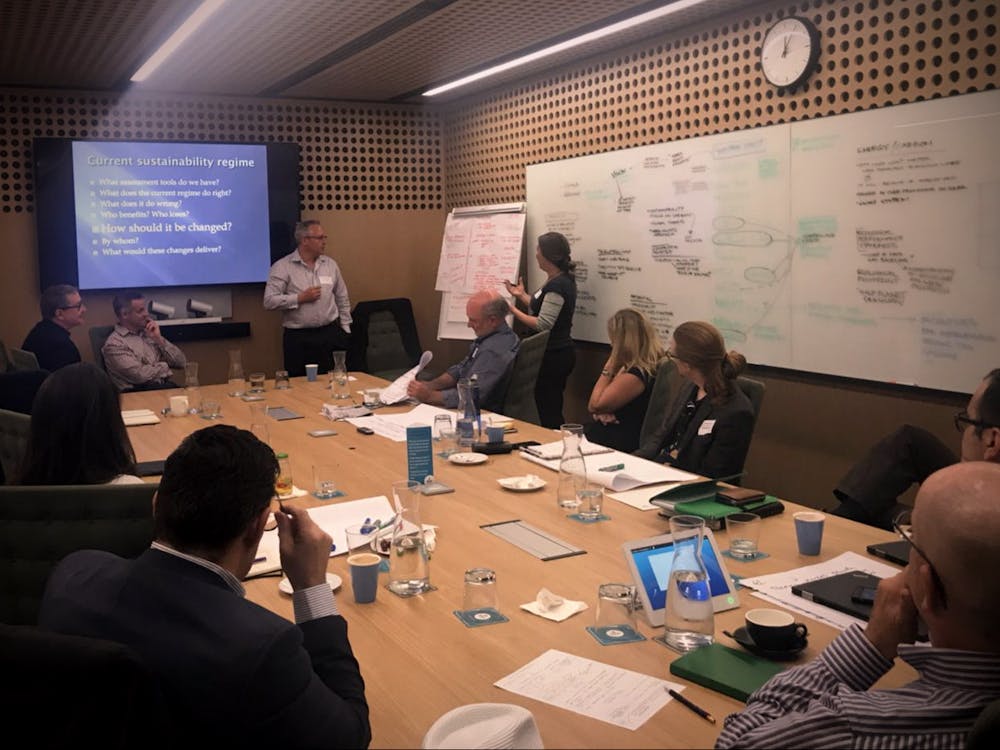 Focus group sessions run by Deakin University helped identify problems with current sustainability ratings.
Author provided
Focus group sessions run by Deakin University helped identify problems with current sustainability ratings.
Author provided
Read more: Construction industry loophole leaves home buyers facing higher energy bills
That’s the backdrop to the sustainability targets now being adopted across Australia. Australia has the highest rate of population growth of any developed country. The population now is 24.8 million. It is expected to reach between 30.9 and 42.5 million people by 2056.
More buildings will be needed for these people to live and work in. And we will have to find ways to ensure these buildings are more sustainable if the targets now being adopted are to be achieved.
Over 80% of local governments have zero-emissions targets. Sydney and Canberra have committed to zero-carbon emissions by 2050. Melbourne has pledged to be carbon-neutral by 2020.
So how do green ratings work?
Each green rating tool works by identifying a range of sustainability parameters – such as water and energy use, waste production, etc. The list of things to be measured runs into the dozens. Tools differ on the parameters measured, method of measurement, weightings given and the thresholds that determine a given sustainability rating.
There are over 600 such rating tools worldwide. Each competes in the marketplace by looking to reconcile the credibility of its ratings with the disinclination of developers to submit to an assessment that will rate them poorly. Rating tools found in Australia include Green Star, NABERS, NatHERS, Circles of Sustainability, EnviroDevelopment, Living Community Challenge and One Planet Communities.
So, it is easy enough to find landmark developments labelled with green accreditations. It is harder to quantify what these actually mean.
Read more: Green building revolution? Only in high-end new CBD offices
Ratings must be independently audited
Government practice, historically, has been to assure building quality through permits. Planning permits ensure a development conforms with city schemes. Building permits assess structural load-bearing capacity, health and fire safety.
All this is done off the plan. Site inspections take place to verify that the building is built to plan. But once a certificate of occupancy is issued, the government steps aside.
The sustainability agenda promoted by government has been grafted onto this regime. Energy efficiency was introduced into the residential building code in 2005, and then into the commercial building code in 2006. At first, this was limited to new buildings, but then broadened to include refurbishment of existing structures.
Again, sustainability credentials are assessed off the plan and certification issued once the building is up and running. Thereafter, government walks away.
We know of only one longitudinal energy performance study carried out on domestic residences in Australia. It is an as-yet-unpublished project conducted by a retiree from the CSIRO, working with Indigenous communities in Far North Queensland.
The findings corroborate a recent study by Gertrud Hatvani-Kovacs and colleagues from the University of South Australia. This study found that so-called “energy-inefficient” houses, following traditional design, managed under certain conditions to outperform 6- and 8-star buildings.
Sustainability tools must measure what matters
 People are concerned about sustainability issues like access to public transport, but the building ratings don’t take account of this.
AAP
People are concerned about sustainability issues like access to public transport, but the building ratings don’t take account of this.
AAP
Energy usage is but the tip of the iceberg. Genuine sustainability is about delivering our children into a future in which they have all that we have today.
Home owners, on average, turn their property around every eight years. They are less concerned with energy efficiency than with real estate prices. And these prices depend on the appeal of the property, which involves access to transport, schools, parks and amenities, and freedom from crime.
Commercial property owners, too, are concerned about infrastructure, and they care about creating work environments that retain valued employees.
These are all core sustainability issues, yet do not come up in the rating systems we use.
If government is serious about creating sustainable cities, it needs to let go of its limited, narrow criteria and embrace these larger concerns of “liveability”. It must embody these broader criteria in the rating systems it uses to endorse developments. And it needs an auditing and enforcement regime in place to make it happen.
Authors: Igor Martek, Lecturer In Construction, Deakin University


















