

How Leonardo da Vinci made a living from killing machines
- Written by: Susan Broomhall, Professor of History, University of Western Australia
On the 500th anniversary of his death, our series Leonardo da Vinci Revisited brings together scholars from different disciplines to re-examine his work, legacy and myth.
Leonardo worked for some of the top military and political leaders in the Italian Wars, a major conflict fought on the Italian peninsula that embroiled most of Western Europe. His patrons read like a roll-call of Europe’s leading familes: Sforza and Borgia dukes and French Valois kings.
Like many other artists and technicians, he negotiated the professional and financial opportunities (as well as dangers) that war presented.
As a brilliant designer, technician and artist, he knew how to appeal to the leaders of his day. A well-known 1482 letter to Ludovico Il Moro Sforza, Duke of Milan, one of Italy’s most powerful military leaders, was in essence a job application.
In it, Leonardo promised a raft of new technological possibilities in warfare, boasting he could create an infinite variety of machines for attack or defence:
I have methods for making very light and strong bridges, easily portable, and useful whether pursuing or evading the enemy; and others more solid, which cannot be destroyed by fire or assault …
If the place under siege cannot be reduced by bombardment, because of the height of its banks or the strength of its position, I have methods for destroying any fortress or redoubt even if it is founded upon solid rock …
I will make armoured cars, totally unassailable, which will penetrate the ranks of the enemy with their artillery, and there is no company of soldiers so great that it can withstand them…
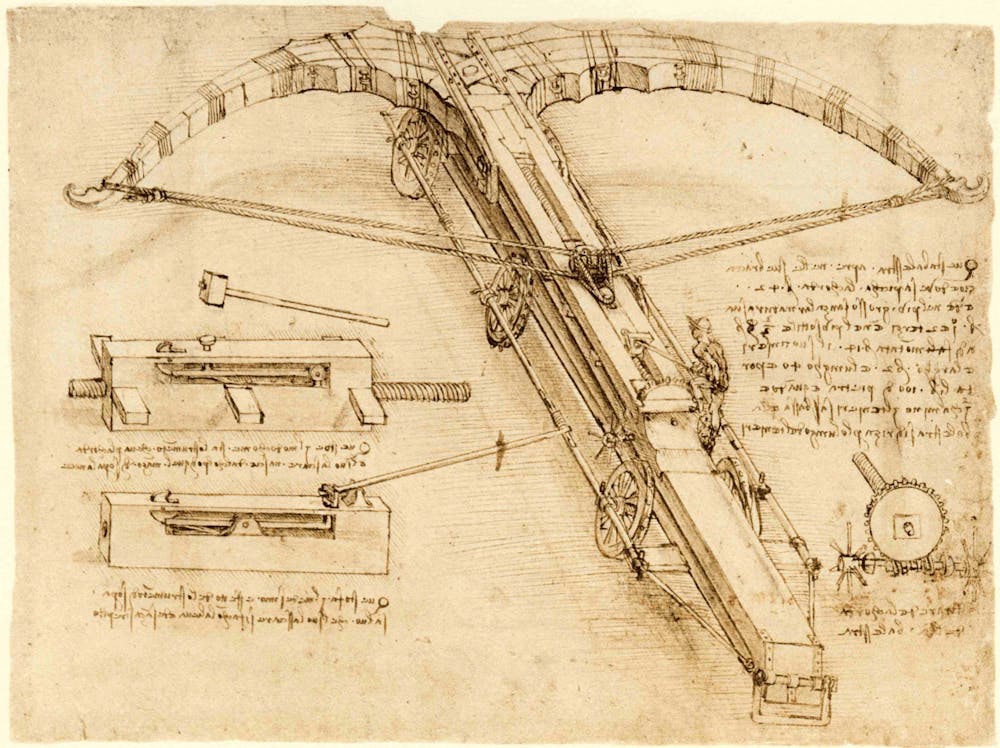 Leonardo’s design for a giant crossbow, Codex Atlantico, fol 53v.
Wikimedia Commons
Leonardo’s design for a giant crossbow, Codex Atlantico, fol 53v.
Wikimedia Commons
His claims spoke powerfully of a dream of invincibility for the Duke. At times, Leonardo followed the armies of his leaders as they waged war across Italy, but he did not fight on the frontline as a soldier himself. His value to his patrons was not his body, but his mind.
Alongside his weapons of war, Leonardo also created magnificent spectacles of his patrons’ military achievements in festivities with advanced dramatic technologies. For instance, the festival Leonardo curated in France in May 1518 for his patron François I celebrated the king’s military achievement. He staged an elaborate, multi-sensory, re-enactment of the Battle of Marignano complete with siege and capture of a castle. The watching crowd were overwhelmed with emotion, as falconets fired missiles of paper and mortars shot out balloons.
Through these displays and performances, — textual, ceremonial, multimedia — Leonardo helped to curate an elite masculine identity for a man at war, shaped and defined by new technological advancements.
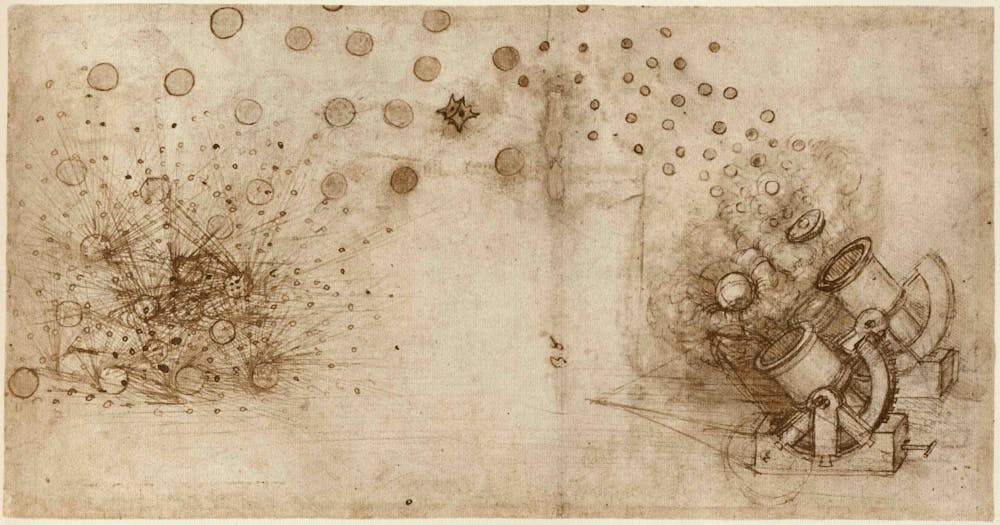 Leonardo da Vinci, Codex Atlantico, fol. 9r.
Wikimedia Commons
Leonardo da Vinci, Codex Atlantico, fol. 9r.
Wikimedia Commons
Shock and awe
While Leonardo explored the power of the senses to channel emotional responses in ceremonial contexts, so too was much of his commentary on his weapons and design about shock and awe. His designs explicitly aimed to make men and horses afraid, causing maximum damage.
These interests in exploiting men’s emotional frailties in war are revealed in his 1482 letter to Ludovico:
I have certain types of cannons, extremely easy to carry, which fire out small stones, almost as if it were a hailstorm, and the smoke from these will cause great terror to the enemy, and they will bring great loss and confusion …
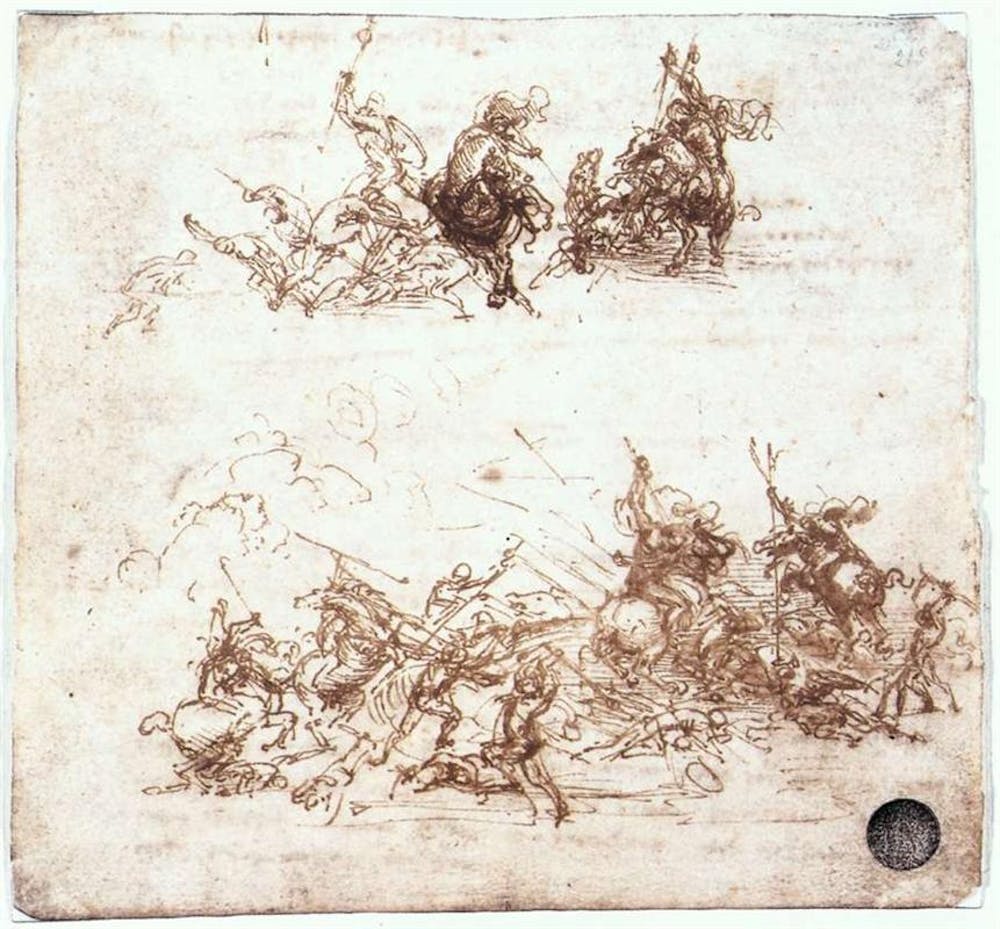 Leonardo, Figures fighting on horseback and on foot, c. 1504.
Wikiart.org
Leonardo, Figures fighting on horseback and on foot, c. 1504.
Wikiart.org
Of his design for a steam-powered cannon made of copper, he wrote that “the sight of its fury and the sound of its roar will seem like a miracle”.
Leonardo’s weapons were thus not just about physical damage to men, animals and buildings, but exploited the emotional experiences of those fighting at the frontline. They offer the prospect of destroying the fortitude and morale of the men facing them, emphasising warfare’s psychological element.
A turbulent mind
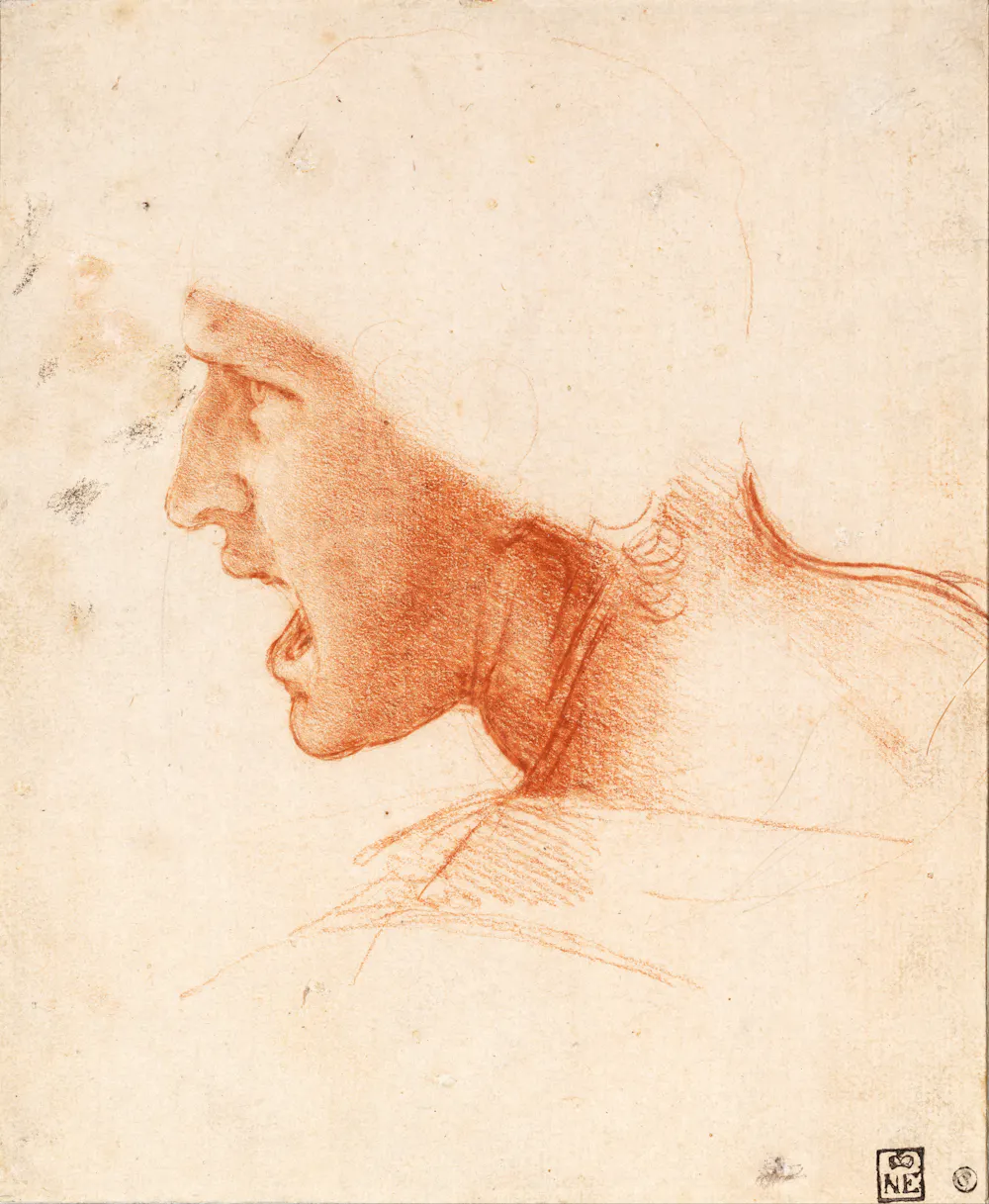 Study of a Warrior’s Head for the Battle of Anghiari, c 1504-5. Red chalk on very pale pink prepared paper, Google Art Project.
Wikimedia Commons
Study of a Warrior’s Head for the Battle of Anghiari, c 1504-5. Red chalk on very pale pink prepared paper, Google Art Project.
Wikimedia Commons
But Leonardo was also frustrated. In one manuscript, he discloses what seem to be ambitions as an author on war: “In order to preserve the main gift of nature, that is liberty, I will find a way to attack and defend, when being besieged by tyrannical ambition. And firstly I will speak of the positioning of walls and then how the people can maintain their good and just lords.”
This book project, if that is what it was, seems less about warfare and more a critique of the men he found himself working for. It seems to suggest his ambition to contribute to, or at least comment on, current events and ideas of good and bad government, which he witnessed at close range as the client of some of Europe’s most influential leaders.
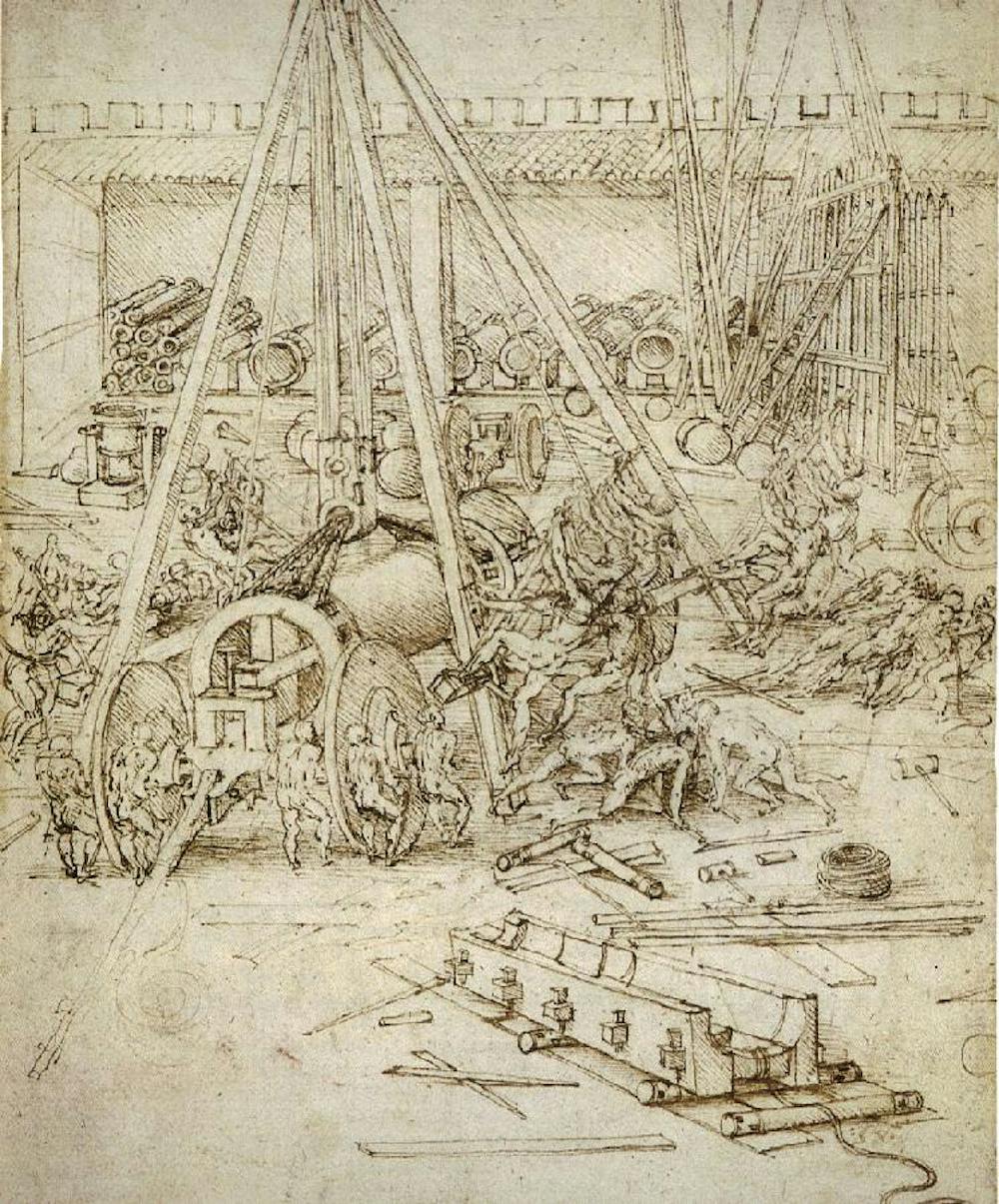 Study for a Hoist and for a Cannon in an Ordnance Foundry, c 1487. Royal Library, Windsor.
Wikimedia Commons
Study for a Hoist and for a Cannon in an Ordnance Foundry, c 1487. Royal Library, Windsor.
Wikimedia Commons
While Leonardo’s textual record attests to his ambitions, it also documents grievances that surrounded his experiences as a participant in war. Above a picture of a scattershot cannon, an unfinished half-sentence reads: “If the men of Milan would for once do something out of the ordinary …” Perhaps this was a throwaway comment meant only for himself, but it suggests some of his frustrations.
In thinking about Leonardo now, we recognise that among his many talents, he was someone who not only made a living from, but was perhaps uniquely gifted at creating, new forms of killing machines.
Authors: Susan Broomhall, Professor of History, University of Western Australia
Read more http://theconversation.com/how-leonardo-da-vinci-made-a-living-from-killing-machines-112402


















