Are kiwi and moa recent immigrants from Australia? Neither fossils nor genetic evidence support the story
- Written by Nic Rawlence, Associate Professor in Ancient DNA, University of Otago
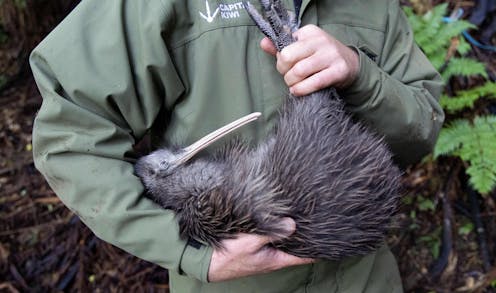
Aotearoa New Zealand is a land of birds, from the smallest of wrens to the mightiest of moa. The ancestors of some species have been here for tens of millions of years, while others arrived only a few million years ago.
So a recent suggestion that moa and kiwi are recent immigrants from Australia, while wrens and kākāpō are New Zealand’s truly ancient birds, was sure to ignite controversy.
The contentious report was based on a scientific review of fossils found at St Bathans in Central Otago.
However, putting dates on arrivals requires a combination of both physical fossil evidence in deposits of a known age and genetic dating techniques that determine when the birds we know today diverged from their closest relatives.
Dating the arrival of birds in New Zealand
New Zealand is part of the larger continent of Zealandia, which finished separating from the supercontinent Gondwana some 57 million years ago.
Some familiar animals were likely present in proto-New Zealand at this time, including our unique silent frogs, the ancient tuatara and many invertebrates. Tens of millions of years of dispersal of both plants and animals followed.
Fossils and DNA allow us to explore these dispersal events in detail. Fossils can preserve evidence for millennia longer than DNA molecules, but DNA can shed light on many processes even when fossils are rare. This quality is particularly valuable since the chance of finding fossils decreases the further back we look in time.
Both approaches carry their own assumptions and biases that influence calculations of the range of arrival times.

Our team uses ancient DNA to date these arrivals, showing for example that the purple swamp hen ancestors of takahē and moho arrived in Aotearoa New Zealand around four million years ago from Australia, as part of a suite of open-habitat birds that included ancestors of the kakī black stilt, pouākai Haast’s eagle and kērangi Eyles’ harrier.
Other genetic studies have shown the ancestors of New Zealand wrens, the most primitive of all perching birds, split off about 50 to 60 million years ago. Wren fossils are part of the wonders unearthed at St Bathans, alongside remains of both moa and kiwi.
Genetic and morphological analyses of ratites (such as ostrich, kiwi, moa and elephant birds) suggest the ancestors of moa and kiwi reached Zealandia, separately, around 50 to 60 million years ago. Both groups filled the job vacancy in the ecosystem left by dinosaurs, becoming large and flightless.
The kākāpō, meanwhile, along with the kākā and kea, belong to a family that split off from all other living parrots very early on; they, too, are an ancient group. But genetic dating of their arrival in Zealandia remains unresolved, with studies variously putting it between 20 to 80 million years ago.
Precise dating of these splits presents a significant challenge. Nevertheless, the range between 30 million and a few million ascribed to the moa and kiwi by the recent announcement is not borne out by available evidence – and neither group is Australian as reported.
Moa are most closely related to the flying chicken-sized tinamous from South America, and kiwi are relatives of the giant extinct elephant birds from Madagascar. Indeed, Australia did not even exist as a discrete entity 50 to 60 million years ago; it was still firmly affixed to Antarctica and South America.
Exactly what routes the ancestors of moa and kiwi took to reach Zealandia remains unknown. They were part of a group of flying birds with a worldwide distribution called Lithornids, which lost flight many times independently and evolved into the ratites we know today.
The bones will speak
The St Bathans fossil deposit has given us an indispensable window into prehistoric New Zealand, and in many ways it is familiar – the bones of moa, kiwi, parrots, wrens and bats provide a reassuring continuity.
As the publication notes, though, there are also many strange things in the fossil deposit – crocodiles, a relative of flamingos and a giant turtle. There’s an Alice in Wonderland quality to St Bathans, and it’s a crucial piece of the story of Aotearoa New Zealand’s biological heritage.
The presence of a bird’s fossil in the deposit indicates the lineage was present in New Zealand a long time ago. But how long ago, exactly? Most estimates put the age of the St Bathans lake sediments between 12 and 20 million years, but these estimates are imprecise, making definitive statements about the age of animal groups difficult.
Even if a lineage was present in the St Bathans deposits, this still does not prove a continuous presence from that time to the present day.
Whatever the age of St Bathans, it’s tempting to think remains found in the palaeo-lake are members of truly ancient lineages, while things that only arrived after the lake dried up are invaders, little more than wayward tourists that got off at the wrong stop.
No matter when ancestors of birds arrived in New Zealand, their time on these isles has shaped their evolution in profound ways. Our team is working on determining arrival times and it’s looking increasingly dynamic, tied to environmental conditions.
The ancestors of the majestic huia arrived here 27 million years ago, evolving distinct beak shapes in males and females and white-tipped feathers that were high-status symbols in Māori society.
At the other end of the scale, the closest relative of the 16kg Haast’s eagle, whose ancestors arrived here a mere 2.5 million years ago, is the smallest eagle in the world – weighing only 1kg.
Let’s continue to embrace and care for our amazing bird fauna – whatever their age, they all have a bit of Aotearoa New Zealand in them.
Authors: Nic Rawlence, Associate Professor in Ancient DNA, University of Otago