
Earth is getting a tiny new mini-moon. It won’t be the first (or the last)
- Written by Laura Nicole Driessen, Postdoctoral researcher in radio astronomy, University of Sydney
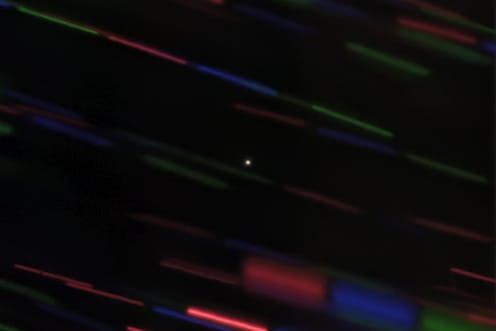
Earth is going to have its very own mini-moon from September 29 until November 25. The regular Moon’s new, temporary friend is 2024 PT₅, an asteroid captured from the Arjuna asteroid group (called the “Arjunas”).
Our new mini-moon is approximately 10 metres in diameter and will be captured by Earth’s gravity for 57 days. It’s small and faint, so it won’t be visible by the eye or with small telescopes, but will be visible to larger telescopes.
What is a mini-moon?
NASA defines “moons” as “naturally formed bodies that orbit planets”. Intuitively, we think of moons as big rocks that stick around for a while, like our very own Moon.
Astronomers have defined mini-moons as asteroids or comets that are gravitationally captured by a planet for a temporary amount of time. Small mini-moons are very common, but ones big enough to spot are more rare.
2024 PT₅ is only the fifth ever detected mini-moon captured by Earth.
Orbiting or just flying by?
A mini-moon is a “temporarily captured orbiter” if it completes at least one full orbit of the Earth before returning to its usual orbit around the Sun.
If a mini-moon is captured by Earth’s gravity but doesn’t make it around for a full orbit, it’s a “temporarily captured flyby” instead.
Two of Earth’s mini-moons were “temporarily captured orbiters”, while the other three (including 2024 PT₅) fall into the “temporarily captured flybys” category.
Where do mini-moons come from?
Mini-moons are asteroids from the large population of near-Earth objects (or NEOs) that are temporarily grabbed from their orbit around the Sun.
Near-Earth objects are defined as natural physical objects floating in space, such as asteroids (space rocks) or comets (dirty space snowballs made of rock and ice), that are orbiting the Sun and approach to within 1.3 times Earth’s distance from the Sun at some point in their orbit.
Because these objects are around the same distance from the Sun as the Earth, they can sometimes be captured by Earth’s gravity.
2024 PT₅ and and a previous mini-moon called 2022 NX₁ were both captured from a group of asteroids orbiting the Sun at a similar distance from Earth, called the Arjunas. Arjuna is one of the main characters of the Hindu epic, Mahābhārata.
The first mini-moon – and a fake one
The first known mini-moon was called 1991 VG. It arrived in late 1991 and left in early 1992, and like 2024 PT₅ it was around 10 metres in diameter.
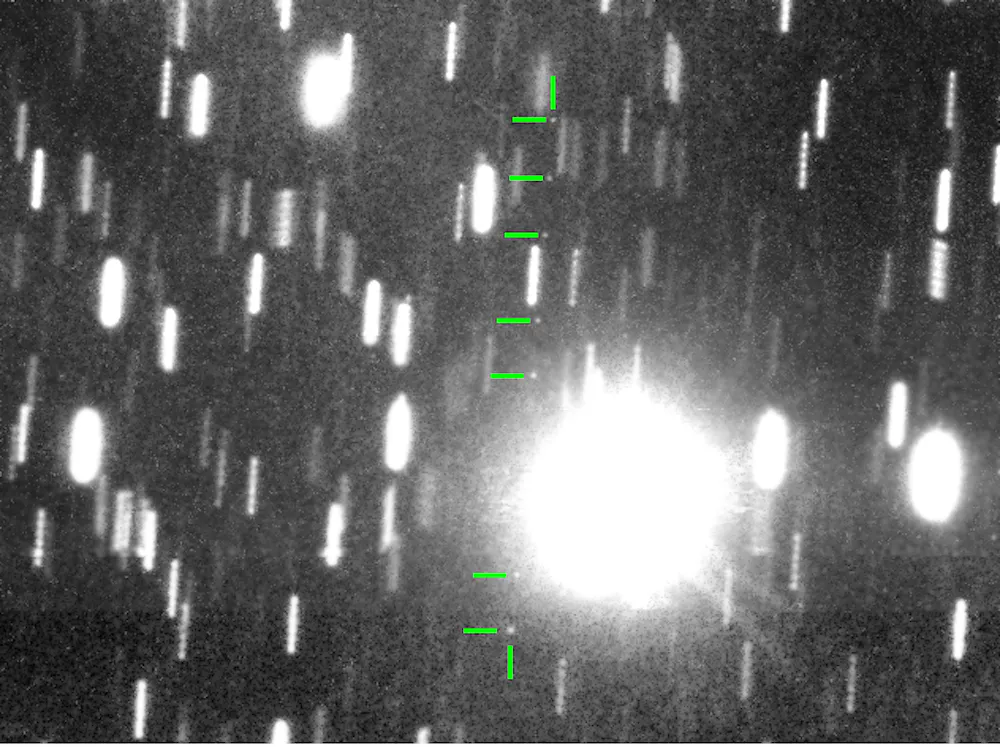
In 2002, amateur astronomer Bill Yeung found what he thought was a second mini-moon: J002E3.
However, on closer inspection the object displayed a spectrum of light suggesting it was coated in white paint containing titanium oxide. Then, a study of how the object’s brightness changed over time found its shape resembled something like the upper stage of a rocket.
Astronomers now believe J002E3 is the third stage of the Apollo Saturn V rocket (S-IVB) instead of a natural mini-moon.
 Images of the false mini-moon J002E3 taken by amateur Bill Yeung on September 3 2002.
Bill Yeung / Bob Denny via Wikipedia, CC BY
Images of the false mini-moon J002E3 taken by amateur Bill Yeung on September 3 2002.
Bill Yeung / Bob Denny via Wikipedia, CC BY
More discoveries – with a note of caution
The plot twist of J002E3 made astronomers a bit more cautious. When another mini-moon (2006 RH₁₂₀) was spotted on September 14 2006, it was first classified as artificial. However, after more observations it turned out to be a natural mini-moon about 2–7 metres in diameter. 2006 RH₁₂₀ stuck around from July 2006 until July 2007.
 Animation of 2006 RH120’s orbit around Earth. The animation runs from April 1 2006 until November 1 2007. Earth is shown in blue, the Moon is shown in yellow and 2006 RH120 is shown in magenta.
Phoenix7777/Wikipedia, CC BY
Animation of 2006 RH120’s orbit around Earth. The animation runs from April 1 2006 until November 1 2007. Earth is shown in blue, the Moon is shown in yellow and 2006 RH120 is shown in magenta.
Phoenix7777/Wikipedia, CC BY
The next mini-moon, 2020 CD₃, was gravitationally captured by Earth for more than two years, making it the longest-captured mini-moon observed to date. It escaped Earth’s orbit in May of 2020. This mini-moon was around 1–2 metres in diameter.
Amateur astronomers Grzegorz Duszanowicz and Jordi Camarasa discovered 2022 NX₁ using the Moonbase South Observatory in Namibia. Similar to 2006 RH₁₂₀, it was initially thought to be an artificial object from a past space mission.
It was later determined to originate from the Arjunas, just like 2024 PT₅. While it was discovered in 2022, it was temporarily captured by Earth’s gravity in January 1981 and June 2022. It’ll be captured again in December 2051.
2022 NX₁ was later found to be a natural mini-moon 5–15 metres in diameter.
Will we find more mini-moons?
Modelling suggests that, at any given time, Earth has at least one captured mini-moon less than 1 metre in diameter.
Even though astronomers think we always have a mini-moon, these bodies are challenging to detect. This is because they’re small and faint. They are usually found by projects specifically looking for asteroids near Earth.
2024 PT₅ was discovered using the Asteroid Terrestrial-impact Last Alert System (ATLAS), which is an ongoing project specifically designed to search for asteroids. 2006 RH₁₂₀ and 2020 CD₃ were discovered using the ongoing Catalina Sky Survey (CSS) for Near Earth Asteroids. 1991 VG was discovered by the SPACEWATCH group using the Spacewatch Telescope.
These projects will continue to search for asteroids, including mini-moons. We can also look forward to new discoveries and investigations when the Vera C. Rubin Observatory’s Legacy Survey of Space and Time (LSST) starts observing in the next couple of years.
This enormous project will take images of the entire sky every few days for a period of ten years. First light of the Vera C. Rubin observatory is expected in mid-2025.
Authors: Laura Nicole Driessen, Postdoctoral researcher in radio astronomy, University of Sydney