

Squid team finds high species diversity off Kermadec Islands, part of stalled marine reserve proposal
- Written by: Kat Bolstad, Senior Lecturer, Auckland University of Technology
Squids and octopuses could be considered the “parrots of the ocean”. Some are smart, and many have complex behaviours. And, of course, they have strange, bird-like beaks.
They are the subject of ancient myths and legends about sea monsters, but they do not live for decades. In fact, their high intelligence and short lifespan represent an unusual paradox.
In our latest research we have discovered several new species that have never been reported from New Zealand waters. Our study almost doubles the known diversity for the Kermadec region, north of New Zealand, which is part of the proposed, but stalled, Kermadec–Rangitāhua ocean sanctuary.
Read more: Why we're watching the giant Australian cuttlefish
More than we bargained for
Collectively, squids and octopuses are known as cephalopods, because their limbs attach directly to their head (cephalus). Our team studies cephalopods in our part of the world - the waters between Antarctica and the most northern reaches of New Zealand, the Kermadec Islands - as well as further afield.
Our first inkling of an impressive regional diversity came as we began to open boxes of frozen cephalopod samples at the National Institute for Water and Atmospheric Research (NIWA). These animals had been collected during a deep-sea survey voyage to the Kermadec Islands to better understand the region’s marine biodiversity. Members of the AUT Lab for Cephalopod Ecology and Systematics (ALCES), also known as the “squid lab”, had come to identify and examine them.
As we gently defrosted each specimen, we marvelled at their perfect suckers, iridescent eyes, and shining light organs. We noticed that many species were rare among New Zealand collections. There were some familiar faces, but also some we had only rarely or never encountered before in our local waters. Some were known from neighbouring regions; others, we suspected, might be entirely new to science.
We examined them, photographed each one, took small samples of muscle tissue for DNA analysis, and preserved them for additional work in the future. Then we set about systematically comparing our observations with what had previously been reported in New Zealand waters. And we were in for a surprise.
Doubling known diversity
Among the 150 cephalopod specimens that were collected, we identified 43 species, including 13 species that had not been previously found anywhere in New Zealand waters. Three entire orders - the taxonomic rank above family, which is the level at which, for example, egg-laying mammals split off from all other living mammals - had not been reported from this region: “Bobtail squids” (sepiolids), “comb-fin squids” (genus Chtenopteryx, order Bathyteuthoidea), and myopsid squids (coastal squids with eyes covered by a cornea).
We extracted DNA and obtained sequences for the species that had been seen for the first time in New Zealand waters. This allows us to compare them with individuals from other regions of the world. These included the strange tubercle-covered “glass” (cranchiid) squid Cranchia scabra, and the little “ram’s horn squid” Spirula spirula.
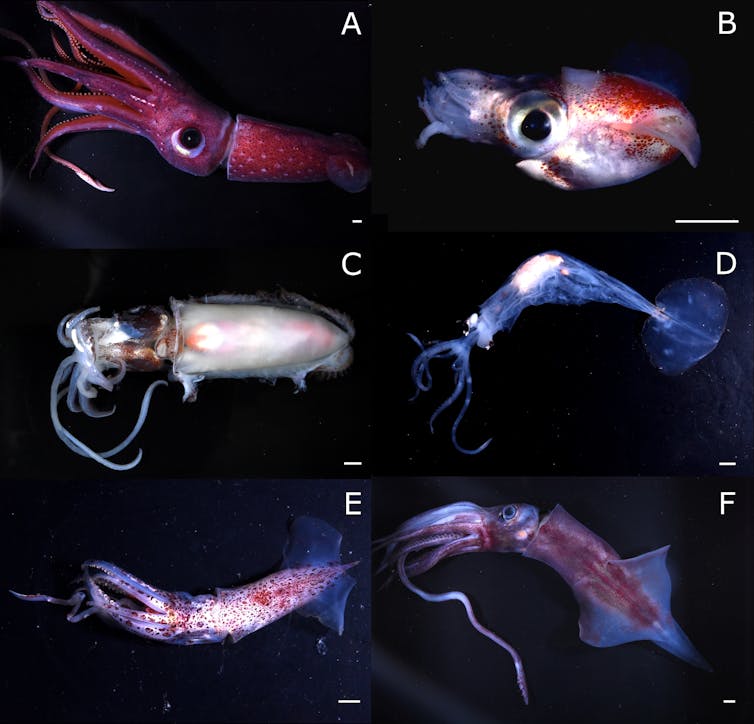 Examples of squid specimens collected recently from the Kermadec Islands Ridge: A) Histioteuthis miranda, B) Heteroteuthis sp. ‘KER’ (likely new to science), C) Chtenopteryx sp. ‘KER1’ (likely new to science), D) Leachia sp. (likely new to science), E) Pyroteuthis serrata, F) Enoploteuthis semilineata. Scale bars: 5mm.
Images by Rob Stewart/Keren Spong, CC BY-ND
Examples of squid specimens collected recently from the Kermadec Islands Ridge: A) Histioteuthis miranda, B) Heteroteuthis sp. ‘KER’ (likely new to science), C) Chtenopteryx sp. ‘KER1’ (likely new to science), D) Leachia sp. (likely new to science), E) Pyroteuthis serrata, F) Enoploteuthis semilineata. Scale bars: 5mm.
Images by Rob Stewart/Keren Spong, CC BY-ND
Five species appear likely new to science, across a number of families with colourful common names such as “strawberry” and “fire” squids (Histioteuthidae and Pyroteuthidae, respectively). These individuals were genetically distinct from all other specimens that had been previously identified and sequenced (by us or others). Their physical appearances will now need to be compared in detail with other similar-looking species in order to fully evaluate their taxonomic status.
In total, 28 of the species we encountered had not previously been reported in the Kermadecs. This brings the total number of species in the region to at least 70. Of these, half are not known to occur elsewhere in New Zealand waters.
Kermadec–Rangitāhua Ocean Sanctuary
The Kermadec Islands, north-north-east of New Zealand, represent a diverse and nearly pristine environment. The region includes (among other habitats) a chain of seamounts and the second-deepest ocean trench in the world.
Currently, the Kermadec Islands region is on a tentative list of UNESCO World Heritage Sites. A small proportion of the area is already protected by an existing marine reserve, which extends 12 nautical miles around each of five islands and pinnacles.
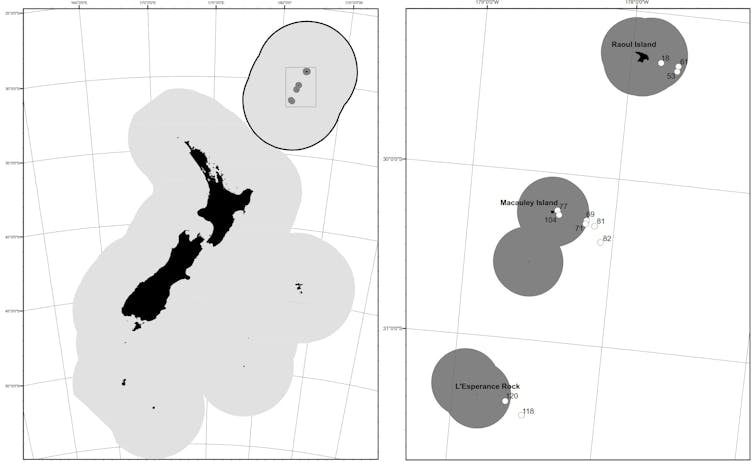 This map shows New Zealand’s Exclusive Economic Zone (EEZ) in light grey, the existing Kermadec Islands marine reserve in dark grey, and the proposed Kermadec–Rangitāhua Ocean Sanctuary outlined in black.
Heather Braid, Kat Bolstad, CC BY-ND
This map shows New Zealand’s Exclusive Economic Zone (EEZ) in light grey, the existing Kermadec Islands marine reserve in dark grey, and the proposed Kermadec–Rangitāhua Ocean Sanctuary outlined in black.
Heather Braid, Kat Bolstad, CC BY-ND
The proposed Kermadec–Rangitāhua Ocean Sanctuary would extend the protection to 200 nautical miles and protect 15% of New Zealand’s ocean environment. It would be among the world’s largest marine protected areas.
Read more: More than 1,200 scientists urge rethink on Australia's marine park plans
We strongly support the establishment of the proposed sanctuary, especially since most of the cephalopod taxa newly reported by this research are deep-sea species whose habitat is not protected by the existing marine reserve.
Although the creation of the sanctuary is supported by most political parties, New Zealand First, which is part of the government coalition, opposes it. So does the fishing industry because fishing would be banned. It is possible that the sanctuary might be created with a lower level of protection than originally proposed (with some fishing still permitted), but the government has reached an impasse.
If the Kermadec–Rangitāhua ocean sanctuary were to be established, it would protect habitats that are used by over half of the known squid and octopus biodiversity in New Zealand waters, including 34 species that have so far only been reported from the Kermadec region.
Authors: Kat Bolstad, Senior Lecturer, Auckland University of Technology


















