What is Plato’s Symposium, the classic book drawn into the Gender Queer culture wars?
- Written by Matthew Sharpe, Associate Professor in Philosophy, Australian Catholic University
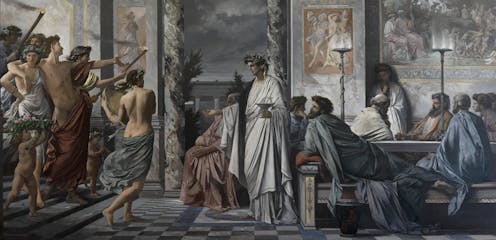
It was probably inevitable, but is deeply sad, that Plato’s Symposium (circa 380 BCE), has been drawn into the culture wars. A dialogue of great complexity and elegance, the book is one of the principal sources of the Greek philosopher’s views on love and beauty.
There are also darker political undertones of the decline of Athenian democracy, surrounding the character of Alcibiades who crashes the drinking party the book depicts. There is a lot going on in The Symposium, and a lot we can learn from.
An illustration of a sexual fantasy inspired by The Symposium features in Maia Kobabe’s graphic-novel memoir Gender Queer. This week, the federal court ordered the Australian classification review board to review its assessment of Gender Queer, finding it had ignored, overlooked or misunderstood public submissions for the book to be censored.
Rightwing activist Bernard Gaynor had applied to the board to review the classification of the book. Gaynor’s barrister, Bret Walker SC, argued in court there had been a “broadbrush dismissal” of submissions the board claimed were anti-LGBTQ+ when many submissions objected to what they saw as “paedophilic” depictions of a man having sex with a minor – an image portraying Plato’s Symposium.
Plato’s work comes from a different culture to our own. This was a culture in which, at least among aristocratic males, there were norms around sexual morality that are not our own.
In this context, as Michel Foucault has shown in The History of Sexuality, there were norms surrounding same-sex relationships between elder and younger men that many contemporaries will find deeply morally problematic. But this does not detract from the book’s importance, nor does it exhaust the work’s content.
Far from it.
Love, beauty, and Plato
The Symposium, as its title reflects, is a dialogue between seven leading figures in Athens, set in the controversial year 416 BCE. This was the year in which Athens, spurred on by the charismatic, hawkish demagogue, Alcibiades, sent its navy fatefully to invade the Italian city of Syracuse.

 Plato, copy of a portrait made by Silanion circa 370 BC.
Wikimedia Commons
Alcibiades, who has lived a life of popular adulation and sexual promiscuity, launches into a speech describing his attempts to seduce Socrates, the ugly, old philosopher. For Socrates is the only man or woman who has ever said “no” to his advances, even, once, when Alcibiades was sleeping right beside him.
This knock back drives Alcibiades crazy. And yet, it impresses him. Socrates is ugly on the outside, he says. Yet, inside his soul, for those who love him, there are secret treasures, (agalmata in the Greek). And he would do anything to possess such hidden beauties.
This is a text rich in images, comedy, and deep insights into the human experience. Yes, Plato’s characters accept the norms of that time surrounding homosexual love. The opening speech, by Phaedrus (a character who comes up in another dialogue on love), celebrates the power of such love, for instance in armies, wherein men will fight more vigorously to protect their beloved. (In Greek culture, the manly Achilles’ love for Patrocles, which is such a theme in Homer’s Iliad, was considered exemplary.)
The second speaker, the rather sleazy Pausanius, makes a case more directly for the nobility of sexual love affairs between older men and young, beautiful adolescent males. In what is arguably special pleading, Pausanius tells the group that
the older man brings to the match his wisdom and his virtue, while the younger nobly seeks to acquire these with a view to his better education.
We don’t need to be convinced. But this is the second speech of seven, and hardly Plato’s final word on love. As shown by the dialogue of Phaedrus, Plato is clearly interested in the elevating capacities of romantic love: the ways that, whether same-sex or heterosexual, it can inspire and elevate people.
In such a view, notably, he is something of an exception among the ancient philosophers, most of whom are decidedly more suspicious about the tendency of romantic love to get people to lose their heads.
For Plato, when human beings fall in love, they can be moved outside of their own egoism, if only to serve their beloved, and then the children the union can bring.
The connection of even sexual love with our responsiveness to beauty shows for Platonists that we are not just animals, without a spiritual dimension. Even the lowliest person is still moved by beauty, and can be inspired by its pursuit to improve themselves.
A different moral message
The big message of the dialogue then is not lasciviousness. When Socrates knocks back Alcibiades’ attempt to seduce him physically, he tells him he would nevertheless be happy to meet with him, to continue discussing virtue and how he can become a better person.
Alcibiades has no interest in this, instead turning from trying to conquer Socrates to trying to conquer the known world. As some readers will know, he soon enough defects to Sparta, seduces its queen and betrays his home city, before defecting to Persia, as related by Thucydides and Xenophon.
If moralists want to find a message in The Symposium, it might be this. The person who can conceive no greater love than them self and their own beauty, is no friend to ordinary standards of civics, or, indeed, good and evil.
Authors: Matthew Sharpe, Associate Professor in Philosophy, Australian Catholic University
Plato, copy of a portrait made by Silanion circa 370 BC.
Wikimedia Commons
Alcibiades, who has lived a life of popular adulation and sexual promiscuity, launches into a speech describing his attempts to seduce Socrates, the ugly, old philosopher. For Socrates is the only man or woman who has ever said “no” to his advances, even, once, when Alcibiades was sleeping right beside him.
This knock back drives Alcibiades crazy. And yet, it impresses him. Socrates is ugly on the outside, he says. Yet, inside his soul, for those who love him, there are secret treasures, (agalmata in the Greek). And he would do anything to possess such hidden beauties.
This is a text rich in images, comedy, and deep insights into the human experience. Yes, Plato’s characters accept the norms of that time surrounding homosexual love. The opening speech, by Phaedrus (a character who comes up in another dialogue on love), celebrates the power of such love, for instance in armies, wherein men will fight more vigorously to protect their beloved. (In Greek culture, the manly Achilles’ love for Patrocles, which is such a theme in Homer’s Iliad, was considered exemplary.)
The second speaker, the rather sleazy Pausanius, makes a case more directly for the nobility of sexual love affairs between older men and young, beautiful adolescent males. In what is arguably special pleading, Pausanius tells the group that
the older man brings to the match his wisdom and his virtue, while the younger nobly seeks to acquire these with a view to his better education.
We don’t need to be convinced. But this is the second speech of seven, and hardly Plato’s final word on love. As shown by the dialogue of Phaedrus, Plato is clearly interested in the elevating capacities of romantic love: the ways that, whether same-sex or heterosexual, it can inspire and elevate people.
In such a view, notably, he is something of an exception among the ancient philosophers, most of whom are decidedly more suspicious about the tendency of romantic love to get people to lose their heads.
For Plato, when human beings fall in love, they can be moved outside of their own egoism, if only to serve their beloved, and then the children the union can bring.
The connection of even sexual love with our responsiveness to beauty shows for Platonists that we are not just animals, without a spiritual dimension. Even the lowliest person is still moved by beauty, and can be inspired by its pursuit to improve themselves.
A different moral message
The big message of the dialogue then is not lasciviousness. When Socrates knocks back Alcibiades’ attempt to seduce him physically, he tells him he would nevertheless be happy to meet with him, to continue discussing virtue and how he can become a better person.
Alcibiades has no interest in this, instead turning from trying to conquer Socrates to trying to conquer the known world. As some readers will know, he soon enough defects to Sparta, seduces its queen and betrays his home city, before defecting to Persia, as related by Thucydides and Xenophon.
If moralists want to find a message in The Symposium, it might be this. The person who can conceive no greater love than them self and their own beauty, is no friend to ordinary standards of civics, or, indeed, good and evil.
Authors: Matthew Sharpe, Associate Professor in Philosophy, Australian Catholic University