

here’s how Ancient Greeks and Romans grappled with environmental damage
- Written by Konstantine Panegyres, McKenzie Postdoctoral Fellow, researching Greco-Roman antiquity, The University of Melbourne
Today the perilous state of the environment is often in the news. Many stories describe how Earth is being damaged by human beings and discuss ways to prevent this.
These concerns are not new. Millennia ago, people in ancient Greece and Rome already knew humans were damaging the natural world. Literature from these ancient times contains many references to the environment and the harms it suffers.
Many of these insights ring true today. Polluting the soil we farm, air we breathe and water we drink has clear repercussions. We can only degrade the environment for so long before it will come back to haunt us.
So let’s explore what the ancient Greeks and Romans can teach us about nature and our place in the world.
An agent of destruction
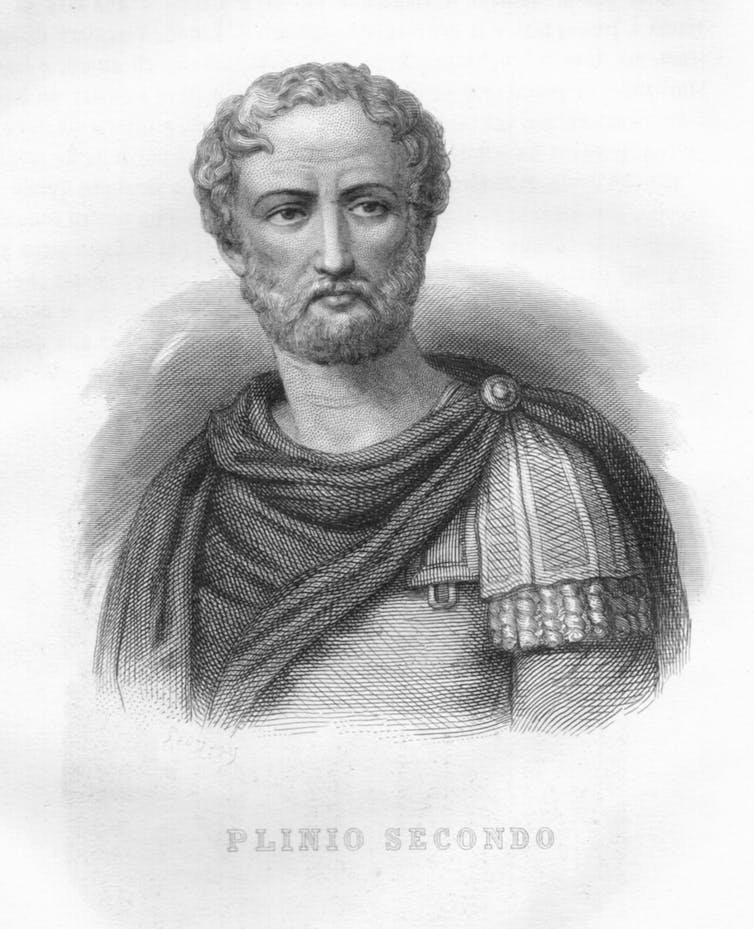
The ancient Roman writer Pliny the Elder, who lived in the first century AD, was concerned about the way human beings were abusing Earth. In his work titled Natural History, he wrote:
We taint the rivers and the elements of nature, and the air itself, which is the main support of life, we turn into a medium for the destruction of life.
He thought of the planet as something humanity ought to protect rather than harm, because we owe our existence to mother Earth:
It is my pleasant duty first of all to champion Earth’s cause and to support her as the parent of all things.
Two millennia later, Pliny’s words seem directly relevant to us.
In the modern world, concerns about the health of the environment have become one of the hottest political topics.
For example, a survey last year of almost 20,000 young people in Australia showed 44% think the environment is the most important issue of our time.

A growing understanding
Roman writers noted their soldiers eventually poisoned the water and the air around their camps. The military writer Flavius Renatus Vegetius, who lived around the fourth and fifth centuries AD, observed:
if a numerous army continues long in one place in the summer or in the autumn, the waters become corrupt, and the air infected, from whence proceed malignant and fatal distempers, which nothing but frequent change of encampments can prevent.
Roman writers also had a lot to say about the pollution of the river Tiber, which runs through Rome.
The biographer Suetonius, who was born around 70AD, tells us the river had been “filled with rubbish and narrowed by jutting buildings” before emperor Augustus (63BC-14AD) took action to clean it up.
Bad policies had polluted the river’s waters. For example, the emperor Nero (37–68AD) dumped huge amounts of rotten grain into the river.
The Roman poet Juvenal (of the first and second centuries AD) referred to the Tiber as a “gushing sewer”. And the physician Galen (129–216AD) said the Tiber was so polluted that fish caught there were not safe to eat.
Measures to protect the environment
The Greeks and Romans introduced various measures to prevent or reduce environmental harm.
In 420BC, for example, the Athenians introduced a law to protect the river Ilissus:
It is forbidden to soak the coats [of animals] in the Ilissus above the sanctuary of Heracles and to tan them. It is forbidden to throw the residue of the laundering into the river.
Modern researchers think this measure might have helped the Ilissus stay clean. That’s because authors writing in the fourth century BC (after the law was introduced) describe the Ilissus as a pure and beautiful river.
 The Ilissus river was a picture of health in the 19th century.
Edward Dodwell, Wikimedia Commons
The Ilissus river was a picture of health in the 19th century.
Edward Dodwell, Wikimedia Commons
Other measures to reduce pollution included banning public defecation and urination. Bans on washing clothes or throwing rubbish into rivers were also common. But it’s unlikely the public adhered to these restrictions all the time.
Some rulers also tried to do public works such as building sewers and aqueducts to clean up pollution.
For example, the emperor Nerva, who ruled 96–98AD, undertook a series of construction projects to make Rome cleaner and healthier.
Sextus Julius Frontinus (35–103AD), manager of Rome’s aqueducts, tells us that thanks to Nerva:
the appearance of the city is clean and altered; the air is purer; and the causes of the unwholesome atmosphere, which gave the air of the city so bad a name in former times, are now removed.
Damaging the environment harms our health
Sometime in the late first or early second century AD, the Roman aristocrat and lawyer Pliny the Younger (61/62–112AD) wrote a letter to the emperor Trajan, who ruled 98–117AD. He complained about a public health issue in the city of Amastris, in modern Turkey:
Among the chief features of Amastris, Sir, is a long street of great beauty. Throughout the length of this, however, there runs what is called a stream, but is in fact a filthy sewer, a disgusting eyesore which gives off a noxious stench. The health and appearance alike of the city will benefit if it is covered in, and with your permission this shall be done.
The emperor replied that he was happy for this to be done:
There is every reason, my dear Pliny, to cover the water which you say flows through the city of Amastris, if it is a danger to health while it remains uncovered.
This story shows the ancients were aware that the health of the land, air and water is intertwined with human health. So when the environment is in an unhealthy state, this is also damaging for our health and wellbeing.
The modern world can learn from antiquity
The message from the ancient Greeks and Romans is as true today for us as it was for them. As humanity grapples with multiple environmental crises, it’s worth reflecting on this age-old knowledge.
The bottom line is, keeping the planet in a healthy state is good not just for the environment, but also for ourselves.
In a modern world where stories about pollution and related environmental problems frequently appear in the news, this message of the ancients is well worth remembering.
Authors: Konstantine Panegyres, McKenzie Postdoctoral Fellow, researching Greco-Roman antiquity, The University of Melbourne



















.jpg)