1 in 5 Australians admit they don’t wash their hands every time they use the toilet
- Written by Christine Carson, Senior Research Fellow, School of Medicine, The University of Western Australia
Do you wash your hands every time you use the toilet? How about before you handle food? Be honest.
Australia’s Food Safety Information Council has released its latest report card on the country’s hand washing habits. It found 19% of Australians don’t wash their hands every time they use the toilet. Close to half (42%) admit they don’t always wash hands before handling food.
So who’s doing well when it comes to hand hygiene, who’s not – and why does it matter?
What did the report find?
The new report surveyed hand washing practices of 1,229 people. Results were consistent with what we’ve learned from similar surveys.
Once again, women do better than men at washing their hands after using the toilet, although only slightly (80% of men say they do every time, versus 83% of women). Just 55% of men wash their hands before touching food, compared to 62% of women.
Age also seemed to make a difference. Under 34 years old, 69% of people washed their hands every time they used the toilet. Over age 65, that jumped to 86%.
Although some of these differences aren’t completely unexpected – such as the gap between men’s and women’s hand washing habits – the reasons remain unclear.
Why don’t people wash their hands?
Public health messaging often focuses on how to wash hands well. But there’s less research that follows up on how widely people actually adopt these practices. And to understand why – if they are skipping the soap and water – those messages might not be getting through effectively.
One study that looked at this question in India asked school children about barriers to hand washing. The vast majority (91%) had low “illness threat perception”. In other words, they simply didn’t perceive a risk of getting sick form not washing their hands after going to the toilet.
Interestingly, the inability to see germs with their own eyes was one of the biggest barriers, cited by 46% of the children. But 72% said they would wash their hands if their friends did.
It’s tempting to speculate these reasons may also apply to other age groups, but we simply haven’t done enough research to know. People’s reasons for hand washing, or not, likely vary across their lifetime and with their circumstances.
What are the risks?
Urine and faeces contain millions of germs, especially faeces, which has more than 100 billion germs per gram.
When you use the toilet and touch surfaces in the bathroom, you will pick up germs. People who skip the hand washing step on the way out take those germs with them when they leave, depositing them on each surface they touch afterwards.
You may not get sick yourself, but you’re increasing the spread of bacteria. This can increase the risk of infection and illness for other people, including those with compromised immune systems such as older people and those undergoing common forms of treatment for cancer.
Hand washing before cooking and eating is also important. The risk here goes both ways. If you have disease-causing germs on your hands (maybe because you didn’t wash them after the toilet) you may transfer them to the food where they can multiply and even produce toxins. People who eat the food may then get sick, often involving vomiting and diarrhoea.
In the other direction, some foods naturally carry germs before cooking – such as salmonella and campylobacter bacteria in raw poultry. If you don’t wash your hands after handling these foods you may transfer them to other surfaces and risk spreading infection.
How should I wash my hands?
Follow these three simple tips for hand washing correctly:
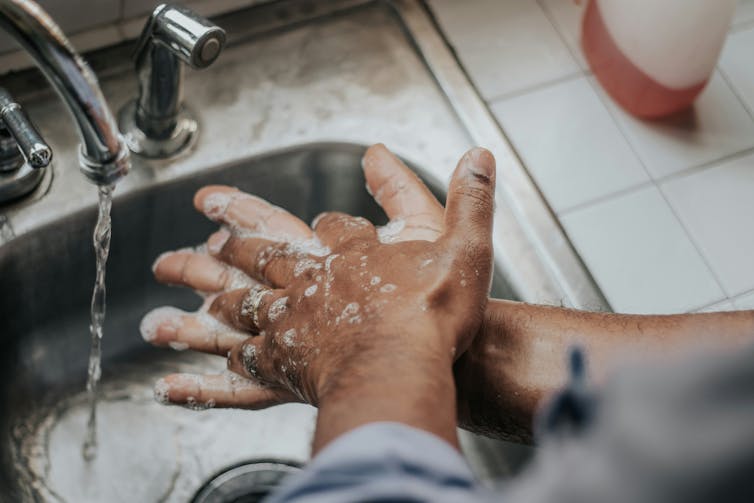
wet your hands and rub them together well to build up a good lather with soap for at least 20 seconds and don’t forget to wash between your fingers and under your nails. You might have to use a nail brush
rinse well under running water to remove the bugs from your hands
dry your hands thoroughly on a clean towel for at least 20 seconds. Touching surfaces with moist hands encourages bugs to spread from the surface to your hands.
What about hand sanitiser?
If no running water is available, use an alcohol-based hand sanitiser. These rapidly inactivate a wide range of germs, rendering them non-infectious. Hand sanitisers are effective against a wide range of bacteria and viruses that can cause many common gastrointesintal and respiratory infections.
However if your hands are soiled with organic matter – such as blood, faeces, meat, sand or soil – they won’t be effective. In that case you should clean your hands with soap and water.
The bottom line
Hand washing is a bit like wearing a seat belt — you do that every time you get in a car, not just on the days you “plan” to be involved in an accident. The bottom line is hand washing is a simple, quick intervention that benefits you and those around you — but only if you do it.
Authors: Christine Carson, Senior Research Fellow, School of Medicine, The University of Western Australia