How light helped shape our skin colour, eyes and curly hair
- Written by Mike Lee, Professor in Evolutionary Biology (jointly appointed with South Australian Museum), Flinders University
Welcome to our ‘Light and health’ series. Over six articles, we look at how light affects our physical and mental health in sometimes surprising ways.
For most of our evolutionary history, human activity has been linked to daylight. Technology has liberated us from these ancient sleep-wake cycles, but there is evidence sunlight has left and continues to leave its mark.
Not only do we still tend to be awake in the daytime and sleep at night, we can thank light for many other aspects of our biology.
Light may have driven our ancestors to walk upright on two legs. Light helps explain the evolution of our skin colour, why some of us have curly hair, and even the size of our eyes.
As we’ll explore in future articles in this series, light helps shape our mood, our immune system, how our gut works, and much more. Light can make us sick, tell us why we’re sick, then treat us.
Million of years of evolutionary history means humans are still very much creatures of the light.
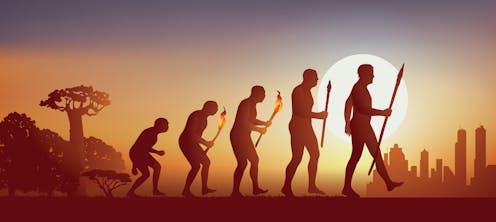
We stood up, then walked out of Africa
The first modern humans evolved in warm African climates. And reducing exposure to the harsh sunlight is one explanation for why humans began to walk upright on two legs. When we stand up and the Sun is directly overhead, far less sunshine hits our body.
Curly hair may have also protected us from the hot Sun. The idea is that it provides a thicker layer of insulation than straight hair to shield the scalp.
Early Homo sapiens had extra Sun protection in the form of strongly pigmented skin. Sunlight breaks down folate (vitamin B9), accelerates ageing and damages DNA. In our bright ancestral climates, dark skin protected against this. But this dark skin still admitted enough UV light to stimulate vital production of vitamin D.
However, when people colonised temperate zones, with weaker light, they repeatedly evolved lighter skin, via different genes in different populations. This happened rapidly, probably within the past 40,000 years.
With reduced UV radiation nearer the poles, less pigmentation was needed to protect sunlight from breaking down our folate. A lighter complexion also let in more of the scarce light so the body could make vitamin D. But there was one big drawback: less pigmentation meant less protection against Sun damage.
How our skin pigmentation adapted with migration patterns and changing light.This evolutionary background contributes to Australia having among the highest rates of skin cancer in the world.
Our colonial history means more than 50% of Australians are of Anglo-Celtic descent, with light skin, transplanted into a high-UV environment. Little wonder we’re described as “a sunburnt country”.
Sunlight has also contributed to variation in human eyes. Humans from high latitudes have less protective pigment in their irises. They also have larger eye sockets (and presumably eyeballs), maybe to admit more precious light.
Again, these features make Australians of European descent especially vulnerable to our harsh light. So it’s no surprise Australia has unusually high rates of eye cancers.
We cannot shake our body clock
Our circadian rhythm – the wake-sleep cycle driven by our brains and hormones – is another piece of heavy evolutionary baggage triggered by light.
Humans are adapted to daylight. In bright light, humans can see well and have refined colour vision. But we see poorly in dim light, and we lack senses such as sharp hearing or acute smell, to make up for it.
Our nearest relatives (chimps, gorillas and orangutans) are also active during daylight and sleep at night, reinforcing the view that the earliest humans had similar diurnal behaviours.
This lifestyle likely stretches further back into our evolutionary history, before the great apes, to the very dawn of primates.
The earliest mammals were generally nocturnal, using their small size and the cover of darkness to hide from dinosaurs. However, the meteorite impact that wiped out these fearsome reptiles allowed some mammalian survivors, notably primates, to evolve largely diurnal lifestyles.
If we inherited our daylight activity pattern directly from these early primates, then this rhythm would have been part of our lineage’s evolutionary history for nearly 66 million years.
This explains why our 24-hour clock is very difficult to shake; it’s so deeply ingrained in our evolutionary history.
Successive improvements in lighting technology have increasingly liberated us from dependence on daylight: fire, candles, oil and gas lamps, and finally electric lighting. So we can theoretically work and play at any time.
However, our cognitive and physical performance deteriorates when our intrinsic daily cycles are disturbed, for instance through sleep deprivation, shift work or jet lag.
Futurists have already considered the circadian rhythms required for life on Mars. Luckily, a day on Mars is around 24.7 hours, so similar to our own. This slight difference should be the least of the worries for the first intrepid martian colonists.

Light is still changing us
In the past 200 years or so, artificial lighting has helped to (partly) decouple us from our ancestral circadian rhythms. But in recent decades, this has come at a cost to our eyesight.
Many genes associated with short-sightedness (myopia) have become more common in just 25 years, a striking example of rapid evolutionary change in the human gene pool.
And if you have some genetic predisposition to myopia, reduced exposure to natural light (and spending more time in artificial light) makes it more likely. These noticeable changes have occurred within many people’s lifetimes.
Light will no doubt continue to shape our biology over the coming millennia, but those longer-term effects might be difficult to predict.
Authors: Mike Lee, Professor in Evolutionary Biology (jointly appointed with South Australian Museum), Flinders University
Read more https://theconversation.com/how-light-helped-shape-our-skin-colour-eyes-and-curly-hair-237240