a problematic history of obsessing over royal women’s looks
- Written by Darius von Guttner Sporzynski, Historian, Australian Catholic University
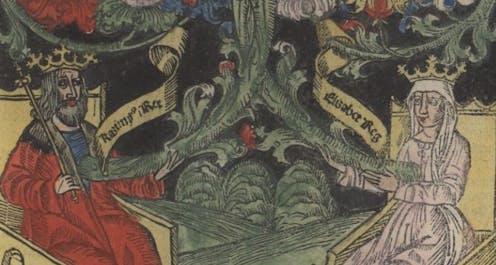
Throughout history, queens have often been judged on their looks. Beauty standards shaped early-modern queenship. Even today, royal women such as the UK royal family’s Camilla, Catherine and Meghan are scrutinised for their looks, while their male counterparts aren’t held to the same standard.
One woman who faced particular scrutiny for her looks was Elizabeth of Austria (1436/37–1505). Known as the “mother of kings”, Elizabeth married Casimir IV of Poland and had 13 children, securing the Jagiellon dynasty’s future. Yet she is still remembered for her supposed lack of beauty.
This obsession with her appearance overlooks what really mattered for queens in her time: fertility, motherhood, political alliances and dynastic stability.
Beauty versus duty
Elizabeth was a powerful queen consort of Poland who played a significant role in European politics. Yet for centuries, she has been chiefly labelled as unattractive. This narrative likely began as early as 50 years after her death, with commentators focusing on her supposed ugliness.
But the foundation for these claims is shaky, at best. Medieval chroniclers, such as Jan Długosz, who documented the lives of Polish rulers and their families, made no mention of Elizabeth’s appearance.
This omission is significant as Długosz often commented on the beauty, or lack thereof, of other royal women. The absence of such remarks in Elizabeth’s case suggests her physical appearance was not a matter of public concern during her lifetime.
Later chroniclers such as Maciej of Miechów (1457–1523) and Marcin Bielski (1495–1575), who drew heavily from Długosz, also failed to comment on Elizabeth’s looks, further underscoring the lack of focus on her beauty.
In 1548, Polish nobleman Andrzej Górka alleged in a rhetorical speech that King Casimir IV was disappointed by Elizabeth’s appearance and considered breaking off their engagement. Górka claimed the king expressed doubts about the impending marriage because of Elizabeth’s lack of beauty – and the only thing that persuaded him to wed was a sense of duty.
However, Górka’s speech took place almost a century after the actual events. It was delivered in a political context where the goal was to influence Casimir’s grandson not to marry for love.
This saga mirrors a well-known English story involving Henry VIII and Anne of Cleves. In 1540, Henry, eager to meet his new bride, rode in disguise to surprise her. The meeting didn’t go as planned. Henry’s disappointment in Anne’s appearance became notorious and the marriage was speedily annulled.
Both of these stories reflect the pressure queens faced to meet idealistic beauty standards, often with serious consequences. Henry’s judgement of Anne based on her looks altered the course of their marriage and, by extension, future political alliances. His behaviour reinforced the idea that a queen’s worth was tied to her physical appearance, overshadowing her political or dynastic significance.
Elizabeth as the ‘ugly queen’
The primary role of a queen in early-modern Europe was to provide heirs and secure political alliances through marriage. Beauty was arguably not the most important factor.

Elizabeth of Austria’s marriage to Casimir IV of Poland was about strengthening ties between the Habsburg and Jagiellon dynasties, not about physical attraction. Of Elizabeth’s 13 children, several went on to become kings and queens across Europe. Her ancestry and status as a mother were the basis of her political influence – far more valuable than her looks.
Around 1502, in anticipation of the birth of her grandchild, Elizabeth commissioned a treatise to provide practical advice on raising a future ruler. She believed a royal child should embody values, attitudes and behaviours befitting a future monarch.
However, as history shows, the perception of a queen’s beauty could still end up influencing her legacy. While Elizabeth’s contemporaries didn’t seem to care about her appearance, later generations did.
The myth of Elizabeth’s unattractiveness gained traction primarily after a 1973 investigation into the royal tombs at the Wawel Cathedral in Kraków. Skeletal remains identified as belonging to Elizabeth showed facial deformities, reinforcing the myth. However, there’s no solid proof these bones were even hers, and the findings have since been questioned.
Nonetheless, the idea that a queen had to be beautiful to be politically capable took hold over time. Even though Elizabeth helped secure the future of one of Europe’s most powerful dynasties, her legacy is clouded by a narrative focused on her appearance.
Royal beauty standards today
Royal women in the 21st century continue to be haunted by the same narratives that plagued Anne of Cleves and Elizabeth of Austria. Queen Camilla, for instance, has been criticised for her looks throughout her public life, especially in comparison to the late Princess Diana.
Kate Middleton and Meghan Markle also face intense media scrutiny over their appearance, with headlines dissecting everything from their fashion choices to their weight. Queen Mary of Denmark, Princess Charlene of Monaco and Queen Letizia of Spain face similar scrutiny.
Sure, queens were and are aware of this. Many even weaponised beauty, ritual and fashion for their own gain. Cleopatra did this to hold onto power in ancient Egypt, and Marie Antoinette to protect herself from the hostile French court.
 Marie Antoinette, with her extravagant dresses, became as renowned for her fashion as her scandalous behaviour.
British Museum, CC BY-NC-SA
Marie Antoinette, with her extravagant dresses, became as renowned for her fashion as her scandalous behaviour.
British Museum, CC BY-NC-SA
Elizabeth I’s reign in England gave rise to a concept of “Elizabethan beauty”, characterised by pale skin and rosy lips and cheeks. And the late Elizabeth II understood the need to dress the part.
By reducing royal women to their looks – or framing them as fashion icons – we fail to reckon with their individual characters and influence in the world. Meanwhile, men such as King Charles, King Frederick of Denmark and King Felipe of Spain are more likely to be judged by their virility, actions and policies.
Should beauty really matter when it comes to royal women? Shouldn’t we be more interested in their contributions to history, politics and society?
It’s time to shift the conversation away from appearance and focus on what matters: the impact these women have on the world. Like their male counterparts, they are crucial figures in shaping history and politics, so we ought to think carefully about how we judge them.
Authors: Darius von Guttner Sporzynski, Historian, Australian Catholic University