

Three weeks of early voting has a significant effect on democracy. Here's why
- Written by Stephen Mills, Hon Senior Lecturer, School of Social and Political Sciences, University of Sydney
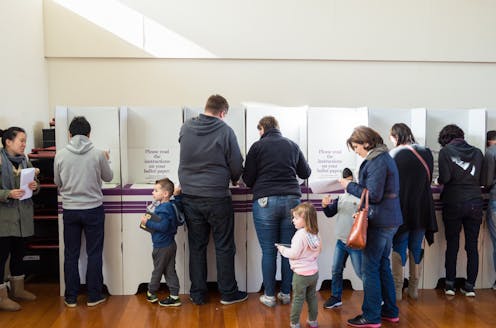
Australians’ enthusiastic uptake of early voting is changing the traditional election campaign in largely unexpected ways. Candidates are spending less time campaigning in the community and more time at pre-polling stations. Parties are announcing their more attractive promises earlier. Party volunteers are being exhausted by long weekday shifts on the hustings. And many voters are casting their votes with incomplete knowledge.
Starting today, hundreds of pre-poll voting centres will open in every electorate around the country for the federal election. They’ll operate on weekdays for the first week, weekdays and Saturday in the second week, and weekdays in the third week running up to May 18. So this federal election will have, in effect, 17 election days – on 16 of those, the campaign will still be in full swing.
There has been little consideration of the implications of allowing voting to run concurrently with campaigning. Our research suggests it is causing substantial changes to the structure and content of campaigning.
Why do we have early voting?
Voters, it seems, like the convenience of early voting and the flexibility of fitting it in around work, travel, family and other commitments. And the queues, theoretically at least, will be shorter.
At the same time, election administrators feel obliged, given compulsory voting, to make it as easy as possible for voters to do their duty. This logic seems unassailable. Tasked with the enormous project of running an election smoothly and accurately, election officials also like how early voting spreads their workload over a longer period.
But after interviewing party officials and candidates about their experience of early voting in the 2017 Western Australian state election and New South Wales byelections, it became clear to us that those actually running for office have a much more nuanced view of this voting innovation.
On one hand, they accept the democratic desirability of early voting. They see, too, that it can make campaigning more efficient. As one Greens party official put it:
The voters come to you, rather than you coming to the voters.
As a result, many candidates now stand at pre-poll centres for the entire period, meeting voters, hoping to impress them in the final moments before they vote. This means they are spending less time in the community, meeting commuters and shoppers and doorknocking residents in their homes.
But there are too many pre-polling centres, and too many voters, for candidates to do the job alone. Parties need an army of volunteers to press how-to-vote cards into the hands of early voters. This in turn requires, in the words of the same Greens official, a “massive logistical operation” involving “a huge volunteering engagement and coordination effort”. Officials and candidates from Labor, Liberals and Nationals agreed with this analysis.
Extending the voting period stretches everyone. The traditional election-day effort has been upgraded to a sustained process of recruitment, mobilisation and training of volunteers who are rostered on to as many shifts as they can offer.
Who benefits most from early voting?
Early voting is not a level playing field. Recruiting and organising volunteers for three weeks is more of a challenge for smaller parties and independents than for the major parties. Larger parties with the luxury of enthusiastic volunteers can use early voting as a means of keeping them engaged for longer. Likewise, incumbent MPs are more available to stand at pre-poll centres all day than, say, a minor party candidate with a job and other non-campaign commitments.
Our research also revealed other important campaign changes. Early voting means early policy announcements. Parties, we were told, all want to “get our policies out” before pre-polling starts. In WA (and in the more recent NSW state election), both the Liberals and Labor held their policy launches on the Sunday before early voting opened.
Fine. But parties still hold back on providing the nitty-gritty of costings until late in the campaign. This may amount to releasing unpopular revenue measures in the final days of campaigning, and then claiming a mandate for them if they win. So early voters almost certainly cast their vote with incomplete knowledge of what the parties and candidates are offering. Gaffes and scandals late in the campaign may also become less electorally damaging.
And there are no democracy sausages at the pre-poll centres; early voting is less a celebration of democracy than a queue-avoiding chore.
In previous federal elections, pre-polling has run for nearly three weeks. In NSW and Victorian state elections, there are just two weeks of pre-polling. In WA, there were three full weeks.
How much time is enough to promote electoral participation without exhausting the parties and subverting the very concept of a campaign? Is 17 election days too many?
Our respondents in WA all felt three weeks was too long. Submissions to the federal parliamentary committee reviewing the 2016 federal election expressed similar views. Voices for Indi – the campaign organisation behind independent Cathy McGowan – suggested one week would be enough.
On the other hand, Unions NSW – whose members have become prominent campaigners in recent election campaigns, especially on industrial relations – argued in its submission that pre-polling plays a crucial role in breaking down barriers to electoral participation by shift and weekend workers and those with a disability. It argued that proposals to “remove or limit” pre-polling could be motivated by political parties “more concerned with their ability to staff pre-poll booths than the accessibility of the electoral system for all voters”.
The committee recommended pre-polling be “restricted” to no more than two weeks.
But the Coalition government rejected that recommendation. It took the side of the union movement rather than the political parties when it legislated late last year for a three-week period for pre-polling.
This means that, for the time being at least, candidates and campaign volunteers will spend long hours trying to buttonhole those who choose to vote before election day. Let’s hope someone buys them a democracy sausage or two along the way.
Authors: Stephen Mills, Hon Senior Lecturer, School of Social and Political Sciences, University of Sydney

















