

Vale Les Murray, a witty, anti-authoritarian, national poet who spoke to the world
- Written by David McCooey, Professor of Writing and Literature, Deakin University
The death of the Australian poet Les Murray at the age of 80 is a profound loss for his family and friends. It is also a great loss for literature. Whether one writes “world literature” or “Australian literature” here signifies not only Murray’s standing, but also a profound tension in his status as a poet. Murray has long been seen, not only as Australia’s pre-eminent living poet, but also as its national poet.
Often referred to as the “Bard of Bunyah” — after the property in New South Wales on which he grew up, and to which he returned in adulthood — Murray was often seen as an unofficial Australian poet laureate (though he repeatedly said he was not interested in such a role).
He was the poet that John Howard turned to when, as prime minister, Howard wanted help with drafting a preamble to the Australian constitution. (The preamble was, along with a proposed Australian republic, sunk at the 1999 referendum.)
Murray was the poet of the rural poor, and many of his poems deal with Australian life beyond the metropolitan centres, as well as with Australian history.
But he was, especially since the 1990s, lauded as a global poet; routinely name-checked with figures such as the Saint Lucian Derek Walcott and the Irish poet Seamus Heaney. Indeed, Murray was touted for a time for the Nobel Prize, which Heaney won in 1995. And just as Murray’s poetry can be seen as “intensely Australian”, it can also be seen as “intensely transnational”, concerned with global histories, languages, and cultures.
Perhaps not surprisingly then, as a supposedly “national poet”, Murray is no Banjo Paterson. He was not an easy poet. His signature style was a potent mix of ordinary language, specialist vocabulary, and eccentric syntax. His poetry cannot be mistaken for anyone else’s.
It is something of a critical cliché to say that poetry makes us see things anew, but Murray’s really did that with its extraordinary linguistic power. This was the case particularly with his representation of the animal world, as seen in the sequence of poems entitled “Presence” from Translations from the Natural World (1992). Who else has described cows as Murray does in The Cows on Killing Day?
All me are standing on feed. The sky is shining.
All me have just been milked. Teats all tingling still
from that dry toothless sucking by the chilly mouths
that gasp loudly in in in, and never breathes out.
And what about this description of an Emu in Second Essay on Interest: The Emu? “Weathered blond as a grass tree, a huge Beatles haircut / raises an alert periscope and stares out / over scrub”.
Certainly, his poems also deal with the “big subjects”: death, nation, religion (Murray was a Catholic convert), family, and poetry itself. Many of his best poems are about such topics. We see this in his extraordinary elegy for his father, The Last Hellos, and in essayistic poems such as Poetry and Religion, The Tin Wash Dish, and The Instrument.
But as Second Essay on Interest, and other serio-comic poems like it show, one should never underestimate the importance of play and comedy in Murray’s work. His poems, like the poet himself, are profoundly creative because they are profoundly uninterested in compliance, whether with majority opinion, political ideology, or the literary history that so profoundly informed his art.
This anti-authoritarian streak shaped Murray’s career from the beginning. When he had to write a statement for Australian Poetry Now (1970), a poetry anthology notable for its avant-gardist experimentation, Murray provocatively stated that “Real experiment would be Baptist, or funny, or popular, or charitable in spirit and tone —something unthinkable like that”.
This connection between creativity and non-compliance, between comedy and art, is one that Murray himself thematised. As he wrote in Cycling in the Lake Country, “We are a colloquial nation, / most colonial when serious”. (For the radical-conservative Murray, to be “colonial” was akin to being authoritarian.)
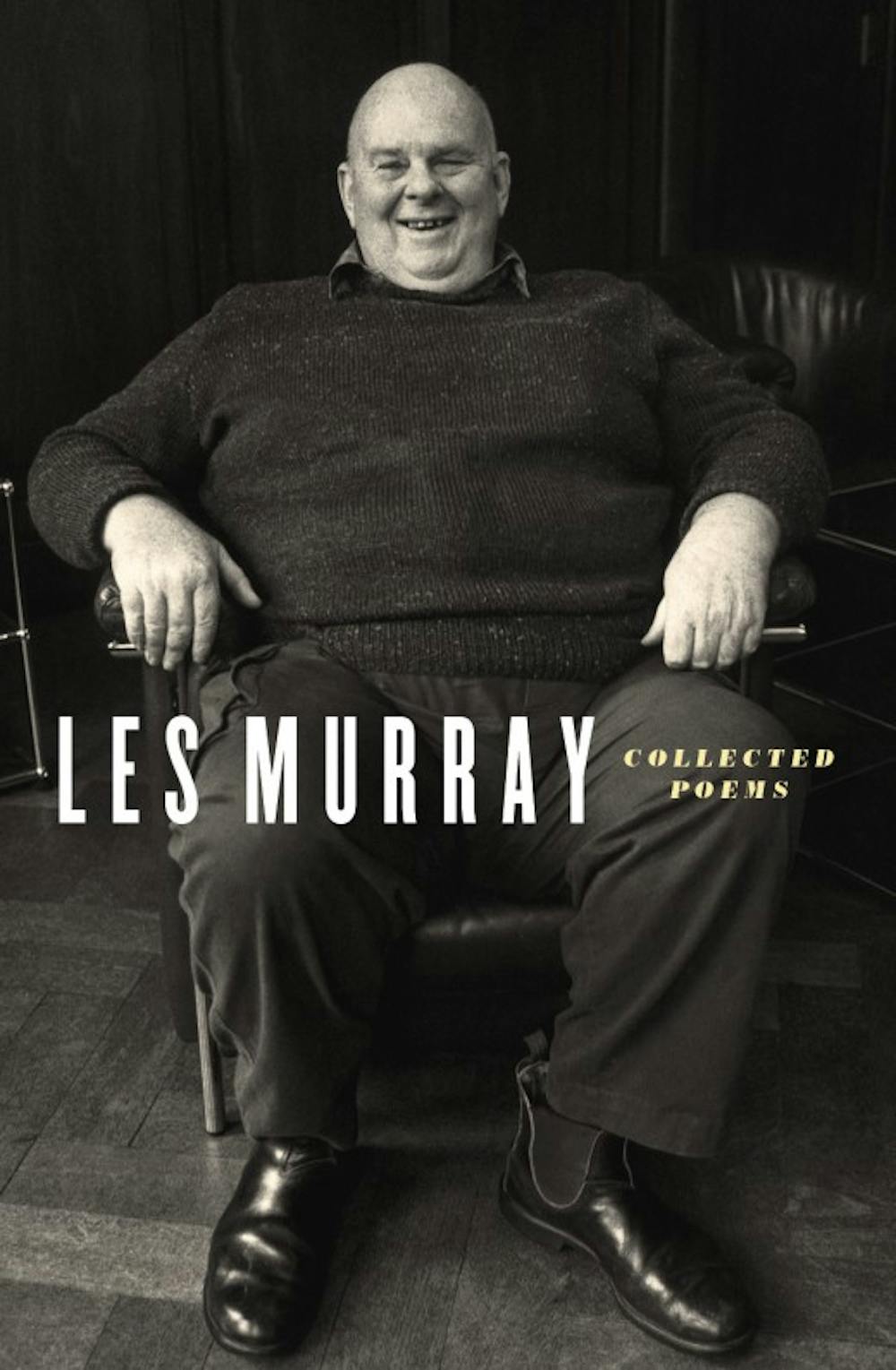 Les Murray’s Collected Poems.
Black Inc
Les Murray’s Collected Poems.
Black Inc
As Murray’s peer, the poet and critic Chris Wallace-Crabbe once wrote, “Time burns the isms”. While Murray’s various forays into cultural and political controversies will remain of interest to historians, it is the poetry — recently brought together in Murray’s latest Collected Poems (the last in his lifetime, as it turned out) — that will be read for many years to come.
In Collected Poems, as well as his masterly long work, the verse novel Fredy Neptune (1998), we can see his extraordinary poetic strengths: his linguistic capaciousness, his formal range (from epigram to epic), his wit and playfulness, his originality, his difficulty and his clarity.
While Murray was associated with the political right, his best poems are everything that a One-Nation version of Australia would distrust: complex, witty, genuinely anti-authoritarian, transnational, and encyclopedically knowledgeable.
They are also profoundly human, alive not just to the poet’s sufferings, but also to those of others. Murray’s humanity is perhaps most clearly shown in his generosity, his sharing of his attentive, thoroughly original, view of the world.
In the end, poetry knows no national boundaries, and poetry, and the English language, is the poorer for his passing.
Authors: David McCooey, Professor of Writing and Literature, Deakin University

















