a ruthlessly unsentimental tale of nature betrayed
- Written by: Jane Rawson, PhD Candidate, University of Tasmania
Some time in the late 1990s, a man is hiking through Tasmania’s Central Plateau, hoping to kill a thylacine. He’s a mainlander, and he has come to a Tasmania that no longer exists: before MONA, before Jetstar, before secret saunas and mountain bike trails, before the Tasmanian Forest Agreement, before Richard Flanagan won the Booker Prize.
In this Tasmania, the Tarkine Tigers, a direct-action conservation group, have recently lost their long fight to stop a road being built through the unlogged wilds of the north-west. The Tasmanian government has only just recognised the dispossession of the Tasmanian Aboriginal people, only just agreed it might be legal to be gay. There is one gin distillery in the entire state.
This was the Tasmania of Julia Leigh’s The Hunter, which 25 years ago hit the shelves to international acclaim and a ripple of local irritation.
At home in the wild
The Hunter is told from the point of view of M. He is a nondescript mercenary who has come to the Central Plateau to harvest a thylacine for a mainland bio-tech company that, for unspecified reasons, wants its genetic material.
Thylacines, or Tasmanian tigers, were declared extinct in 1936, but have allegedly been seen all over the island ever since. (In his book, The Song of the Dodo, David Quammen estimates 300 unconfirmed sightings in the 60 years after extinction.)
The thylacine of The Hunter has been spotted in the Walls of Jerusalem National Park. M’s employer has set him up with a cover story and a place to stay in a nearby town.

 Julia Leigh speaking at the Cannes Film Festival about her film Sleeping Beauty in 2011.
Ian Langsdon/aap
Tasmanians often view mainlanders with suspicion, so it wasn’t that surprising when Tasmanian reviewers didn’t warm to The Hunter.
Writing in The Age, journalist Martin Flanagan said there had been only seven significant Tasmanian novels in the past two decades. (He listed two by his brother, but somehow overlooked two Miles Franklin winners by compatriot Christopher Koch.) He seemed disappointed The Hunter was likely to kick off “a new era”, writing:
the author relies on a neatly compiled set of prejudices that are instantly familiar to anyone who has travelled far in the world as a Tasmanian. Surprise, surprise, there’s even a jokey remark about the locals being inbred.
Both Flanagan and Elizabeth Dean, writing for Island magazine, were particularly annoyed by a scene where M is accosted by a local who says, “From the mainland aren’t ya, some university, eh? … Just one thing, mate. We don’t take greenie cunts round here”.
In her review, Dean wrote disparagingly of Leigh’s portrayal of “the Tasmanian community” as “filled with unattractive and ignorant people”. (Last week, in my local Facebook group, a poster asked, “if a farmer uses chemicals on their crop above your property and the water that flows from that property ends up in your dam, can you do anything about it?” and was told, “Yeah… You can go back to the mainland.”)
Dean also took issue with Leigh’s nature writing. “Leigh’s landscape doesn’t ever come alive,” she wrote. “Her Tasmania is flat, unreal and, except for the tiger, could be anywhere. It seems doubtful that she has ever visited a Tasmanian forest.”
This lack of “life” – in M, in nature – is often raised by critics. But to my mind, the specificity of Leigh’s writing is true to M’s perception as a hunter. Leigh does not describe the landscape lyrically or sentimentally, but instrumentally.
[He] settles with his rifle on a promontory of rock overlooking a stretch of button grass … a sharp-beaked currawong calls to a friend. He hears the thud-thud of a wallaby passing not far behind him, but does not turn to look. He lets an inch-man trail over his mountainous boot. The scent of lemon boronia is ushered by on a light breeze.
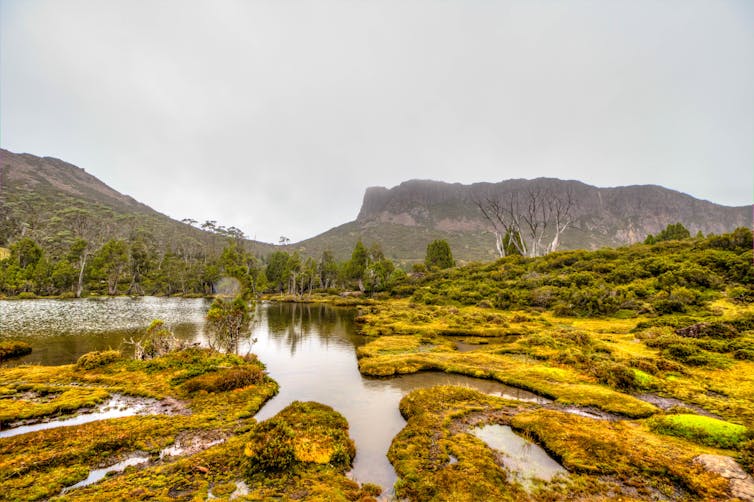
The lake is braceleted with dark pines, and rising beyond them is a thin and austere dolerite ridge, a giant semi-circular wall. The wind, he sees, has stirred up the lake, making little white-tipped ripples. The sky, too, is whitening. Tonight it will be cold.
In a gnarly patch of scoparia he lifts his arms to shield his upper body and slithers, brusquely, catching himself now and then, tearing himself away.
Julia Leigh speaking at the Cannes Film Festival about her film Sleeping Beauty in 2011.
Ian Langsdon/aap
Tasmanians often view mainlanders with suspicion, so it wasn’t that surprising when Tasmanian reviewers didn’t warm to The Hunter.
Writing in The Age, journalist Martin Flanagan said there had been only seven significant Tasmanian novels in the past two decades. (He listed two by his brother, but somehow overlooked two Miles Franklin winners by compatriot Christopher Koch.) He seemed disappointed The Hunter was likely to kick off “a new era”, writing:
the author relies on a neatly compiled set of prejudices that are instantly familiar to anyone who has travelled far in the world as a Tasmanian. Surprise, surprise, there’s even a jokey remark about the locals being inbred.
Both Flanagan and Elizabeth Dean, writing for Island magazine, were particularly annoyed by a scene where M is accosted by a local who says, “From the mainland aren’t ya, some university, eh? … Just one thing, mate. We don’t take greenie cunts round here”.
In her review, Dean wrote disparagingly of Leigh’s portrayal of “the Tasmanian community” as “filled with unattractive and ignorant people”. (Last week, in my local Facebook group, a poster asked, “if a farmer uses chemicals on their crop above your property and the water that flows from that property ends up in your dam, can you do anything about it?” and was told, “Yeah… You can go back to the mainland.”)
Dean also took issue with Leigh’s nature writing. “Leigh’s landscape doesn’t ever come alive,” she wrote. “Her Tasmania is flat, unreal and, except for the tiger, could be anywhere. It seems doubtful that she has ever visited a Tasmanian forest.”
This lack of “life” – in M, in nature – is often raised by critics. But to my mind, the specificity of Leigh’s writing is true to M’s perception as a hunter. Leigh does not describe the landscape lyrically or sentimentally, but instrumentally.
[He] settles with his rifle on a promontory of rock overlooking a stretch of button grass … a sharp-beaked currawong calls to a friend. He hears the thud-thud of a wallaby passing not far behind him, but does not turn to look. He lets an inch-man trail over his mountainous boot. The scent of lemon boronia is ushered by on a light breeze.
The lake is braceleted with dark pines, and rising beyond them is a thin and austere dolerite ridge, a giant semi-circular wall. The wind, he sees, has stirred up the lake, making little white-tipped ripples. The sky, too, is whitening. Tonight it will be cold.
In a gnarly patch of scoparia he lifts his arms to shield his upper body and slithers, brusquely, catching himself now and then, tearing himself away.
 The Walls of Jerusalem National Park, Tasmania.
Liam Preece/shutterstock
I don’t know whether Leigh visited a Tasmanian forest (not that there is much forest in the Walls of Jerusalem), but she has done her research. She describes species endemic to the region, experiences that can be had only there. Nature is not a sentimental metaphor in these descriptions: it is itself and it does not care for your human meaning-making.
We expect books that feature nature to be lyrical about nature’s beauty or elegiac about its demise. We expect that a character immersed in nature the way M is to be gentled, filled with love for the fragility of creation. But nature is not lyrical or elegiac or interested in fragility, except where it indicates an easy meal.
As critic Tony Hughes d’Aeth wrote in a 2002 essay:
M’s hyperrationality is natural. It is destructive, of course, but many things in nature destroy. M’s singular logic, unimpeded by conscience, is as natural as a virus.
That hyperrationality, though, led turn-of-the-century critics to describe M as unlikable, unrelatable and – in some cases – unrealistic, due to his lack of emotion. Hughes d’Aeth wrote,
M has an android relationship to his world, gathering information, noting anomalies, formulating strategies. His mode is not reflection but process […] He administrates himself, constantly attending to data, and managing his needs in terms of the task at hand.
The Walls of Jerusalem National Park, Tasmania.
Liam Preece/shutterstock
I don’t know whether Leigh visited a Tasmanian forest (not that there is much forest in the Walls of Jerusalem), but she has done her research. She describes species endemic to the region, experiences that can be had only there. Nature is not a sentimental metaphor in these descriptions: it is itself and it does not care for your human meaning-making.
We expect books that feature nature to be lyrical about nature’s beauty or elegiac about its demise. We expect that a character immersed in nature the way M is to be gentled, filled with love for the fragility of creation. But nature is not lyrical or elegiac or interested in fragility, except where it indicates an easy meal.
As critic Tony Hughes d’Aeth wrote in a 2002 essay:
M’s hyperrationality is natural. It is destructive, of course, but many things in nature destroy. M’s singular logic, unimpeded by conscience, is as natural as a virus.
That hyperrationality, though, led turn-of-the-century critics to describe M as unlikable, unrelatable and – in some cases – unrealistic, due to his lack of emotion. Hughes d’Aeth wrote,
M has an android relationship to his world, gathering information, noting anomalies, formulating strategies. His mode is not reflection but process […] He administrates himself, constantly attending to data, and managing his needs in terms of the task at hand.
 Willem Dafoe in The Hunter (2011)
Porchlight Films, Screen Australia, Screen New South Wales
Challenging a myth
Re-reading The Hunter today, I wonder if we would now – with our far better understanding of neurodiversity – perceive M differently. Surely we can at least see him as a believable character, a distinct possibility on the spectrum of human brains.
Martin Flanagan was right: The Hunter did kick off “a new era” of Tasmanian novels, particularly novels featuring thylacines. Heather Rose’s White Heart came out the same year and since then there has been (at least) James Bradley’s Ghost Species, Kris Kneen’s Wintering, Sarah Kanake’s Sing Fox to Me, Michelle Kadarusman’s Music for Tigers and Octavia Cade’s The Impossible Resurrection of Grief.
There have also been hugely successful non-thylacine Tasmanian novels, such as Limberlost, The Narrow Road to the Deep North, The Seven Skins of Esther Wilding, Past the Shallows, The Bluffs, and The Labyrinth.
People in Tasmania still hope to see a thylacine; many claim they have. As recently as 2021, there was feverish speculation that footage had been taken of thylacine pups; it turned out they were wallabies.
In the context of an island where rumours of sightings have never quite died out (unlike the animal itself), The Hunter did not stray too far from reality. But the days of alleged sightings may soon be over. Seeing a thylacine might yet become commonplace. The latest thylacine “de-extinction team”, Colossal Biosciences, is promising to return the creature to the landscape in the next few decades.
We keep telling ourselves we can somehow wind back time and fix the mess we have made of nature, and Tasmania seems ripe for these dreams. As Dean wrote in 1999, Tasmania “can easily become an idea in the mind, more real than life, ready for invention”.
But Leigh won’t stand for this kind of sentimentality. In a 1999 interview with The Sydney Morning Herald, she said The Hunter upsets people because it “challenges the myth that there is a last remaining Tasmanian tiger and if only man could find it we would repent and look after it”.
Pondering his future, M also refuses rose-coloured glasses:
he will travel with a thylacine foot as a talisman, his bastard rabbit’s foot, a reminder not of the way things might be, but of the way they really are.
Authors: Jane Rawson, PhD Candidate, University of Tasmania
Willem Dafoe in The Hunter (2011)
Porchlight Films, Screen Australia, Screen New South Wales
Challenging a myth
Re-reading The Hunter today, I wonder if we would now – with our far better understanding of neurodiversity – perceive M differently. Surely we can at least see him as a believable character, a distinct possibility on the spectrum of human brains.
Martin Flanagan was right: The Hunter did kick off “a new era” of Tasmanian novels, particularly novels featuring thylacines. Heather Rose’s White Heart came out the same year and since then there has been (at least) James Bradley’s Ghost Species, Kris Kneen’s Wintering, Sarah Kanake’s Sing Fox to Me, Michelle Kadarusman’s Music for Tigers and Octavia Cade’s The Impossible Resurrection of Grief.
There have also been hugely successful non-thylacine Tasmanian novels, such as Limberlost, The Narrow Road to the Deep North, The Seven Skins of Esther Wilding, Past the Shallows, The Bluffs, and The Labyrinth.
People in Tasmania still hope to see a thylacine; many claim they have. As recently as 2021, there was feverish speculation that footage had been taken of thylacine pups; it turned out they were wallabies.
In the context of an island where rumours of sightings have never quite died out (unlike the animal itself), The Hunter did not stray too far from reality. But the days of alleged sightings may soon be over. Seeing a thylacine might yet become commonplace. The latest thylacine “de-extinction team”, Colossal Biosciences, is promising to return the creature to the landscape in the next few decades.
We keep telling ourselves we can somehow wind back time and fix the mess we have made of nature, and Tasmania seems ripe for these dreams. As Dean wrote in 1999, Tasmania “can easily become an idea in the mind, more real than life, ready for invention”.
But Leigh won’t stand for this kind of sentimentality. In a 1999 interview with The Sydney Morning Herald, she said The Hunter upsets people because it “challenges the myth that there is a last remaining Tasmanian tiger and if only man could find it we would repent and look after it”.
Pondering his future, M also refuses rose-coloured glasses:
he will travel with a thylacine foot as a talisman, his bastard rabbit’s foot, a reminder not of the way things might be, but of the way they really are.
Authors: Jane Rawson, PhD Candidate, University of Tasmania