We can’t solve family violence until we include violence between siblings in the conversation
- Written by: Hayley Boxall, Research Fellow, Australian National University
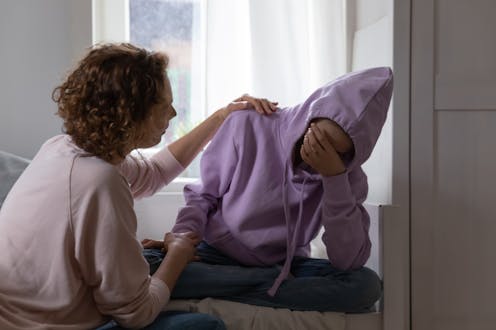
Domestic and family violence (DFV) has received increasing attention in recent years. It is most commonly associated with intimate partner violence between current and former partners, followed by abuse perpetrated against children by their parents and carers.
But what about sibling violence?
International estimates suggest that sibling violence (also known as sibling-to-sibling violence) is one of the most common forms of DFV globally. Yet in Australia and internationally, there is very little conversation or research about it. This means our understanding of when, why and how it occurs remains underdeveloped, and this in turn affects the development of effective policy and practice.
To improve understandings of sibling violence in Australia, we analysed data collected as part of a national study of 16–20-year-olds’ use and experiences of DFV in the home. Of the 5,021 young people we surveyed, 4,340 said they had siblings.
What is sibling violence?
One of the biggest barriers to better understanding sibling violence is differentiating between sibling rivalry and conflict, and abuse. Research suggests abuse is often minimised by family members and clinicians, even when the behaviours are described as “extreme” and persistent.
For our study, guided by the literature, we defined sibling violence as involving serious and high-harm behaviours. This includes:
- threats to kill
- threats to hurt someone close to the young person
- non-fatal strangulation or sexual abuse
- persistent and frequent forms of other abusive behaviour (for example, verbal, emotional physical, property damage and threats to harm/hurt a sibling).
Overall, 303 young people in the sample self-reported they had been subjected to or used sibling violence by the time they were 18. Within this, 58% said they had used sibling violence, 60% said they had been subjected to it, while 18% said they experienced both victimisation and perpetration.
Sibling violence is multifaceted
The most common form of sibling violence reported by young people was verbal abuse. Of our respondents, 72% reported experiencing verbal abuse from a sibling, while 74% reported using verbal abuse against a sibling. Physical violence was the next most common form of sibling violence reported, with 64% reporting experiencing physical abuse from a sibling, and 73% reporting using physical abuse against a sibling.
Although less common, a significant proportion of young people also reported experiences of:
- threats to kill (victimisation: 26%; perpetration: 9%)
- non-fatal strangulation (victimisation: 14%; perpetration: 3%)
- sexual abuse (victimisation: 13%; perpetration: 2%).
Almost all young people who had experienced sibling violence reported experiencing multiple and overlapping forms of abuse. Indeed, our study finds that sibling violence is rarely experienced as an isolated act of abuse. Rather, it is often experienced as part of a broader patterns of behaviours encompassing physical, sexual and non-physical abuse.
Sibling violence is gendered
The findings from our study highlight that like other forms of DFV, sibling violence is gendered.
A significantly larger proportion of cis female (47%) and trans/non-binary young people (50%) reported they had been subjected to sibling violence, compared to cis males (25%).
Meanwhile, a larger proportion of cis males (59%) said they had used sibling violence compared to cis female (35%) and trans/non-binary young people (32%).
Sibling violence often co-occurs with other forms of DFV within families
Over 90% of young people in our study reported they had experienced DFV between other family members, such as intimate partner violence between their parents.
Also, over half of the young people who had been subjected to sibling violence reported they had experienced other forms of maltreatment by another family member, most frequently by their mothers and fathers.
Sibling violence has significant impacts on young people
Young people in our study reported that sibling violence and other forms of DFV had significant impacts on them. It affected their social, emotional and physical wellbeing, and education achievements.
Relationships between siblings have important developmental implications for young people’s understandings of familial relationships. The strength of sibling relationships has been linked to longer-term health and social wellbeing outcomes. While our siblings can sometimes feel like our greatest enemies, they can also be our strongest supports in life.
An emerging body of research has also found that young people who use sibling violence are at higher risk of perpetrating abusive behaviours against their intimate partner(s) and family members later in life.
Sibling violence can have significant impacts, including trauma, anxiety and poor mental health, eating disorders, and the misuse of alcohol and drugs on those who experience it.
What is needed?
Our study builds new understandings of sibling violence in Australia. It highlights the importance of early interventions for young people who experience DFV during childhood. This includes ensuring effective responses for young people who use violence against their siblings.
Without effective early intervention, we are missing opportunities to address the negative consequences of such experiences, including an increased risk of future perpetration of intimate partner violence.
To facilitate improved identification and early intervention, frontline screening for DFV among individuals and families must include sibling violence.
Given the substantial overlap of intimate partner violence, other forms of child maltreatment, child-to-parent abuse and sibling violence, we need holistic interventions that address the support needs of all family members.
These responses must extend to supporting children and families’ recovery from DFV and seek to break the cycle of inter-generational violence in the home.
Authors: Hayley Boxall, Research Fellow, Australian National University