

why this election is posing problems for the media
- Written by Tony Walker, Adjunct Professor, School of Communications, La Trobe University
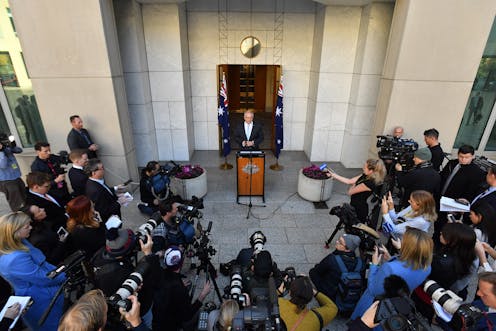
Election 2019 may well prove a watershed event in more ways than one. This will likely be the first time in the country’s electoral history that more voters are following the campaign online than via conventional media – television, newspapers and radio.
In other words, the ability of media behemoths like News Corp, Nine, the ABC and Seven to dominate an election narrative is less than it was. This sway over the political agenda is far from extinguished, of course. It is simply that traditional media, including their social media arms, are operating in a more competitive marketplace.
Read more: From irreverence to irrelevance: the rise and fall of the bad-tempered tabloids
Perhaps the most significant number to emerge in the opening stages of this campaign are the up to 1 million additions to the electoral rolls since the 2016 poll. A significant proportion of these new arrivals will be younger, technology-savvy, social-media-using voters.
Accessing these millennials is not least of challenges facing the major parties.
Campaigning media
The arrival of a phalanx of younger millennial voters on the rolls may well serve as a counterweight to the battering-ram approach of the tabloids, Sydney’s Daily Telegraph, Brisbane’s Courier Mail and, to a lesser extent, Melbourne’s Herald Sun and Adelaide’s Advertiser.
These Murdoch mastheads, whose readers tend to be older working-class voters, have stepped up the war against the Labor Party since the election was called. If a front-running Labor under Bill Shorten is run down in the straight and Scott Morrison survives, we may see a reprise of the Sun headline in the 1992 election of the Conservative John Major: “It’s The Sun Wot Won It”.
On the other hand, if Shorten prevails against the weight of the Murdoch tabloids and their echo chambers in talk radio – amplified by Fox News-lite Sky News – then other conclusions may be drawn.
Shorten, incidentally, became the first aspiring prime minister since Gough Whitlam not to court Rupert Murdoch. Whitlam won with Murdoch’s support in 1972, but lost that support thereafter.
What is relevant in all of this is that trust in the media more generally is fragile and is unlikely to be bolstered by a fractious 2019 election campaign in which all sorts of half-truths and mistruths are being peddled.
Read more: Lies, obfuscation and fake news make for a dispiriting – and dangerous – election campaign
In the 2018 Edelman Trust Barometer, a longstanding survey of trust in the media among 28 countries, Australian regard for the media ranked second lowest at 31%, just above Turkey on 30%.
Given that the Turkish government of Recep Erdogan has locked up dozens of journalists and shut down disobliging media outlets, this is not good company.
Of course, it’s ridiculous to compare an Australian media environment with that of Turkey, but the Edelman finding does indicate the extent to which polarised and polarising media are weighing on public trust.
Significantly, the Edelman survey found Australia’s trust in social media had slumped last year to 23% from 28% in 2017, compared with a global average of 40%.
Trust in Facebook and search engines had also dropped considerably. Only the Irish and Swedes were less trusting of such media platforms, according to Edelman.
Fake news
Early stages of the Australian election campaign underscore the challenges facing any Western democracy these days in conducting untarnished elections.
Denis Muller notes:
The campaign has already been marred by fake news, political exploitation of social media falsehoods and amplifications by mainstream media of crude slurs made on Facebook under the cover of anonymity.
Muller instances a false post on Facebook of what was claimed to be a Labor plan to bring back death duties. No such plan exists or has even been mentioned at any stage of the campaign, yet Coalition spokespeople gave the claim currency.
Malcolm Turnbull blamed Labor’s fake “Mediscare” campaign, in which it was falsely asserted doctors’ fees would rise under changes to Medicare services, for a close result in 2016. On this record, Labor is far from blameless in seeking to exploit a media echo chamber to peddle a false narrative.
In some cases, social media trolls, whose provenance is disguised, are used to spread such misinformation. In the 2016 US presidential election, Russian-sponsored troll farms pumped bile into a campaign that was, in any case, awash with vitriol.
In other words, a foreign power deployed false and dangerous narratives to influence an election in a way that accorded with that power’s political preferences. This was a dangerous moment for Western democracies.
Under pressure globally and from local regulators, Facebook has announced it will not accept advertising in the Australian election that is paid for by, or on behalf of, foreign interests. But this might be hard to police in an environment in which keeping track of such funding presents its own challenges.
Mindful of the risks of disinformation campaigns upending an election, the Australian Electoral Commission has launched its own “Stop and Consider’’ campaign to warn voters of the risks of fake news.
In its publicity documents, the AEC acknowledges the difficulty of policing the truth or otherwise in electoral communications. It provides a checklist for voters to assess the reliability of such information.
It remains moot whether the AEC campaign will stop the misuse for political purposes of social media, but the organisation should be given credit for trying. Nothing less than reasonable confidence in the fairness of the political process is at stake.
Enter the disruptors
In this election year, an electorate spoiled for choices, or spoiled by choices depending on your point of view, is also contending with relatively new phenomena. The left-wing movement GetUp has stepped up its campaign of recent years against what it describes as "hard right” representatives like the former prime minister Tony Abbott in Warringah.
GetUp is performing like an American political action committee (PAC) whose mission is to force defeat of its ideological opponents. In its intensity, this is a relatively new development in Australian politics. It is one that is straining the system and inviting a response from groups on the right like Advance Australia.
These PACs present a particular challenge for media seeking to achieve a reasonable balance between the contending parties. Social media provide fertile territory for these activist groups whose publicity campaigns are not subjected to editorial constraints beyond the defamation laws.
Then there is the Clive Palmer phenomenon. Palmer’s spending of vast sums on advertising to purloin a Senate seat, and otherwise influence the election outcome via preference deals, represents a significant challenge for the mainstream media.
Should the media ignore Palmer, or go after him over some of his more ridiculous claims and his personal behaviour? This includes his failure to settle outstanding entitlements with laid-off workers at his mothballed Queensland nickel smelter.
In his populist prejudices, Palmer is a cashed-up version of Pauline Hanson, and in some ways is more threatening to a relatively stable political system and confidence in the integrity of the democratic process itself.
This unravelling of a national consensus is complicating the task for mainstream media used to relatively clear-cut choices.
Finding a clear path through
The ANU’s Australian Election Study finds that satisfaction with democracy is at its lowest ebb since the Whitlam dismissal of 1975. In 2016 just 60% of those interviewed were satisfied with democracy compared with a high of 86% in 2007, the year Kevin Rudd was elected prime minister.
That represents a substantial 26-percentage-point decline in satisfaction in less than 10 years.
Michele Levine of the Roy Morgan polling organisation attributes an unusually contentious political environment to a “very polarising media environment”.
In its Media Net Trust Survey, Morgan found 47% of Australians distrusted social media. This compared with 9% of people who distrusted the ABC.
In an Essential poll, published in September 2018, the ABC ranked fourth on “trust in institutions” behind the Federal Police, state police and the High Court. Political parties were at the bottom of the survey, trusted by just 15% of those interviewed.
In a separate “trust in news sources” Essential poll, the ABC ranked above The Australian and Nine newspapers. The tabloids found themselves at the bottom of the table.
What these polls tell us is that people are crying out for information they trust from institutions they respect.
An election that itself is unusually polarised between sharply differing visions of the country presents the media with huge challenges. Getting the balance right in a hostile social media environment is not least of them.
Authors: Tony Walker, Adjunct Professor, School of Communications, La Trobe University

















