

The extreme floods which devastated Spain are hitting more often. Is Australia ready for the next one?
- Written by: Conrad Wasko, ARC DECRA Fellow in Hydrology, University of Sydney
Spain is still reeling from recent floods in the Valencia region. In some areas, a year’s worth of rain fell in a single day. Sudden torrents raced through towns and cities. Over 200 people are dead. Rapid analysis suggests daily rainfall extremes in this region and season have become twice as common over the last 75 years and become 12% more intense.
The World Meteorological Organisation has pointed out that climate change is steadily increasing the risk of extreme floods like these. Warmer air can hold more water vapour, about 7% more per degree Celsius of warming. More moisture generally leads to more intense rainfall, and therefore more extreme floods.
The physics of how temperature influences the atmosphere’s capacity to hold moisture has been known for close to 200 years. But we’ve learned something worrying more recently. When water vapour condenses to form rain droplets, it releases heat which can fuel stronger convection and boost updrafts of air currents in storms. This means the intensity of extreme rainfall could increase not just 7% per degree of warming, but over twice that rate.
Last week, CSIRO and the Australian Bureau of Meteorology released their biennial report on the State of the Climate, which found “heavy short-term rainfall events are becoming more intense”. Australia, the report states, has already warmed 1.5°C since national records began in 1910. In recent years, extreme rains have triggered devastating floods in New South Wales and Queensland.
The question now is – are we prepared for these more damaging floods? This year, Australia updated the climate change section of Australia’s flood design guidance. But while this will help ensure that future infrastructure is better able to weather extreme floods, our current bridges, roads and stormwater drains have not been built to weather these increases in extreme rainfall. Similarly, our flood planning levels – used to determine where houses, offices, hospitals and so forth can be built – have generally not factored in the reality of the threat.

More floods and more extreme
Many of us would have learned about the water cycle in school. Water evaporates from seas and lakes before falling as rain and filling lakes and rivers, which eventually makes it back to the sea.
Unfortunately, climate change is making this cycle more intense, as detailed in a recent Intergovernmental Panel on Climate Change report. Rain is more likely to fall in intense short-duration bursts which are more likely to trigger floods.
This year alone, we have seen disastrous and deadly floods from extreme storms across the Americas, Asia and Europe. Scientific analysis has showed these floods were more severe due to human-caused climate change.
Australia is not immune. The devastating northern New South Wales floods of 2022 took 24 lives and ravaged towns such as Lismore. These floods are the most expensive natural disaster to date in Australia, costing A$5.65 billion in damages.
 February 28th 2022 set a new flood record for Lismore in NSW, at 14.4 metres – two metres higher than the previous record.
Bradley Richardson/AAP
February 28th 2022 set a new flood record for Lismore in NSW, at 14.4 metres – two metres higher than the previous record.
Bradley Richardson/AAP
How do you prepare for worse floods?
When urban planners set flood planning levels, or engineers begin designing a new bridge or rail line, they have to take floods into account. To do so, they will inevitably reach for the local bible, Australia’s flood design guidance.
Before 2024, this document allowed for a 5% increase in rainfall intensity per degree of global warming, and generally applied it only to infrastructure intended for a very long lifespan. This clashed with most scientific studies on the topic both globally and in Australia, which showed much greater increases, and that these increases are already being witnessed.
To provide better flood guidance, we and our colleagues undertook a comprehensive review of over 300 scientific papers covering climate change in Australia and extreme rainfall.
The review proved we had been underestimating the threat of extreme rains and subsequent floods. Rain events over a 24-hour period leading to flooding are likely to increase at 8% per degree of warming, not 5%. Hourly rainfall extremes are likely increasing even faster, at 15% per degree.
Worse, these are just the central estimates. The wide range of plausible values suggests some rain events could eclipse these. For daily or longer extreme rains, the range is 2–15%. For hourly or shorter periods, that figure is 7–28% for hourly or shorter duration.
Over the month of February in 2022, the Lismore region had about 600–800 mm of rain – much more than a normal February, which might see closer to 150 mm on average. These floods took place with just 1.1°C of warming since the pre-industrial period. On our current path, it’s possible the world could warm another 1.5°C or more by the end of this century. If this happens, these rainfall totals could be substantially higher and more likely to cause even worse flood impacts.
These new figures have now been included in the August update of Australia’s flood design guidance. This is good news. It means future decisions on infrastructure and planning can now be well informed by the latest science on how climate change influences flood risk.
Over time, this will ensure essential infrastructure can be built to endure worse floods. It will affect the design and construction of everything from local stormwater drains to levees, bridges, culverts and dam spillways.
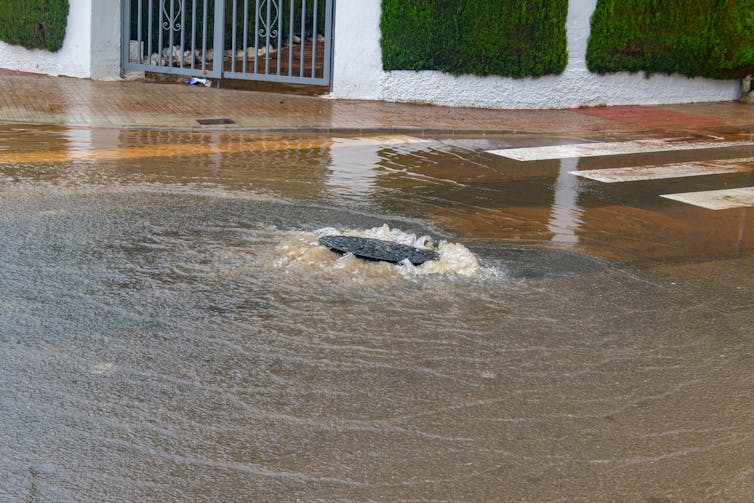
 Preparing for extreme floods is complex. Pictured: water spilling out from a manhole during Spain’s floods.
Fernando Astasio Avila/Shutterstock
Preparing for extreme floods is complex. Pictured: water spilling out from a manhole during Spain’s floods.
Fernando Astasio Avila/Shutterstock
Local councils can use it to set the height of floor levels for property development. State and federal decision-makers can use it in planning for responses to flood emergencies.
Does it mean we can avoid disastrous floods like those in Spain and Lismore? Yes and no. We now have the knowledge and tools to adapt to the increased risk levels already arriving. Yet implementing this will be challenging. In many cases, it will require retrofitting or redesigning existing infrastructure to withstand more intense flooding.
Climate change is no longer something we can file under “problem for the future”. It’s here already. The flood risks we face today are already substantially worse than 25 years ago, and will continue to worsen. We must accelerate how we plan for extreme, rapid rainfall creating catastrophic floods like those in Spain.
Authors: Conrad Wasko, ARC DECRA Fellow in Hydrology, University of Sydney


















