

Why is the oboe used to tune an orchestra? And other questions about tuning, answered
- Written by: Kathleen McGuire, Senior Lecturer in Education (Music), National School of Education, Faculty of Education and Arts, Australian Catholic University
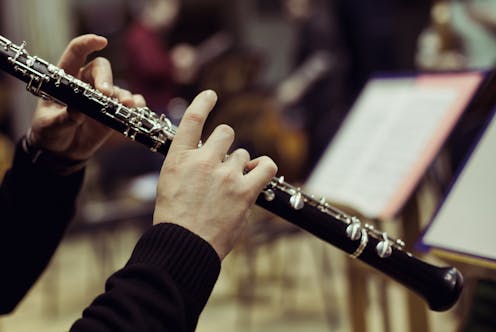
The iconic sound of an orchestra tuning is highly recognisable, even for those who’ve never set foot in a concert hall. Many of us first heard it while watching a Looney Tunes cartoon.
Have you ever wondered why the oboe begins the tuning? How is the starting note decided? With access to electronic tuning devices, along with advancements in materials and manufacturing enabling instruments to better sustain their pitch, is the tuning ritual still needed? What is the purpose, beyond building excitement or signalling the conductor’s entrance?
Whether or not professional orchestras’ tuning rituals are required, there is something inherently comforting about it for audiences.
Enter the oboe
The earliest orchestras, in the Baroque era, comprised a non-standard set of instruments. One combination could have been a harpsichord, a few string players (violin, viola, viola da gamba), one or more wind instruments, and perhaps even timpani.
As the number of string players grew in the orchestra, the flute replaced the quiet recorder.
The oboe brought complex, contrasting overtones, plus a limited yet stable tuning range controlled mostly by a pair of “fixed” reeds.
These factors made the oboe the practical choice as the tuning instrument in the Baroque era.
By the 1800s, the size and instrumentation were much like the modern orchestra. An order was added to the tuning ritual, with each “family” of instruments taking its turn to tune with the oboe.
When a fixed-pitch instrument, such as an organ, was included with the orchestra, the oboe would be tuned to it before the ritual began.
These tuning traditions continue today.
Constantly retuning
The tuning ritual heard by the audience is just the tip of the iceberg. Many instruments need micro-tuning adjustments throughout a performance.
Tuning can also slip, which may be caused when string or brass instruments need to use a mute. The mute lowers the volume and adds a different tonal quality, but it can also slightly alter the pitch of the instrument.
Tuning is also affected by changes in temperature or humidity as the instrument warms while being played or cools due to external changes.
Consider the weather during the opening ceremony of the 2024 Paris Olympics – it would have been challenging to keep the instruments in tune in the rain and extreme humidity.
Depending on the instrument, sometimes when the pitch slips it cannot be adjusted mid-performance.
In a recent concert I conducted at St Patrick’s Cathedral, Melbourne, the yidaki was slightly out of tune after being perfectly in tune two hours earlier in rehearsal. The difference? The yidaki’s wood was affected by a sudden drop in temperature when a thunderstorm came through mid-concert.
Pipe organs suffer the same fate at the mercy of the weather with their large, metal components.
What makes an ‘A’?
The traditional tuning note is A. This stems from the open A string being common to all orchestral string instruments.
The oboist plays a long A when instructed by the concert master – usually the lead violinist – who stands and indicates to the oboist and then to each section of the orchestra when it’s time to tune.
The string players tune their A strings, from which they can tune their other strings. In turn, other sections of the orchestra also tune to A. When the tuning ends and the instruments are silent, the orchestra is ready to perform.
This all seems straightforward, but there are variations on what an A should sound like. An audio frequency of A=440 hertz (Hz) is considered standard or “concert” pitch, although this is a fairly modern concept.
Tuning forks were invented in Europe in the early 1700s, around the same time as the emergence of orchestras. Based on tuning forks and organs remaining from the 18th and 19th centuries, such as Beethoven’s tuning fork, historians have identified concert pitches ranging from 395 to 465Hz.
Efforts to standardise concert pitch at A=440Hz arose in the 19th century, further reinforced in the 20th century.
Today, the pitch used may be decided by historically informed performance, adopting the likely tuning from when the music was composed. Giuseppe Verdi, for instance, campaigned for Italy to adopt concert pitch A=432Hz. Using the slightly lower tuning for Verdi’s Messa da Requiem is justifiable, allowing for the choir to execute extended high passages more comfortably.
In the 1960s, conductor Herbert von Karajan decided the Berlin Philharmonic sounded “brighter” when tuned to A=443–444Hz. This trend continues today for several prominent orchestras: The New York Philharmonic tunes to A=442Hz, and the Vienna Philharmonic to A=443Hz.
Changing rituals
Is the tuning ritual essential? It depends.
Earlier this year I saw Wicked. The orchestra tuned very quickly. Practicalities can trump ritual – especially on days with matinee and evening shows, each running almost three hours.
Symphony orchestras comprise mostly acoustic instruments. In contrast, modern musical theatre orchestras often include electronic instruments and a rhythm section, with synthesizers that don’t need tuning.
Compared with a large auditorium, a pit may have fewer temperature fluctuations. When needed, pit players use electronic tuning devices. Some play multiple instruments in each performance, which are tuned in advance and during the performance.
Despite contemporary advancements, the tradition of an orchestra tuning in the presence of an audience is a special, transcendent moment, unique to the live concert experience.
Authors: Kathleen McGuire, Senior Lecturer in Education (Music), National School of Education, Faculty of Education and Arts, Australian Catholic University


















