

In a record-breaking drought, bush birds from around Perth flocked to the city
- Written by: Harry Moore, Adjunct Research Fellow, School of Agriculture and Environment, The University of Western Australia
Perth is no stranger to hot and dry summers, but the period from October 2023 to April 2024 was exceptional. The city’s rainfall for these seven months was only 23 millimetres, the lowest since records began in the 1870s. It was also one of the warmest summers on record, with temperatures 1.7°C higher than the long-term average.
The “canary in the coalmine” is a metaphor for an early warning that something is wrong. In this case, though, it wasn’t the birds that first alerted us. Rather, we saw the drought’s impacts on our iconic and unique vegetation.
Jarrah, marri, karri and banksia trees, some as old as 100 years, began to die. The die-offs created a mosaic of brown patches across 1,000 kilometres of south-west Australia’s otherwise green forest.
The region’s ecosystems are diverse and complex. As the drought took hold, there were more subtle changes beyond the visible tree deaths. Perth has a community of avid birdwatchers who began noticing bird species rarely seen in the city, or known to be infrequent visitors.
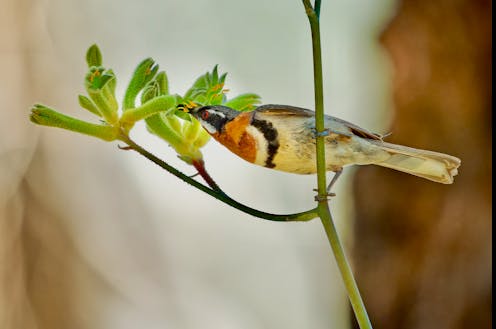
We analysed bird observation data from the global citizen science platform, eBird, to determine which species had increased in the Perth metropolitan area at this time. We found a dramatic spike in reporting rates for four species – the black-shouldered kite, black-tailed nativehen, tawny-crowned honeyeater and western spinebill. Some species were reported up to nine times more than usual.
Birds sought refuge in the city
These shifts hint at how extreme weather can push wildlife into new and unexpected spaces.
The black-shouldered kite, a nomadic bird of prey, is often found in heath and woodlands in south-western Australia, as well as in rural landscapes. The black-tailed nativehen is more commonly associated with inland wetlands but is known to appear suddenly in large numbers in new habitats and then disappear just as quickly. Honeyeaters, such as the tawny-crowned honeyeater and the western spinebill, tend to favour coastal heathlands and forests. So why were they turning up in Perth city?
We suggest it’s likely because the drought stripped their usual habitats of vital resources, particularly food and water.
The city, on the other hand, although also hot and dry at this time, had water in remnant wetlands, the Swan River, artificial lakes and ponds, and people’s gardens. These areas may also have nectar-rich plants for the honeyeaters, insect populations perhaps eaten by the black-tailed nativehen, and rodents or rabbits for the black-shouldered-kite. We think these urban environments became temporary refuges, providing a different water and food source for these birds.
A long history of bird immigration
This isn’t the first time birds have flocked to Perth during challenging environmental conditions.
Galahs, for example, were confined historically to inland areas. Early explorers such as John Gould and John Forrest noted their absence around the Swan River colony. They weren’t common in this area until after the second world war, following a series of dry years.
In many cities in Australia, cockatoos are known to take advantage of watered lawns, sports fields, parks and artificial lakes in cities. These resources have created a novel urban habitat for these birds.
This also happens in rural towns. Parrots, birds of prey and our beloved “bin chickens” (white ibis) have increased in these towns as inland rainfall declines.
The short-term movement of species such as the black-shouldered kite, western spinebill and tawny-crowned honeyeater into cities represents a new chapter in this urban immigration story. Perhaps we should expect more drought migrants as the climate crisis continues to impact their natural habitats.
On the front-line of climate change
South-west Western Australia is a global biodiversity hotspot. It is also considered one of the most climate-vulnerable regions in the world.
In Perth, annual rainfall has decreased by around 130mm (15%). That’s a drop from about 860mm to 730mm over the past 30 years (1993–2023) compared to the previous 30 years (1959–1988).
This long-term drying trend, combined with rising temperatures, puts immense pressure on the ecosystems local wildlife depends on. The drought event of 2023–24 may be a precursor of what’s to come. More research is needed to understand the movements of birds and other wildlife in response to these events.
To the relief of those watching the landscape turn brown, it started raining in May 2024. We bought ourselves a rain gauge to celebrate, and waited to see what the next months of eBird data would reveal. The data showed all four drought immigrants retreated from the city almost as quickly as they had arrived.
This movement supported the theory that these birds were using the city only as a temporary refuge during the harshest drought months.
Observations of unusual bird behaviour highlight the complex relationship between wildlife and urban environments under climate stress. While cities may offer some refuge, they are not a long-term solution for wildlife facing habitat loss. Indeed, the spread of urban areas poses its own major threats to bird communities.
As the climate crisis intensifies, integrating urban areas into conservation plans could be crucial for supporting species during extreme events. Individuals, councils and urban planners may be able to increase the quality of the refuges in cities in relatively simple ways. Planting more native vegetation and providing safe water sources for visiting wildlife would be a good start.
Authors: Harry Moore, Adjunct Research Fellow, School of Agriculture and Environment, The University of Western Australia


















