

A single atom can change the colour of a bird. These are the genes responsible
- Written by: Simon Griffith, Professor of Avian Behavioural Ecology, Macquarie University
Across the animal kingdom, birds are some of the most colourful creatures of all. But how did all the amazingly coloured different bird species arise?
Nearly all birds with bright red, orange, and yellow feathers or bills use a group of pigments called carotenoids to produce their colours. However, these animals can’t make carotenoids directly. They must acquire them through their diets from the plants they eat. Parrots are the exception to this rule, having evolved an entirely new way to make colourful pigments, called psittacofulvins.
Although scientists have known about these different pigments for some time, understanding the biochemical and genetic basis behind how birds use them to vary in colour has been less clear. But two recent separate studies about parrots and finches have provided vital insight into this mystery.
One study, published in Current Biology, was led by one of us (Daniel Hooper), and the other was led by Portuguese biologist Roberto Abore and published in Science. Together, they advance our understanding of how birds produce their colourful displays – and how these traits have evolved.
A single enzyme
The two new studies involved large teams of international researchers. They used recent advances in genetic sequencing to examine which regions of the genome (an animal’s complete set of DNA) determine natural yellow-to-red colour variation in parrots and finches.
Remarkably, even though these two groups of birds produce their colourful displays using different types of pigments, scientists found they have evolved in similar ways.
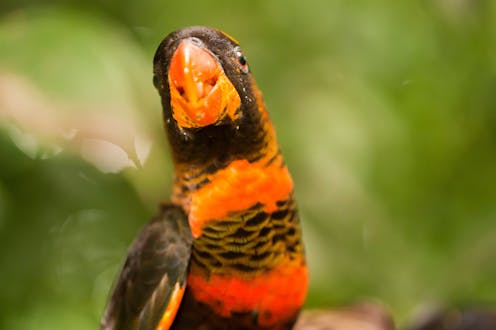
Arbore’s study looked at the dusky lory (Pseudeos fuscata), a parrot native to New Guinea with bands of feathers that may be coloured yellow, orange or red. The research found that shifts between yellow and red feather colouring were associated with an enzyme called ALDH3A2. This enzyme converts red parrot pigments to yellow ones. When developing feathers contain large amounts of the enzyme, they end up yellow; when they have less, they end up red.
Scientists found the ALDH3A2 enzyme also explains colour variation in many other species of parrots which have independently evolved yellow-to-red colour variation.

Two special genes
The long-tailed finch (Poephila acuticauda) is a species of songbird native to northern Australia. There are two hybridising subspecies with different coloured bills. One is yellow-billed while the other is red-billed.
Most carotenoid pigments that birds might consume from their diet are yellow or orange, so birds’ bodies must somehow change the chemistry of the pigments after eating them to produce red colours.
Hooper’s study examined variation in this trait across the whole distribution of the long-tailed finch in the wild, and variation in the genomes of the measured birds. It turned out bill colour in these finches was mostly linked to two genes, CYP2J19 and TTC39B.
Together, these two genes drive the conversion of yellow dietary carotenoids to red ones.
In the long-tailed finch, yellow coloration appears to result from mutations that turn these genes off in the bill specifically while keeping them on in other parts of the body, such as the eyes.
By comparing the DNA code of these colour genes to other finch species, the researchers also found the ancestors of the modern long-tailed finch had red bills, but mutant yellow bills have slowly been growing more common.
Like a lightbulb dimmer
Together these studies show how colours can evolve in natural populations.
In both parrots and finches, the mutations responsible for yellow-to-red colour variation did not change the function of the enzymes involved. Instead they influenced where and when these enzymes were active. Think of it as changing the lighting in a room by installing a dimmer on an existing light switch, rather than removing an entire light fitting.
The scientists also showed that in wild populations of both parrots and finches, mutations to just a few genes can alter the chemical structure of the pigments profoundly – enough to make the difference between red and yellow.
The key genes change the chemical structure of the pigment molecule through the actions of an enzyme which adds just one atom of oxygen to the pigment. This changes it from a bright red to a bright yellow in parrots, and the opposite in finches, from bright yellow to bright red.
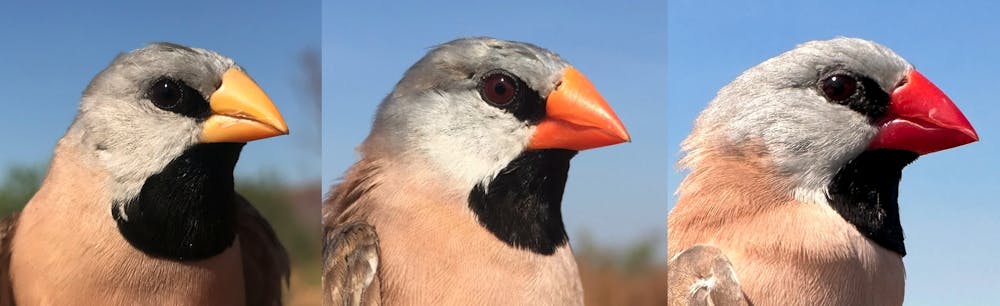 Bill colours of long-tailed finches from the Kimberley (left) Katherine (centre) and Queensland (right), illustrating the variation in the colour as the frequency of the genes change across Australia.
Daniel Hooper, CC BY-NC-ND
Bill colours of long-tailed finches from the Kimberley (left) Katherine (centre) and Queensland (right), illustrating the variation in the colour as the frequency of the genes change across Australia.
Daniel Hooper, CC BY-NC-ND
The wonder of nature
The evolution of colour in birds has been the focus of attention since Charles Darwin used them in outlining his theory of evolution by natural selection. The most obvious difference between the closely related species of birds that we see around us is their colour.
These two new studies have shown us how a few genes and the addition of that single oxygen atom can change the course of evolution, creating a new form that looks so dramatically different. If this improves the animal in an evolutionary sense – perhaps they look more attractive to potential partners or stand out more – it can lead to the origin of a new species.
This work reminds us of the wonder of nature and shows that evolution is an ongoing process.
To conserve species we need to protect as much of their genetic complexity as possible. Every individual in a population contains a unique genome and every small bit of variation is the product of millions of years of evolution in the past. It could also be the key to the development of a new species in the future.
Authors: Simon Griffith, Professor of Avian Behavioural Ecology, Macquarie University


















