

What’s the difference between liquid and powder laundry detergent? It’s not just the obvious
- Written by: Nathan Kilah, Senior Lecturer in Chemistry, University of Tasmania
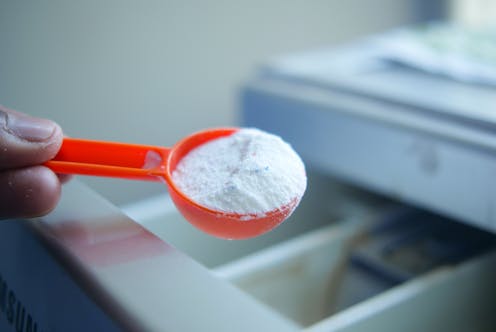
When shopping for a laundry detergent, the array of choices is baffling. All of the products will likely get your laundry somewhat cleaner. But what gets the best outcome for your clothes and your budget?
Do you want whiter whites? Do you need enzymes? And what’s the difference between a powder and liquid detergent?
As is often the case, knowing more about the chemistry involved will help you answer those questions.
What is a detergent?
The active ingredients in both laundry powders and liquids are “surfactants”, also known as detergents (hence the product name). These are typically charged or “ionic” molecules that have two distinct parts to their structure. One part interacts well with water and the other interacts with oils.
This useful property allows surfactants to lift grease and grime from fabrics and suspend it in the water. Surfactants can also form bubbles.
Metal salts dissolved in your water can limit the performance of the surfactants. So-called hard water contains lots of dissolved calcium and magnesium salts which can readily form soap scum.
Modern laundry detergents therefore contain phosphates, water softeners and other metal “sequestrants” to stop the formation of soap scum. Phosphates can cause algal blooms in fresh water environments. This is why modern detergent formulations contain smaller amounts of phosphates.
Many products also contain optical brighteners. These chemicals absorb ultraviolet light and release blue light, which provides the “whiter white” or “brighter colour” phenomenon.
Laundry detergents typically contain fragrances. These aren’t essential to the chemistry of cleaning, but give the impression the clothes are fresh.
Lastly, some laundry detergents contain enzymes – more on those later.
What’s in laundry powder?
While detergents and ingredients to avoid soap scum are the most important components, they aren’t the most abundant. The main ingredients in powders are salts (like sodium sulfate) that add bulk and stop the powder from clumping.
Another common salt added to laundry powders is sodium carbonate, also known as washing soda. Washing soda (a chemical cousin of baking soda) helps to chemically modify grease and grime so they dissolve in water.
Laundry powders also frequently contain oxidising agents like sodium percarbonate. This is a stable combination of washing soda and hydrogen peroxide. An additive known as tetraacetylethylenediamine activates the percarbonate to give a mild bleaching effect.
Chemically, powders have an advantage – their components can be formulated and mixed but kept separate in a solid form. (You can usually see different types of granules in your laundry powder.)

What’s in laundry liquid?
The main ingredient of laundry liquid is water. The remaining ingredients have to be carefully considered. They must be stable in the bottle and then work together in the wash.
These include similar ingredients to the powders, such as alkaline salts, metal sequestrants, water softeners and surfactants.
The surfactants in liquid products are often listed as “ionic” (charged) and “non-ionic” (non-charged). Non-ionic surfactants can be liquid by default, which makes them inappropriate for powdered formulations. Non-ionic surfactants are good at suspending oils in water and don’t form soap scum.
Liquid detergents also contain preservatives to prevent the growth of microbes spoiling the mixture.
There are also microbial implications for inside the washing machine. Liquid products can’t contain the peroxides (mild bleaching agents) found in powdered products. Peroxides kill microbes. The absence of peroxides in liquid detergents makes it more likely for mould biofilms to form in the machine and for bacteria to be transferred between items of clothing.
As an alternative to peroxides, liquids will typically contain only optical brighteners.
Liquids do have one advantage over powders – they can be added directly to stains prior to placing the item in the wash.
A recent “convenience” version of liquid formulas are highly concentrated detergent pods. Colourful and bearing a resemblance to sweet treats, these products have been found to be dangerous to young children and people with cognitive impairment.
Pods also remove the option to add less detergent if you’re running a smaller load or just want to use less detergent in general.
 Detergent ‘pods’ mainly contain highly concentrated laundry liquid.
Vershinin89/Shutterstock
Detergent ‘pods’ mainly contain highly concentrated laundry liquid.
Vershinin89/Shutterstock
So, what about enzymes?
Enzymes are naturally evolved proteins included in laundry products to remove specific stains. Chemically, they are catalysts – things that speed up chemical reactions.
Enzymes are named for the molecules they work on, followed by the ending “-ase”. For example, lipase breaks down fats (lipids), protease breaks down protein, while amylase and mannanase break down starches and sugars.
These enzymes are derived from organisms found in cool climate regions, which helps them function at the low temperature of washing water.
Running an excessively hot wash cycle can damage or denature the enzyme structure, stopping them from assisting in your wash. Think of an egg white changing from translucent to white while cooked – that’s protein denaturing.
If your detergent contains enzymes, the washing temperature should be neither too hot nor too cold. As a guide, temperatures of 15–20°C are used in standard laundry tests.
Is powder or liquid better?
We make consumer choices guided by performance, psychology, cost, scent, environmental considerations and convenience.
It’s worth experimenting with different products to find what works best for you and fits your needs, household budget and environmental considerations, such as having recyclable packaging.
Personally, I wash at 20°C with half the recommended dose of a pleasant-smelling laundry powder, packaged in recyclable cardboard, and containing a wide range of enzymes and an activated peroxide source.
Knowing a little chemistry can go a long way to getting your clothes clean.
However, laundry detergent manufacturers don’t always disclose the full list of ingredients on their product packaging.
If you want more information on what’s in your product, you have to look at the product website. You can also dig a little deeper by reading documents called safety data sheets (SDS). Every product containing potentially hazardous chemicals must have an SDS.
Authors: Nathan Kilah, Senior Lecturer in Chemistry, University of Tasmania


















