

Move away from a car-dominated city looks radical but it's a sensible plan for a liveable future
- Written by Hussein Dia, Professor of Future Urban Mobility, Swinburne University of Technology
More shared spaces, safer streets and fewer cars in the city are all part of a newly released ten-year plan by the City of Melbourne. This evening, Town Hall will consider the ambitious draft transport strategy that would boost pedestrian, cycling and tram access across the CBD’s Hoddle Grid.
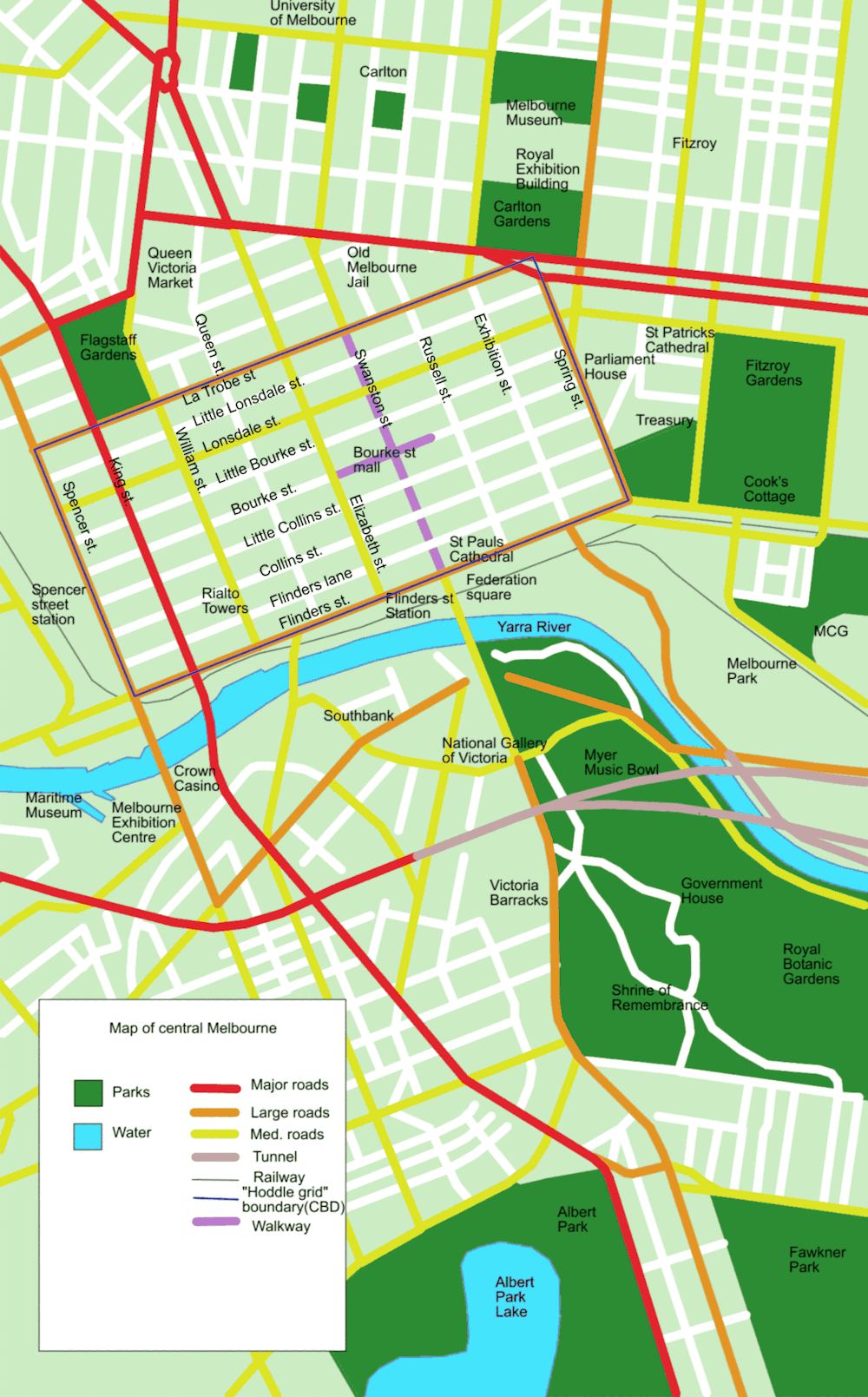 A map of central Melbourne, with the Hoddle Grid, including the ‘little’ streets, at its heart.
Wikimedia, CC BY-SA
A map of central Melbourne, with the Hoddle Grid, including the ‘little’ streets, at its heart.
Wikimedia, CC BY-SA
A significant amount of on-street parking and road space would be reallocated to walking, cycling and greenery. Some “little” streets would be converted to shared zones that give priority to pedestrians, with reduced speed limits. Variable parking pricing would be trialled and congestion charging not be ruled out.
The strategy recognises the role of technology in delivering community benefits. It supports trials of shared mobility (all types of conveniently accessible rental vehicles) and tech-enabled seamless travel solutions (people using mobility as a service, typically via an app and single payment platform, when they need it).
The result of these digital technology-driven mobility shifts is a lower proportion of people owning vehicles.
Read more: For Mobility as a Service (MaaS) to solve our transport woes, some things need to change
The strategy also foresees transport in the city will be emissions-free by 2050. On-demand travel and deliveries by air could be in the mix of solutions.
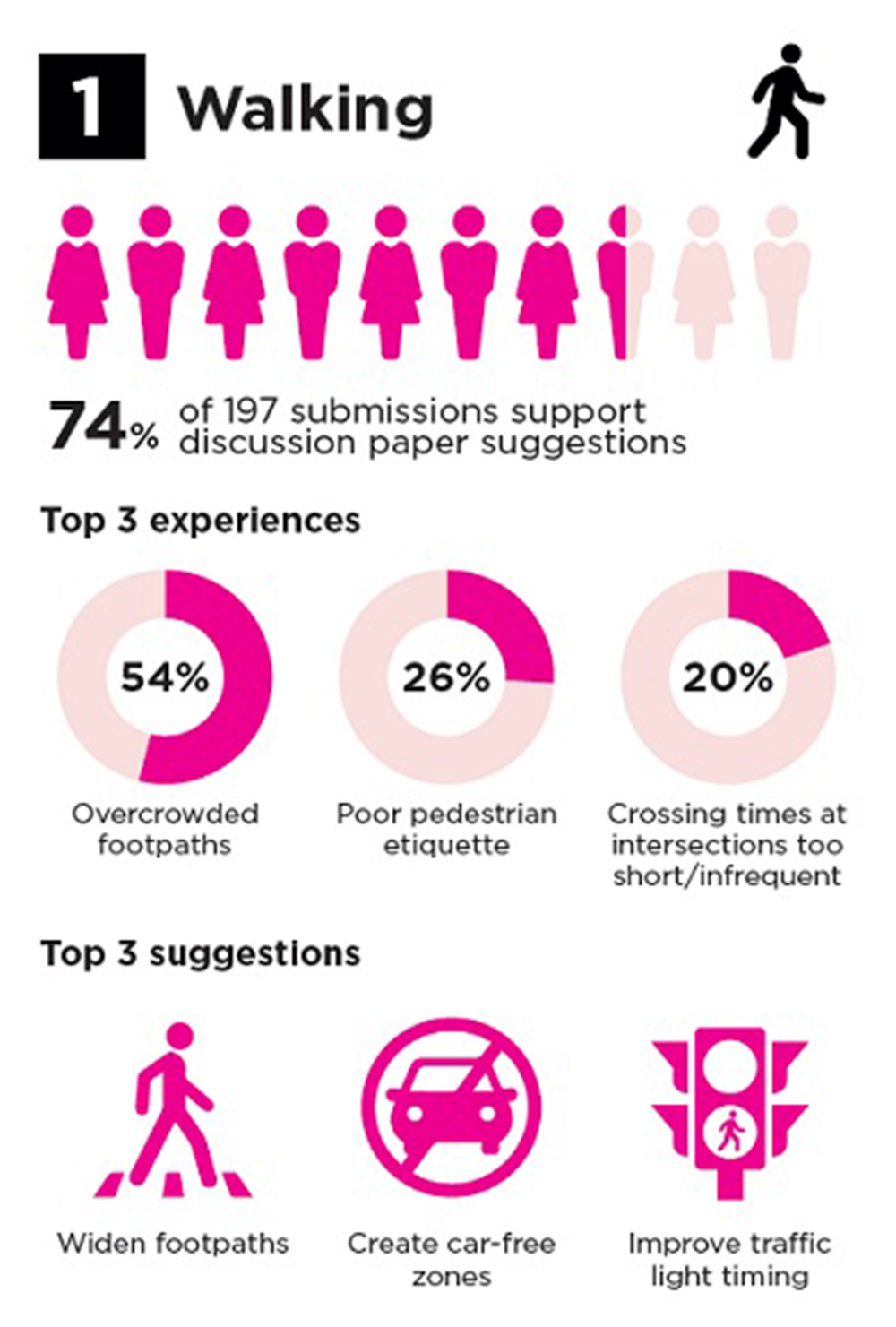 An analysis of public feedback to the city council on walking in the city.
Participate Melbourne/Melbourne City
An analysis of public feedback to the city council on walking in the city.
Participate Melbourne/Melbourne City
While the plan might seem radical, these policies are sensible, comprehensive and crucial to the city’s future. They’re aligned with best practice in leading global cities.
Some cities have far more aggressive policies and emissions reduction targets. Around the world, 15 cities are already starting to ban cars altogether from urban centres.
Melbourne’s transport strategy “refresh” follows a year of reviews and public consultation (you can see the public responses here).
There will be implementation challenges, which the draft strategy acknowledges. It notes the need to provide access for people with disability.
The plan also includes ongoing access for commercial vehicles, delivery vans and emergency services.
Read more: Four ways our cities can cut transport emissions in a hurry: avoid, shift, share and improve
Responding to travel trends
The new strategy recognises that Melburnians’ travel habits have changed and will continue to adapt to modern-day urban living. This includes recent trends towards increased use of public transport and active travel options such as cycling and walking.
Today, walking accounts for about 90% of all travel in the Hoddle Grid, yet pedestrians are allocated only 24% of street space.
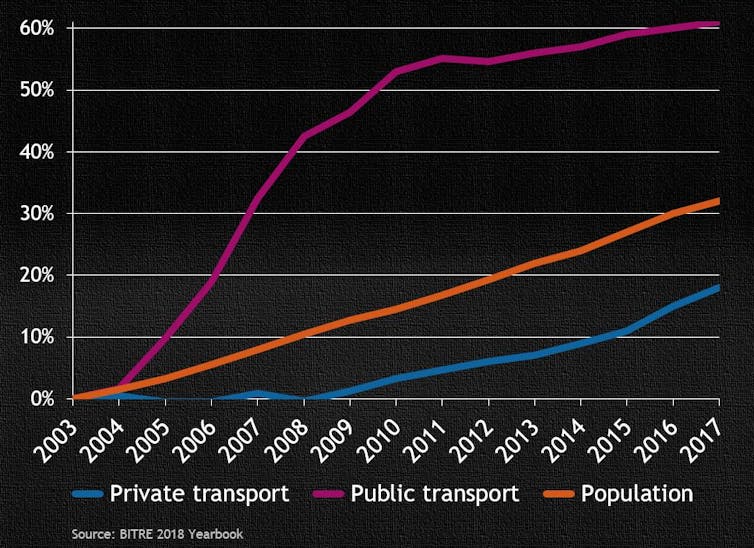
Across Melbourne since 2003, the growth in public transport use has been around three times the growth in private transport use. Over this time the growth in car use has been slower than population growth.
Growth in private and public transport passenger kilometres in Melbourne since 2003
 More than 900,000 people move into, within and through the municipality each day, the strategy notes. This is expected to climb to 1.4 million people a day in 2036. The city’s streets and places would need to adapt to support these changes.
Read more:
The battle to be the Amazon (or Netflix) of transport
Another policy in the draft strategy is to reduce through-traffic. Around 43% of cars coming into the city are heading for a destination beyond the Hoddle Grid. Spencer Street, King Street and William Street carry most of that traffic.
More than 900,000 people move into, within and through the municipality each day, the strategy notes. This is expected to climb to 1.4 million people a day in 2036. The city’s streets and places would need to adapt to support these changes.
Read more:
The battle to be the Amazon (or Netflix) of transport
Another policy in the draft strategy is to reduce through-traffic. Around 43% of cars coming into the city are heading for a destination beyond the Hoddle Grid. Spencer Street, King Street and William Street carry most of that traffic.
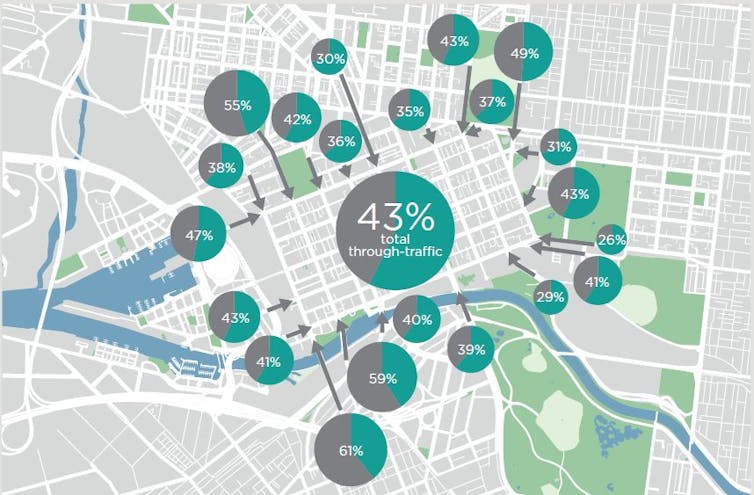 Proportion of through-traffic entering the Hoddle Grid at each entry point.
City of Melbourne, Draft Transport Strategy 2030, page 53
The strategy calls for the city council to work with government to contain through-traffic to freeways and arterial roads. Removing non-essential vehicle trips can free up space to make streets safer and more efficient. It also improves access for emergency vehicles, on-road public transport and deliveries.
Rethinking transport priorities
The draft strategy represents a call for action to overcome unsustainable transport practices. For Melbourne to thrive, the transport priorities need to be rearranged to meet travel demand, emissions targets and citizens’ changing needs.
In adopting this approach, the strategy reflects the changing landscape and emerging trends of urban mobility, as well as community expectations.
Proportion of through-traffic entering the Hoddle Grid at each entry point.
City of Melbourne, Draft Transport Strategy 2030, page 53
The strategy calls for the city council to work with government to contain through-traffic to freeways and arterial roads. Removing non-essential vehicle trips can free up space to make streets safer and more efficient. It also improves access for emergency vehicles, on-road public transport and deliveries.
Rethinking transport priorities
The draft strategy represents a call for action to overcome unsustainable transport practices. For Melbourne to thrive, the transport priorities need to be rearranged to meet travel demand, emissions targets and citizens’ changing needs.
In adopting this approach, the strategy reflects the changing landscape and emerging trends of urban mobility, as well as community expectations.
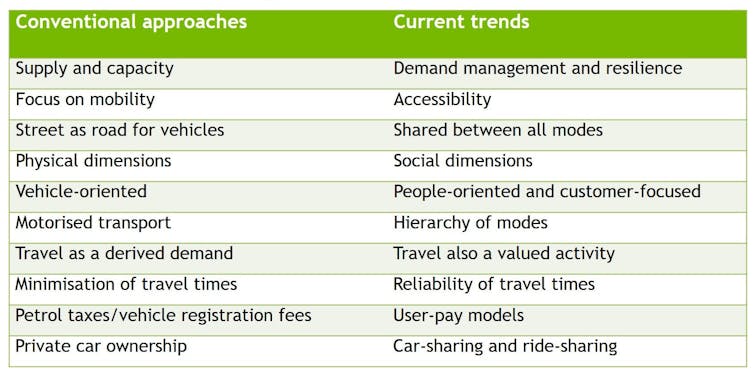 The changing landscape of urban mobility.
Low Carbon Mobility for Future Cities: Principles and Applications, Author provided
The draft strategy gives priority to policy solutions that will improve liveability and promote a safe and healthy city. These focus on active modes of transport, integrating transport and land use, investments in pedestrian-oriented initiatives, optimising use of scarce space and encouraging public transport.
The strategy also looks to overcome barriers to urban innovation. It points to the need for more agile regulation to support emerging modes of travel such as dockless bikes and e-scooters.
Read more:
Banning 'tiny vehicles' would deny us smarter ways to get around our cities
What’s the next step?
Councillors will consider the draft strategy at a Future Melbourne Committee meeting today. If endorsed, it will be released for further public consultation and feedback for six weeks.
The strategy will require a shift in travel behaviour. Whether the public embraces or objects to the new policy directions remains to be seen. The details will be critical.
Many would be excited by this vision and would want certain policies rolled out today, not by 2030. Others might be sceptical and some would still want to drive into the inner city, even if other attractive travel options are made available.
If well executed and implemented, the strategy’s proposals will improve liveability and access to the city. Together with some state government projects, such as Melbourne Metro, these policies will help to modernise the city’s infrastructure to meet the needs for smart and sustainable growth and jobs.
The changing landscape of urban mobility.
Low Carbon Mobility for Future Cities: Principles and Applications, Author provided
The draft strategy gives priority to policy solutions that will improve liveability and promote a safe and healthy city. These focus on active modes of transport, integrating transport and land use, investments in pedestrian-oriented initiatives, optimising use of scarce space and encouraging public transport.
The strategy also looks to overcome barriers to urban innovation. It points to the need for more agile regulation to support emerging modes of travel such as dockless bikes and e-scooters.
Read more:
Banning 'tiny vehicles' would deny us smarter ways to get around our cities
What’s the next step?
Councillors will consider the draft strategy at a Future Melbourne Committee meeting today. If endorsed, it will be released for further public consultation and feedback for six weeks.
The strategy will require a shift in travel behaviour. Whether the public embraces or objects to the new policy directions remains to be seen. The details will be critical.
Many would be excited by this vision and would want certain policies rolled out today, not by 2030. Others might be sceptical and some would still want to drive into the inner city, even if other attractive travel options are made available.
If well executed and implemented, the strategy’s proposals will improve liveability and access to the city. Together with some state government projects, such as Melbourne Metro, these policies will help to modernise the city’s infrastructure to meet the needs for smart and sustainable growth and jobs.
Authors: Hussein Dia, Professor of Future Urban Mobility, Swinburne University of Technology


















