are water crystals bad for the environment?
- Written by Michelle Ryan, Lecturer - Environmental Health and Management, Western Sydney University
This is an article from I’ve Always Wondered, a series where readers send in questions they’d like an expert to answer. Send your question to alwayswondered@theconversation.edu.au
Are water crystals bad for the environment? –Terry Gilmour
This is an excellent question, and something an environmentally conscious gardener might wonder. With changing rainfall patterns, drought and an increasing average temperature in Australia many people are looking for ways to save water in their garden, and adding water crystals to your soil appears to be a good solution. But what do we really know about water crystals and are they bad for the environment?
Well, you can put your mind at ease: water crystals are not bad for the environment. In fact, in other forms they are actually used to help protect the environment.
What are water crystals?
Water crystals are tiny super-absorbent polymers (a long chain that’s made up of identical repeating molecules), about the size of a sugar crystal. They are added to potting mix or added to soil in a garden bed to increase the water holding capacity of the soil.
Water crystals act like a sponge, binding water molecules with the molecule chains in the crystals (with what’s technically known as cross-link bonding). This makes the crystal swell, creating a three-dimensional gel network up to 300 times its original size, absorbing water and nutrients.
Read more: Not all community gardens are environmental equals
Over 5-6 years water crystals slowly degrade, releasing the absorbed water into the root zone of the plant and wetting the soil.
While many water crystals are marketed as water-saving, and many people use them to drought-proof their plants, it’s really important to know that these water crystals don’t actually conserve water. The plants still use the same amount of water, but instead of the water flowing through to the bottom of the pot and into the saucer and evaporating, or through to the bottom of the garden bed, the water crystals hold onto the water in the root zone of the plant. It makes for a more efficient use of the water in the soil.
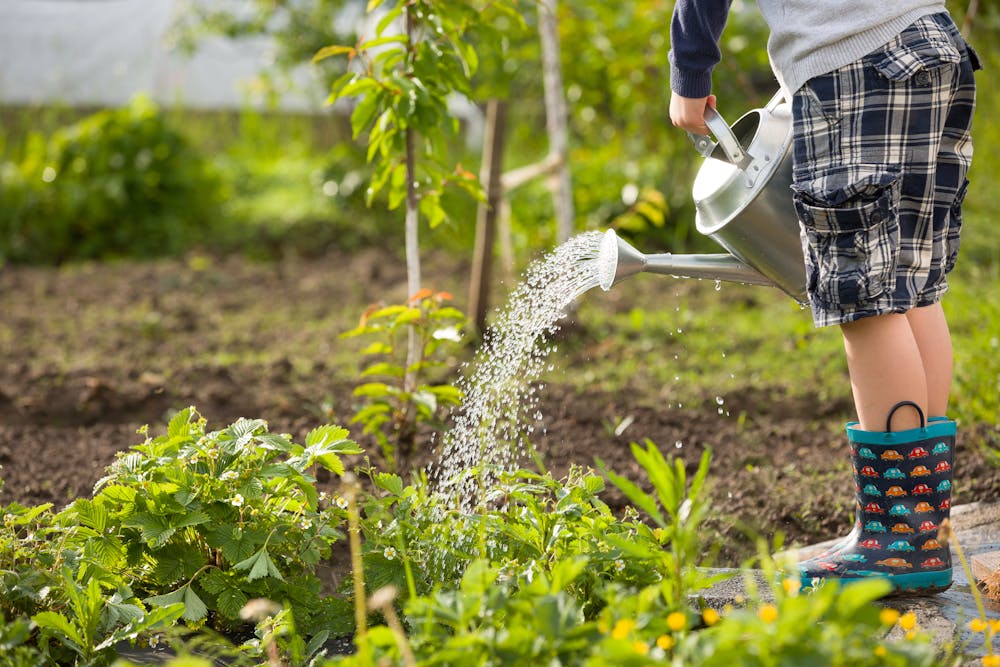 Gardeners are not always able to frequently water their plants on hot summer days.
Shutterstock
Gardeners are not always able to frequently water their plants on hot summer days.
Shutterstock
Cross-linked vs linear polymers
To understand where the environmental concerns come from, we have to get a little technical.
The most common type of water crystal on the market is a cross-linked polyacrylamide. Cross-linked polyacrylamides are water absorbent but not water soluble. One of their best-known uses is in disposable nappies.
The environmental concern regarding water crystals comes from people confusing these cross-linked polyacrylamides with non-cross-linked polyacrylamide used by industry. While they are commonly described in the same way, they have a different chemical bonding and properties.
Read more: How your garden could help stop your city flooding
Non-cross-linked (linear) polyacrylamide is water-soluble. It is currently used in Australian agriculture for improving soil and to help control erosion. It also plays an integral role in aiding flocculation as part of the sewage treatment process.
A 1997 study found when non-cross linked polyacrylamide degrades it creates acrylamide, a suspected carcinogen and neurotoxin.
Obviously this would be very concerning if it also affected water crystals! Acrylamide could leach into the soil and water and be taken up by plants, entering the human food chain. However there’s no proof cross-linked polyacrylamides – which are the water crystals you’d find in a gardening store – behave like this.
 It is not clear if water crystals have a negative impact on Australia’s rivers and streams.
Shutterstock
It is not clear if water crystals have a negative impact on Australia’s rivers and streams.
Shutterstock
It is also worth noting that further studies, including one published in 2008, found a very small amount (less than 0.5 parts per billion) of acrylamide was released into the environment, which does not cause any environmental concern.
You may also worry water crystals could impact aquatic life if they found their way into rivers and streams. The good news is there’s no reported toxicity or impact on aquatic life from commercially available water crystals (results are more mixed for the water soluble non-cross-linked polyacrylamide, with some studies finding little impact and others showing no toxicity.
Read more: Are common garden chemicals a health risk?
The other good news is water crystals do not accumulate in the soil or water over the long term. The use of water crystals has no adverse impact on soil microbe populations, which we need for a good healthy soil. If used as directed there is no risk to human health (however, it is always good practice to wear gloves while handling any chemical product).
So environmentally conscious gardeners don’t need to worry about water crystals. They’re great for people who don’t have time to water their pot plants every day in summer. Remember, these crystals do not save water but increase the water holding capacity of the soil, so you still need to water your plants regularly – especially on hot days!
Authors: Michelle Ryan, Lecturer - Environmental Health and Management, Western Sydney University
Read more http://theconversation.com/ive-always-wondered-are-water-crystals-bad-for-the-environment-112519