

Overwhelmed by ever more clothing donations, charities are exporting the problem. Local governments must step up
- Written by: Yassie Samie, Postdoctoral Researcher in Fashion and Textiles, RMIT University
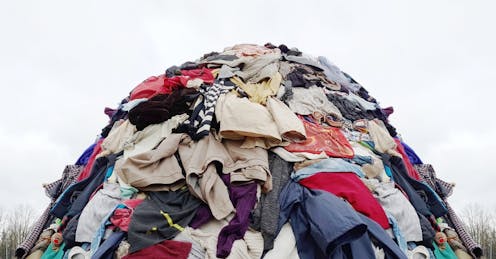
What happens to your clothes after you don’t want them any more? Chances are, you will donate them to op shops run by a charity organisation.
There are more and more clothes in circulation, and they are getting cheaper and lower quality. That means the clothes you give away are worth less and less. For charities, this means donated clothes are less gift, more rubbish.
Our new research explores what happens to clothes and other textiles after we don’t want them across nine cities in Europe, North America and Australia. The pattern was the same in most cities. The sheer volume is overwhelming many shops. In Geneva, donations to charity shops have surged 1,200% in three decades, from 250 tonnes in 1990 to 3,000 tonnes in 2021. Worldwide, we now dump 92 million tonnes of clothes and textiles a year, double the figure of 20 years earlier.
There’s less and less value in managing these clothes locally. As a result, charities are forced to send more clothes to landfill – or sell bale after bale of clothing to resellers, who ship them to nations in the Global South.
Local governments usually handle other waste streams. But on clothes and textiles, they often leave it to charitable organisations and commercial resellers. This system is inherited from a time when used clothing was a more valuable resource, but the rising quantity of clothing has pushed this system towards collapse.
From January, all EU states have to begin rolling out collection services for used textiles. But in Australia and the United States there are no moves to do the same – even though these two countries consume the most textiles per capita in the world. As we work towards creating circular economies, where products are continually reused, this will have to change.

Textile waste is a new problem
Historically, textiles were hard to make and hence valuable. They were used for as long as possible and reused as rags or other purposes before becoming waste. These natural fibres would biodegrade or be burned for energy.
But synthetic fibres and chemical finishings have made more and more clothes unable to biodegrade. Fast fashion – in which high fashion trends are copied and sold at low cost – is only possible because of synthetic fibers such as polyester.
These clothes are often worn for a brief period and then given or thrown away.
What happens to this waste? To find out, we looked at textile waste in Amsterdam, Austin, Berlin, Geneva, Luxembourg, Manchester, Melbourne, Oslo and Toronto. In eight of these cities, charities and commercial resellers dealt with the lion’s share of clothing waste. But in Amsterdam, local governments manage the problem.
Across the nine cities, most donated clothes go not to charity shops shelves but to export. In Oslo, 97% of clothes are exported.
The flood of clothes is producing strange outcomes in some places. In Melbourne, charities are now exporting higher quality secondhand clothes to Europe. But we found this forces independent secondhand clothing outlets to import similar clothes back from Europe or the US.
 Textile waste piles up in Oslo, Norway.
Author provided, Author provided (no reuse)
Textile waste piles up in Oslo, Norway.
Author provided, Author provided (no reuse)
Charity organisations usually export the clothes across the Global South. But shipping container loads of secondhand clothes and textiles can do real damage environmentally. Clothing that can’t be sold becomes waste. In Ghana, there are now 20-metre-high hills made of clothing waste. Synthetic clothes clog up rivers, trap animals and spread plastics as they break apart. This practice has been dubbed “waste colonialism”.
Uganda has recently banned imports. The secondhand clothing export industry provides work, but its social and environmental impacts have been devastating.
What should we do?
At present, charities and resellers are struggling with managing the rising volume of donations, but they have little room to change. Exporting excess clothing is getting less profitable, but moving to local sorting and resale would be even less so due to higher costs and too many clothes collected relative to demand for secondhand items.
These clothes are disposed of by consumers who live in cities in wealthier countries. The actions city leaders take can reduce the problem globally, such as encouraging residents to buy fewer new clothes and boosting local reuse, repair and recycling efforts.
 Charity shops are inundated with fast fashion donations.
triocean/Shutterstock
Charity shops are inundated with fast fashion donations.
triocean/Shutterstock
We are already seeing seeing grassroots initiatives emerging in all nine studied cities promoting local reuse and repair, with some receiving government support and others operating independently.
To make real change, municipal governments will have to take on a larger role. At present, municipal governments in most of the cities we studied have limited roles, ranging from sending clothing waste to landfill to sharing data on clothing recycling bins, letting charities and resellers set up collection points and supporting repair and swapping.
Here are three ways local governments could take the lead:
1. Curb overconsumption
Dealing with waste is a major role for municipal governments, and comes with major costs. To reduce clothing waste, cities could launch campaigns against overconsumption by focusing on the environmental damage done by fast fashion – or even banning ads for clothing retailers in city centres.
2. Boost reuse
Local governments could stop charging charities for the right to collect clothing and instead offer compensation for every kilo of collected textiles to help replace the money they get from sending clothing bales to resellers for export. Cities can also train and support circular economy practitioners, such as those involved in repair and upcycling.
3. Reduce exports of clothing waste
City leaders could reduce textile exports by recognising them as a waste stream and including textiles in their waste management planning.
One thing is certain – if we keep going as we are, flows of clothing waste will only grow, leading to more waste locally – and greatly increase the waste problem overseas.
Authors: Yassie Samie, Postdoctoral Researcher in Fashion and Textiles, RMIT University


















