

how First Nations people take ownership of their cultural stories through fashion
- Written by: Treena Clark, Chancellor’s Indigenous Research Fellow, Faculty of Design, Architecture and Building, University of Technology Sydney
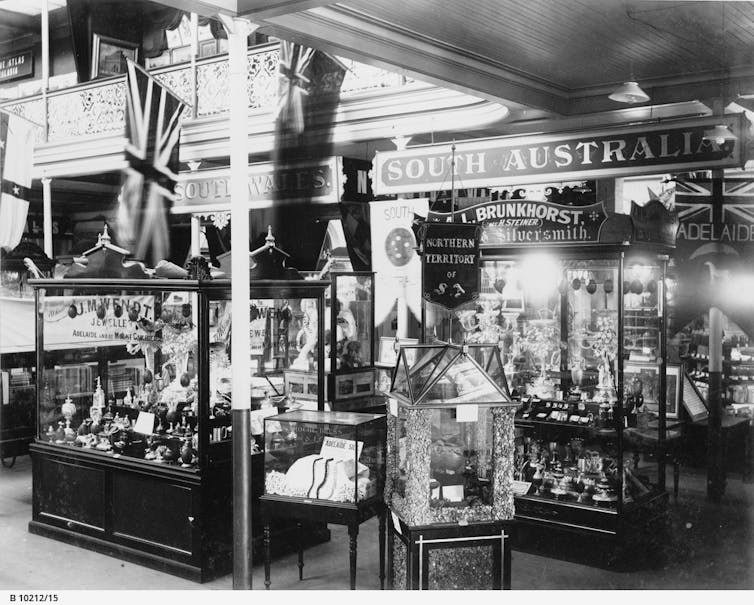
Once located 250 metres to the east of the Art Gallery of South Australia, the grand beaux-arts style Jubilee Exhibition Building was constructed to house the 1887 Adelaide Jubilee International Exhibition and to celebrate the 50th anniversary of South Australian settlement.
Hosting interstate and international participants, the exhibition presented various items, including machinery, fine art, textiles and produce.
In the South Australian section, the Protector of Aborigines, responsible for controlling Aboriginal people in South Australia and the Northern Territory, exhibited cultural implements and artefacts.
Some of these items included bags and wallets made of “native hemp” from the Northern Territory.
This colonial presentation of forced and unpaid fashion labour from First Nations people was a practice that had commenced decades earlier.

In 1866, the Central Board for the Protection of the Aborigines showcased baskets, bags, and bonnets at the Melbourne Intercolonial Exhibition of Australasia.
In the Queensland Court of the 1888 Melbourne Centennial Exhibition, pearl jewellery from the Torres Strait Islands was exhibited.
By the mid-20th century, these wares ceased being displayed in the exhibitions and First Nations people had more autonomy in their craft production. This rise of self-determination led to the first wave of First Nations fashion design, of contemporary garment-makers and textile-designers.
A market for design
In Coffs Harbour in the mid-1960s, First Nations women made clothes for tourists at the Big Banana. Although the garments did not feature their designs, the women received income from crafting the dresses and sarongs.
In the late 1960s, textiles from the Tiwi Islands emerged and were later paraded in small fashion shows.
Other arts and crafts centres soon joined the textile movement, and an explosion of designs materialised in the market.
 The Big Banana, photographed in the mid-1960s.
Courtesy of the City of Coffs Harbour, CC BY
The Big Banana, photographed in the mid-1960s.
Courtesy of the City of Coffs Harbour, CC BY
By the 1980s, First Nations fashion design had been cemented as a movement.
This was the time of individual designers presenting alongside the established arts and crafts centres and showcasing their designs on international runways.
Their designs and silhouettes were new: they told contemporary stories of colonisation, community, family and culture.
Self-determination
Today, First Nations artists and designers are self-determining the ownership of their cultural stories and the appropriate practices within the fashion, gallery, library and museum sectors.
Many First Nations artists and designers are presenting across multiple mediums and ensuring their designs and practices are culturally, environmentally and economically sustainable.
The First Nations pieces featured in the exhibition Radical Textiles traverse art and fashion design, taking the item off the body and onto a mannequin or frame. These works of art share a common thread of honouring and celebrating tradition, ancestors, family, community and Country.
The pieces embody wearable art from a purely experimental or commercial approach.
Trudy Inkamala (Western Arrernte/Luritja people) (1940–2023) and Sheree Inkamala’s (Western Arrernte/Luritja/Pitjantjatjara people) (b. 1995) Dilly bags everywhere (2021) features a contemporary vibrant bag and striking bold dress print depicting women and animal motifs.
 Trudy Inkamala, Western Arrernte/Luritja people, Northern Territory, born Hamilton Downs Station, Northern Territory 1940, died Northern Territory 2023, Sheree Inkamala, Western Arrernte/Luritja/Pitjantjatjara people, Northern Territory/South Australia, born Mparntwe (Alice Springs), Northern Territory 1995, Yarrenyty Arltere Artists, Dilly bags everywhere! (dress and dilly bag), 2021, Mparntwe (Alice Springs), Northern Territory, cotton, recycled woolen blankets, plant dyes, discarded metal, wool, 96.0 cm (centre back), 120.0 cm (diam) (bust), 57.0 x 27.0 x 7.5 cm (b); Gift of the Hon. Diana Laidlaw AM through the Art Gallery of South Australia Foundation 2024, Art Gallery of South Australia, Adelaide.
© the artist and Yarrenyty Arltere Artists
Trudy Inkamala, Western Arrernte/Luritja people, Northern Territory, born Hamilton Downs Station, Northern Territory 1940, died Northern Territory 2023, Sheree Inkamala, Western Arrernte/Luritja/Pitjantjatjara people, Northern Territory/South Australia, born Mparntwe (Alice Springs), Northern Territory 1995, Yarrenyty Arltere Artists, Dilly bags everywhere! (dress and dilly bag), 2021, Mparntwe (Alice Springs), Northern Territory, cotton, recycled woolen blankets, plant dyes, discarded metal, wool, 96.0 cm (centre back), 120.0 cm (diam) (bust), 57.0 x 27.0 x 7.5 cm (b); Gift of the Hon. Diana Laidlaw AM through the Art Gallery of South Australia Foundation 2024, Art Gallery of South Australia, Adelaide.
© the artist and Yarrenyty Arltere Artists
Sustainable and recycled materials, including used woollen blankets, discarded metal and cotton dyed from plants, are prominent in this work.
Trudy Inkamala was a respected Elder and knowledge-keeper who crafted fibre and hand-painted art that depicted and featured people and wildlife. Her younger relation, Sheree Inkamala, is an emerging sculptural textile and print artist.
Their designs embody the Yarrenyty Arltere Artists style, an Aboriginal-owned and run art centre in Mparntwe (Alice Springs), renowned for its colourful and playful soft sculptures, works on paper, textiles and film.
Annabell Amagula’s (Anindilyakwa people) (b. 1965) representation of Country, culture and sustainability in her Ghost Net Bag and Dress (2020) highlights technical skill and intricate detail in several layers of craft.
Amagula’s dress and bag make use of fair-trade silk, a handwoven ghost net, and recycled miners’ high-vis uniforms.
The silk pattern depicts an existing image of Amagula’s ghost net crab sculpture, which has been repeated and digitally printed. A recycled miner’s uniform is used to edge the dress and, along with the ghost net, construct and shape the bag.
Amagula is a senior artist from Groote Eylandt in the Northern Territory and a member of Anindilyakwa Arts, whose family has significantly assisted her in the art of paint and bag creation.
Always was, always will be
Clothing The Gaps’ iconic Power Tee boldly incorporates the Aboriginal flag colours and features the historically significant message “Always Was, Always Will Be”, a powerful acknowledgement that Aboriginal and Torres Strait Islander people are the rightful custodians of this land and sovereignty was never ceded.
Clothing The Gaps is a majority Aboriginal-owned social enterprise located in Victoria, co-founded by Laura Thompson (Gunditjmara people) and Sarah Sheridan. The organisation designs wearable clothing for First Nations peoples and allies and uses colours and slogans to highlight the profoundly important themes impacting First Nations people.
Ethically made in Australia on Wurundjeri Country, Victoria, their clothes embody wearable activism, which calls for and influences social change.
Paul McCann’s (Marrithiyel people) (b. 1984) Sovereignty Never Ceded Gown and Suit (2023) speaks to the trauma and resilience of First Nations people and the importance of sovereignty and self-determination.
As a commissioned set for the 2023 Melbourne Fashion Festival, McCann’s gown features cream satin, blue organza and gold hand-painted designs. The black vintage suit is adorned with blue and gold hand-painted motifs.
A fashion design graduate, McCann was inspired by his grandmother’s vintage outfits and his family’s cultural stories and art. His design ethos is that of culture and glamour and he often adds hand-painted art and embellishments to garments and jewellery that tell stories of tradition and Country.
These four works of art and fashion have multiple interwoven messages, themes and creative practices. Some are wildly colourful, while others are subdued. Some represent contemporary graphics, while others traditional art. Some overtly speak to sovereignty, while others are subtle in their message.
Their commonality advocates and showcases culture, craft, sustainability and a desire for truth-telling.
This essay was originally published in the Radical Textiles publication from the Art Gallery of South Australia and is republished with permission.
Authors: Treena Clark, Chancellor’s Indigenous Research Fellow, Faculty of Design, Architecture and Building, University of Technology Sydney


















