

A 4.45 billion-year-old crystal from Mars reveals the planet had water from the beginning
- Written by: Aaron J. Cavosie, Senior lecturer, School of Earth and Planetary Sciences, Curtin University
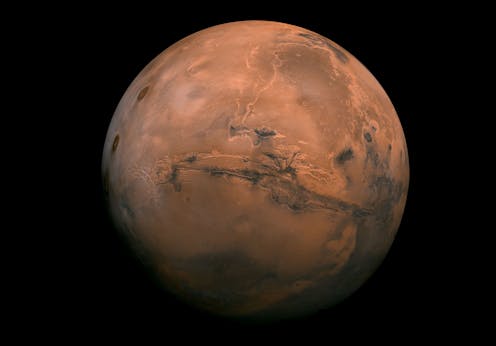
Water is ubiquitous on Earth – about 70% of Earth’s surface is covered by the stuff. Water is in the air, on the surface and inside rocks. Geologic evidence suggests water has been stable on Earth since about 4.3 billion years ago.
The history of water on early Mars is less certain. Determining when water first appeared, where and for how long, are all burning questions that drive Mars exploration. If Mars was once habitable, some amount of water was required.
We studied the mineral zircon in a meteorite from Mars and found evidence that water was present when the zircon crystal formed 4.45 billion years ago. Our results, published in the journal Science Advances today, may represent the oldest evidence for water on Mars.
A wet red planet
Water has long been recognised to have played an important role in early Martian history. To place our results in a broader context, let’s first consider what “early Mars” means in terms of the Martian geological timescale, and then consider the different ways to look for water on Mars.
Like Earth, Mars formed about 4.5 billion years ago. The history of Mars has four geological periods. These are the Amazonian (from today back to 3 billion years), the Hesperian (3 billion to 3.7 billion years ago), the Noachian (3.7 billion to 4.1 billion years ago) and the Pre-Noachian (4.1 billion to about 4.5 billion years ago).
Evidence for water on Mars was first reported in the 1970s when NASA’s Mariner 9 spacecraft captured images of river valleys on the Martian surface. Later orbital missions, including Mars Global Surveyor and Mars Express, detected the widespread presence of hydrated clay minerals on the surface. These would have needed water.
The Martian river valleys and clay minerals are mainly found in Noachian terrains, which cover about 45% of Mars. In addition, orbiters also found large flood channels – called outflow channels – in Hesperian terrains. These suggest the short-lived presence of water on the surface, perhaps from groundwater release.
Most reports of water on Mars are in materials or terrains older than 3 billion years. More recent than that, there isn’t much evidence for stable liquid water on Mars.
But what about during the Pre-Noachian? When did water first show up on Mars?

A window to Pre-Noachian Mars
There are three ways to hunt for water on Mars. The first is using observations of the surface made by orbiting spacecraft. The second is using ground-based observations such as those taken by Mars rovers.
The third way is to study Martian meteorites that have landed on Earth, which is what we did.
In fact, the only Pre-Noachian material we have available to study directly is found in meteorites from Mars. A small number of all meteorites that have landed on Earth have come from our neighbouring planet.
An even smaller subset of those meteorites, believed to have been ejected from Mars during a single asteroid impact, contain Pre-Noachian material.
The “poster child” of this group is an extraordinary rock called NWA7034, or Black Beauty.
 The Martian meteorite NWA 7034, also known as Black Beauty.
NASA
The Martian meteorite NWA 7034, also known as Black Beauty.
NASA
Black Beauty is a famous Martian meteorite made up of broken-up surface material, or regolith. In addition to rock fragments, it contains zircons that formed from 4.48 billion to 4.43 billion years ago. These are the oldest pieces of Mars known.
While studying trace elements in one of these ancient zircons we found evidence of hydrothermal processes – meaning they were exposed to hot water when they formed in the distant past.
Trace elements, water and a connection to ore deposits
The zircon we studied is 4.45 billion years old. Within it, iron, aluminium and sodium are preserved in abundance patterns like concentric layers, similar to an onion.
This pattern, called oscillatory zoning, indicates that incorporation of these elements into the zircon occurred during its igneous history, in magma.
 Iron elemental zoning in the 4.45 billion-year-old martian zircon. Darker blue areas indicate the highest iron abundances.
Aaron Cavosie & Jack Gillespie
Iron elemental zoning in the 4.45 billion-year-old martian zircon. Darker blue areas indicate the highest iron abundances.
Aaron Cavosie & Jack Gillespie
The problem is that iron, aluminium and sodium aren’t normally found in crystalline igneous zircon – so how did these elements end up in the Martian zircon?
The answer is hot water.
In Earth rocks, finding zircon with growth zoning patterns for elements like iron, aluminium and sodium is rare. One of the only places where it has been described is from Olympic Dam in South Australia, a giant copper, uranium and gold deposit.
The metals in places like Olympic Dam were concentrated by hydrothermal (hot water) systems moving through rocks during magmatism.
Hydrothermal systems form anywhere that hot water, heated by volcanic plumbing systems, moves through rocks. Spectacular geysers at places like Yellowstone National Park in the United States form when hydrothermal water erupts at Earth’s surface.
 Old Faithful geyser erupting at Yellowstone National Park.
Edward Fielding/Shutterstock
Old Faithful geyser erupting at Yellowstone National Park.
Edward Fielding/Shutterstock
Finding a hydrothermal Martian zircon raises the intriguing possibility of ore deposits forming on early Mars.
Previous studies have proposed a wet Pre-Noachian Mars. Unusual oxygen isotope ratios in a 4.43 billion-year-old Martian zircon were previously interpreted as evidence for an early hydrosphere. It has even been suggested that Mars may have had an early global ocean 4.45 billion years ago.
The big picture from our study is that magmatic hydrothermal systems were active during the early formation of Mars’ crust 4.45 billion years ago.
It’s not clear whether this means surface water was stable at this time, but we think it’s possible. What is clear is that the crust of Mars, like Earth, had water shortly after it formed – a necessary ingredient for habitability.
Authors: Aaron J. Cavosie, Senior lecturer, School of Earth and Planetary Sciences, Curtin University


















