

Why Monday is the most dangerous day on a building site
- Written by: Milad Haghani, Senior Lecturer of Urban Risk & Resilience, UNSW Sydney
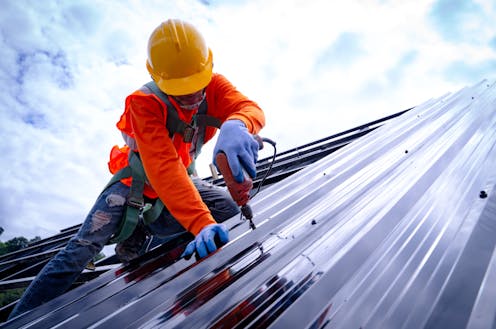
Australia’s construction industry employs more than 1.3 million workers. That’s about 9% of the workforce.
But construction sites can be dangerous workplaces. There are also more accidents on a Monday than any other weekday, a pattern we see in many countries.
A number of factors combine to give us this “Monday effect”. And we can address these and other issues to reduce the number of avoidable workplace accidents on Mondays and other days of the week.
Construction is dangerous
The construction sector has higher rates of workplace injuries than the national average.
In 2023, the industry reported 45 workers had died, an increase from the five-year average of 33.
Construction workers most commonly die after being hit by moving objects. Deaths after falls, trips and slips are the next most common reasons.
The 2022–23 financial year saw more than 16,600 serious workers’ compensation claims in the construction sector. The median compensation now stands at A$18,479, with a median work time lost of 8.5 weeks – both up from previous years.
The ‘Monday effect’
Various studies across different regions confirm the “Monday effect” in construction. For example, a Chinese study found fatal accidents were 12.6% more common on Mondays compared with other weekdays. There was a similar trend in Spain and Hong Kong.
We also see the “Monday effect” in other industries, such as agriculture, forestry, mining and manufacturing.
A Spanish study that looked at the records of nearly 3 million occupational accidents, including construction, confirmed the Monday effect across industries, in companies of all sizes, for all types of workers, and for different types of injury.
Combined data of all occupational accidents in Queensland also confirms the Monday affect.
Why Mondays?
Construction accidents are more likely on a Monday for many reasons.
For instance, falling asleep late on Sunday night and having poor-quality rest the night before the start of the working week contributes to “cognitive failure” and errors at work on Monday.
Mondays tend to involve the start of new tasks or projects. This can introduce unfamiliar risks.
Site conditions, including the weather, may also change over the weekend, creating unexpected hazards. For instance, strong winds over the weekend could cause scaffolding or unsecured materials to shift, increasing the risk of accidents on Monday.
We need to address the root causes
A study into the safety and performance of Australia’s construction industry emphasised being proactive in anticipating and preventing accidents rather than taking measures after accidents have occurred – on Mondays or on other days of the week.
The study drew on in-depth interviews with 30 industry professionals across 14 companies to identify several factors contributing to construction accidents:
unrealistic deadlines, which may lead workers to rush and cut corners to get the job done on time
a shortage of skilled labour, meaning some workers might be doing work they are not qualified to do
workers afraid to speak up about safety concerns, which can lead to potential hazards not being reported and resolved
complex and unfamiliar bespoke builds, which may introduce unique risks and challenges workers may have not yet encountered
inadequate risk assessments of human factors, which include fatigue, stress, or cognitive overload, and can lead to errors and unsafe decisions on site
rushed training programs, particularly for safety, which can leave workers ill-equipped to handle hazards or follow proper procedures.
What can we do to prevent accidents?
Part of addressing some of these issues involves fostering a workplace culture where safety is viewed as a core value and a shared responsibility between employers, supervisors and workers.
In construction companies where safety is treated as a “psychological contract” – an unwritten but mutual obligation between workers and supervisors – workers are better equipped to identify and address safety hazards.
Awareness campaigns highlighting issues such as the “Monday effect” could also encourage workflows to be adjusted to reduce the risk of an accident. This could include scheduling less hazardous or less complex tasks on Mondays to allow workers time to get back into the swing of things.
What else can we do?
Technology may also help prevent accidents.
For example, wearable sensors on a wristband or smartphone could identify, track and monitor workers’ body posture. These sensors might detect unsafe lifting practices, excessive bending, or prolonged periods in static or awkward positions. These are factors that can contribute to ergonomic risks and injuries.
Augmented reality may be be used to simulate tasks to help workers practise techniques safely.
Artificial intelligence could analyse camera vision to monitor work sites for unsafe activities and to flag hazards.
But concerns about cost, privacy and convincing the industry these investments are worthwhile are among barriers to introducing these technologies.
Money talks
Raising awareness about the economic costs of workplace accidents may shift attitudes and priorities.
A 2019 Australian study found the mean cost of a construction accident is $2,040 to $6,024,517. This depends on whether the accident results in a short or long absence from work, someone is partially or fully incapacitated, or someone dies.
A compensation payment, loss of income or earnings, staff training and retraining costs, social welfare payments, as well as medical, investigation and carer costs are among components in this estimate.
Aim for zero deaths
Occupational deaths and injuries on construction sites should not be dismissed as unfortunate mishaps. They are a symptom of multiple, systemic factors that need to be addressed through deliberate action and a commitment to safety.
Just as road safety initiatives aim for zero fatalities, the construction industry should set its sights on achieving zero workplace deaths.
Authors: Milad Haghani, Senior Lecturer of Urban Risk & Resilience, UNSW Sydney
Read more https://theconversation.com/why-monday-is-the-most-dangerous-day-on-a-building-site-243787


















