

Minerals in hot springs performed a key chemical reaction for early life on Earth, new study confirms
- Written by: Quoc Phuong Tran, PhD Candidate in Prebiotic Chemistry, UNSW Sydney
One of the biggest scientific mysteries is where life on Earth started.
Research has often focused on the role of deep-sea hydrothermal vents – those towering structures on the ocean floor constantly pumping out a melange of organic and inorganic material. Within these plumes are minerals called iron sulfides, which scientists believe could have helped trigger early chemical reactions that created life.
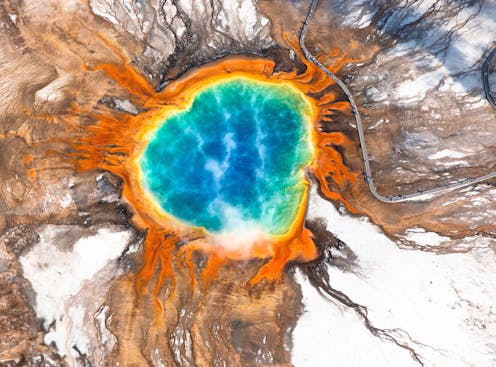
These same minerals are also found in hot springs today, such as the Grand Prismatic Spring in Yellowstone National Park in the United States. Hot springs are bodies of groundwater heated by volcanic activity beneath Earth’s surface.
Our new research adds to a small but growing body of evidence that ancient versions of these hot springs could have played a pivotal role in the emergence of life on Earth. This helps bridge the gap between competing hypotheses regarding where life could have emerged.
Geochemistry to biology
Carbon fixation is the process by which living organisms convert carbon dioxide, in the air and dissolved in water, into organic molecules.
Many life forms, including plants, bacteria and microorganisms known as archaea, have different pathways for achieving this. Photosynthesis is one example.
Each of these pathways contains a cascade of enzymes and proteins, some of which contain cores made of iron and sulfur.
We can find proteins with these iron-sulfur clusters in all forms of life. In fact, researchers propose they date back to the Last Universal Common Ancestor – an ancient ancestral cell from which scientists propose life as we know it evolved and diversified.
Iron sulfides are minerals that form when dissolved iron reacts with hydrogen sulfide – the volcanic gas that makes hot springs smell like rotten eggs.
If you look closely at the structure of these iron sulfides, you will find that some of them look incredibly similar to iron-sulfur clusters.
This connection between iron sulfides and carbon fixation has led some researchers to propose that these minerals played a crucial role in the transition from early Earth geochemistry to biology.
Our newly published research expands on this knowledge by investigating the chemical activity of iron sulfides in ancient land-based hot springs which have similar geochemistry to deep-sea vents.
Custom-built chamber
We custom-built a small chamber that would allow us to simulate hot spring environments on early Earth.
Then we spread synthesised iron sulfide samples through the chamber. Some were pure. Others were dosed with other metals commonly found in hot springs. A lamp above these samples simulated sunlight on the early Earth’s surface. Different lamps were used to mimic lighting with different amounts of ultraviolet radiation.
Carbon dioxide and hydrogen gas were constantly pumped through the chamber. These gases have been shown to be important for carbon fixation in deep-sea vent experiments.
We found that all of the iron sulfide samples synthesised were capable of producing methanol, a product of carbon fixation, to varying extents. These results showed that iron sulfides can facilitate carbon fixation not only in deep-sea hydrothermal vents but land-based hot springs too.
Methanol production also increased with visible light irradiation and at higher temperatures.
Experiments with varying temperatures, lighting and water-vapour content demonstrated that iron sulfides likely facilitated carbon fixation in land-based hot springs on early Earth.

An ancient pathway
Additional experiments and theoretical calculations revealed that the production of methanol occurred through a mechanism called a reverse water-gas shift.
We see a similar reaction in the pathway some bacteria and archaea use to turn carbon dioxide into food. This pathway is called the “acetyl-CoA” or “Wood-Ljungdahl” pathway. It is proposed to be the earliest form of carbon fixation that emerged in early life.
This similarity between the two processes is interesting because the former happens on dry land, at the edge of hot springs, while the latter takes place in the wet environment inside cells.
Our study demonstrates methanol production in a wide range of conditions that could have been found in early Earth’s hot springs.
Our findings expand the range of conditions where iron sulfides can facilitate carbon fixation. They show it can happen both in the deep sea and on land – albeit via different mechanisms.
As such, we believe these results support the current scientific consensus suggesting that iron-sulfur clusters and the acetyl-CoA pathway are ancient and likely played an important role in the emergence of life – regardless of whether it happened on land or at the bottom of the sea.
Authors: Quoc Phuong Tran, PhD Candidate in Prebiotic Chemistry, UNSW Sydney


















