

Minor parties perform well in federal election and reconfirm the power of preference deals
- Written by Chris Salisbury, Research Associate, School of Political Science & International Studies, The University of Queensland
This was an election brimming with surprises and shocks. An unexpected Coalition victory, and the inaccuracy of opinion poll predictions, have many scratching their heads in the post-election wash-up.
What didn’t defy predictions, though, was another high non-major party vote of close to 25%. At this election, primary vote support for both Labor and the Coalition is slightly diminished, continuing a trend of waning faith in the parties of the political “establishment”.
Read more: Morrison has led the Coalition to a 'miracle' win, but how do they govern from here?
It is also unsurprising to see the popularity in certain regions of minor parties like Pauline Hanson’s One Nation (PHON) and Clive Palmer’s United Australia Party (UAP). In this, at least, it seems opinion polls were more accurate.
Minor parties in the lower house
As anticipated, though, neither of these minor parties looks to have won lower house seats. But at this point in the count, their voters’ preferences generally appear to have flowed strongly in favour of the Coalition. This has helped support large two-party-preferred swings for government MPs in formerly at-risk marginal seats.
Irrespective of recent controversies, PHON again managed to attract significant numbers of disgruntled voters, particularly in its home state of Queensland. The party’s national vote of 3% is more than double its effort at the 2016 election. In Queensland, PHON’s vote increased by over 3% to 8.7%. In most of the 59 electorates it contested, PHON outperformed its main minor party rival, the UAP.
Read more: Coalition wins election but Abbott loses Warringah, plus how the polls got it so wrong
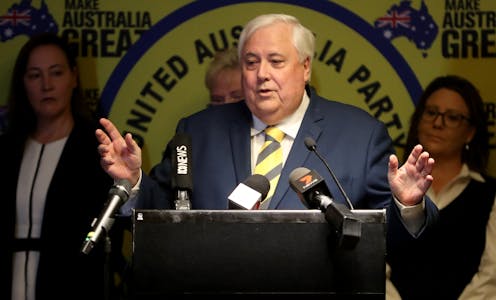
Palmer stood candidates in all 151 lower house seats and spent an estimated $60m on election advertising. Despite this, the UAP secured just 3.4% of the national vote, and gained roughly an equivalent figure in Queensland. But that remarkable spend may have paid off in different ways.
Major party strategists have claimed that Palmer’s outlay had an impact in shaping the election result. This applies mainly in Queensland, where his omnipresent, bright yellow advertising frequently targeted opposition leader, Bill Shorten, with negative messaging.
In addition to this, though, UAP and PHON – plus Katter’s Australian Party (KAP) and other regionally-focused minor parties – campaigned hard on issues of great local concern to regional Queenslanders.
Prominent among these issues is the Adani coal mine project and, by association, the promise of employment opportunities in regional communities. The extent of desire for such opportunities in regional Queensland, and the likelihood that votes would follow such promises, was a factor in the election lead-up perhaps not fully appreciated outside those regions.
The Greens have again secured approximately 10% of the vote nationwide, consolidating their place as the minor party enjoying highest voter support. Despite running prominent and popular campaigns in government-held seats like Kooyong and Higgins in Victoria, the party has not added to its sole elected MP, Adam Bandt in Melbourne.
In addition, the Centre Alliance’s Rebekha Sharkie and KAP’s Bob Katter, as expected, retained Mayo in South Australia and Kennedy in far north Queensland respectively. Both could play key roles in the potential formation with Prime Minister Scott Morrison of a minority government.
Independents in the lower house
A feature of this election was the number of high-profile independent candidates challenging prominent government MPs in city and regional electorates. But the anticipated independent “wave” – mainly of hoped-for women representatives – crashing through at this election didn’t quite materialise.
The ‘blue ribbon’ contest in Malcolm Turnbull’s former seat of Wentworth is still to be formally decided. But Liberal candidate Dave Sharma looks to have won the seat back from independent MP, Kerryn Phelps, successful there at last October’s high-profile by-election.
In another highly anticipated contest, independent candidate Zali Steggall has succeeded sensationally in capturing the safe Liberal seat of Warringah from Tony Abbott. The former prime minister had held the seat since 1994, yet suffered a two-candidate swing of almost 19% against him.
In Victoria’s Indi, Helen Haines defied doubts about the ability of a new independent to “inherit” a seat from a departing one. Haines secured the seat with the committed support behind her of the “Voices for Indi” movement, which had previously propelled Cathy McGowan into parliament.
As anticipated, independent Andrew Wilkie easily retained his hold on Clark in Tasmania. This, though, was in the face of an improved Coalition standing in the island state, potentially picking up two seats from Labor.
By contrast, Rob Oakeshott failed to win the regional seat of Cowper in New South Wales, despite his recognisable status giving him a good chance of success. At Oakeshott’s second attempt at winning the seat, this time from the retiring Luke Hartsuyker, he was defeated fairly comfortably by the Nationals’ Pat Conaghan.
In all, the lower house crossbench currently stands at six MPs, an increase of only one member from the 2016 election.
The Senate crossbench
The Senate vote count is still underway and only roughly half-completed at this stage. Early totals indicate that the record crossbench of 20 senators elected in 2016 will be reduced in number.
Neither major party, though, will control a majority in the Senate. The Coalition will have to contend with a combination of right-wing and centrist minor party senators (including a returning Jacqui Lambie) in addition to a likely 9 Greens.
In Queensland, where Clive Palmer was given the party’s best chance at winning a Senate seat, the UAP is currently well short of reaching a quota. PHON’s Queensland senate candidate, Malcolm Roberts, will likely capture the final spot in that state and return to the upper house after his disqualification in 2017. Fraser Anning’s attempted re-election under his own party banner has been thwarted.
Significance of preference deals
It remains to be seen exactly how influential the Coalition’s preference dealing with the UAP and (for the Nationals) PHON proved to be. Yet Shorten contended in his election night concession speech that Coalition preference deals with these parties had “hurt” Labor’s support, particularly in Queensland and New South Wales.
The closeness of the two-party-preferred vote – currently 51.1% for the Coalition to 48.9% for Labor – indicates how little margin for error there is in losing voter support.
Significant backing for minor parties and independents at recent federal elections may not have converted to many lower house seats. But it at least ensures that preference dealing - and minor parties themselves - will continue to play a prominent role in our politics.
Authors: Chris Salisbury, Research Associate, School of Political Science & International Studies, The University of Queensland

















