

Like your pet more than people? So did some of the Greco-Romans
- Written by: Konstantine Panegyres, McKenzie Postdoctoral Fellow, researching Greco-Roman antiquity, The University of Melbourne
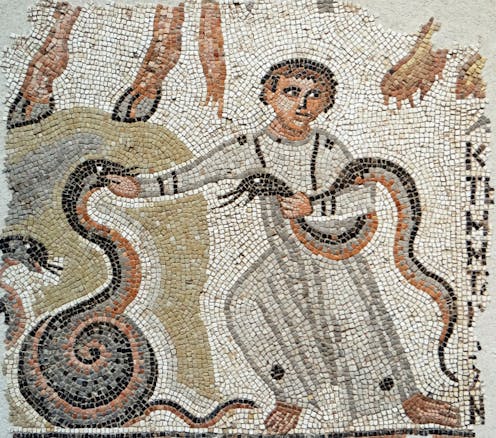
The Roman writer Claudius Aelian (2nd–3rd century CE) tells us a curious story about a boy and a pet snake:
A boy bought a small snake and reared it with great care. When it grew he spoke to it as if it could hear, played with it and let it stay in his bed while he was sleeping. When it became very big the city had it sent to an uninhabited spot. Later, when the child, now a young man, came back from an entertainment, he and his companions were set upon by brigands. There was a commotion, and the snake appeared. It dispersed some of the attackers and killed others, saving the young man.
The boy was lucky. His pet snake remembered his earlier kindness, and came to save him in his moment of need, if we can believe the story.
This is one of many tales from the Greco-Roman world about people and their pets.
Just like today, people back then loved and enjoyed the company of animals in their homes. So, what sorts of pets did they keep and what do we know about them?
Some famous stories about pets
Many stories about pets survive from Greco-Roman times. These stories usually attest to the close bonds humans and animals can form with one another.
Here are a few of them.
One day, the Roman general Paulus Aemilius (229–160 BCE) arrived home after work and found his little daughter Tertia crying.
Why was she crying? The biographer Plutarch(1st–2nd century CE) tells us what happened:
Paulus asked the reason. And she said, “Our Perseus is dead”.
Perseus was the name of their pet dog. We don’t know what Perseus died from, but Paulus’ daughter was obviously deeply fond of the animal.

In some ancient stories, people’s pets were sometimes their only source of support in difficult times.
The Theban general Epaminondas (410–362 BCE) was charged with various petty crimes by his political enemies at Thebes. After proving himself innocent of the charges in court, he finally got to go home:
when he returned from the court his little Melitaean dog greeted him with a wag of the tail. This led him to say to those who were present: “This dog thanks me for my favours, but the Thebans, after the benefits I conferred on them, tried me on a capital charge”.
The philosopher Lacydes of Cyrene (died 205 BCE) had a close bond with his pet goose:
when he went for a walk, it went too. When he sat down, it would remain still and would not leave him for a moment. And when it died Lacydes gave it a most costly funeral as though he were burying a son or a brother.
But one of the most famous ancient pet stories is about Darius III (died 330 BCE), the King of Persia. He was defeated by Alexander the Great and then betrayed by one of the Persians, called Bessus:
when Darius, the last king of Persia, was struck by Bessus in the battle against Alexander and lay dead, all abandoned the corpse, only the dog which had been reared under his care remained faithfully at his side, unwilling to abandon, as though he was still alive, the man who could no longer tend him.
Darius’ dog stayed loyal to him to the end, unlike the people around him.
Different types of pets
Dogs were the most popular house pet in Greco-Roman times. The favourite breed of dog was called the Melitaean.
This breed of dog was originally from Carthaginian Africa. It was very small with long hair, a bushy tail and sharp nose, and apparently barked with a squeaky voice.
Other favourite pets were monkeys, snakes and birds of many different kinds. Even the Roman emperor Tiberius (42 BCE to 37 CE) had a pet snake.
Pet cats of the kind we are familiar with were, for a long time, mainly found in Egypt. The Egyptians’ word for “cat” actually sounded like the noise cats make, “meow”.
 A red-figure vase painting of a man with a big cat (probably a cheetah). Athens, circa 490 BCE.
British Museum
A red-figure vase painting of a man with a big cat (probably a cheetah). Athens, circa 490 BCE.
British Museum
Ancient Greeks and Romans seem not to have kept these sorts of household cats as pets.
But there is evidence that in Athens in the 5th century BCE, it was trendy for wealthy people to own exotic big cats such as cheetahs, possibly for hunting purposes.
Some wealthy people even had lions as house pets. For example, Berenice (273–226 BCE), wife of Ptolemy III of Egypt, had a tame lion as her companion. “It would softly wash her face with its tongue and smooth away her wrinkles”, says Aelian. It would also eat at her table at dinnertime.
The loyalty of animals
Ancient writers such as Aelian praised animals for their loyalty.
Aelian says animals become loyal when you do simple things for them like giving them food and love, whereas human beings can be disloyal no matter how much you do for them:
well-treated animals are good at remembering kindness […] a human being however […] can become the bitter enemy of a friend and for some trifling and casual reason blurt out confidences to betray the very man who trusted him.
Aelian gives as an example of this the story of a boy who was given a baby eagle to care for:
he reared the bird not as a plaything to sport with, but as a favourite or as a younger brother […] as time passed it lit the flame of a strong mutual friendship. It happened that the youth fell sick, and the eagle stayed at his side and nursed its keeper. While he slept, the bird remained quiet. When he woke, it was there. If he took no food, it refused to eat. And when the youth at last died, the eagle also followed him to the tomb, and as the body burned it threw itself on to the pyre.
So, if there’s one message that Greco-Roman writers give about pets, it’s that the bonds between humans and animals can sometimes be stronger than the bonds between humans and other humans.
Authors: Konstantine Panegyres, McKenzie Postdoctoral Fellow, researching Greco-Roman antiquity, The University of Melbourne
Read more https://theconversation.com/like-your-pet-more-than-people-so-did-some-of-the-greco-romans-236592


















