

Can animals make ‘art’? These examples from nature suggest so
- Written by: Susan Hazel, Associate Professor, School of Animal and Veterinary Science, University of Adelaide
According to Britannica, “art” can be described as something “consciously created through an expression of skill or imagination” – whereas Wikipedia defines it more narrowly as a human activity. But are humans the only species that makes art?
If we take art to be something that is beautiful and consciously created – and animals consciously create things that look like art – shouldn’t we accept these productions as art, too? As Edgar Degas put it, “art is not what you see, but what you make others see”. Indeed, we see beautiful creations all across the animal kingdom.
Some of these works, such as the bowerbird’s nest, are defined in the eyes of their animal beholders. Others have a largely functional purpose, such as mating or feeding, yet manifest in patterns and/or colours that make them beautiful to behold.
On that note, here are some of our favourite animal “artworks”.
Molluscs
Walking on the beach, you can’t help but notice the beautiful patterns on seashells scattered across the sand.
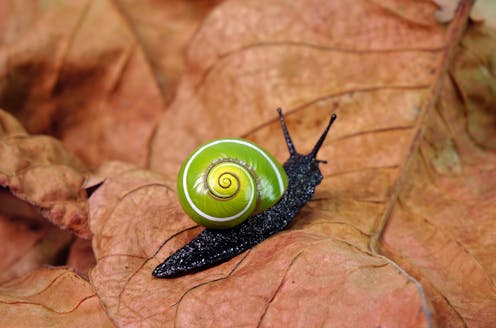
Molluscs such as sea and land snails have delicate bodies, so they need protection. They create their shells by layering a calcium carbonate secretion that hardens once it leaves their bodies.
On these spiral shells, you will find all manner of stripes, swirls and oblique lines that resemble geometric abstraction in art.

Pufferfish
In 1995, some divers off the coast of Japan noticed intricate and beautiful circular patterns etched into the sea floor. These “underwater crop circles” remained a mystery for more than a decade. In 2011, it was finally discovered a pufferfish – in this case the white-spotted pufferfish (Torquigener albomaculosus) – was responsible.
Male pufferfish spend several days creating these circles by repeatedly swimming in and out while digging into the sand with their fins. The circles themselves have two uses. They help attract a mate – wherein the males that make the most beautiful circles are more likely to have success – while the centre of the circle functions as a nest for eggs.
Some of these circles have even been found off the coast of Western Australia.
Bowerbirds
Bowerbirds are found across Australia and Papua New Guinea. While it’s unclear what their nests looked like before the plastic era, today they are often dominated by blue plastic.
 Satin bowerbirds males are satin blue in colour and tend to decorate their nests with mostly blue items.
Shutterstock
Satin bowerbirds males are satin blue in colour and tend to decorate their nests with mostly blue items.
Shutterstock
The male birds scavenge and steal all things blue to take back to their nest, where the objects are scattered around two walls of carefully formed sticks bending towards each other.
Beauty is definitely in the eyes of the beholder, as researchers have found these nest decorations are linked to mating success for male bowerbirds.
Other bird nests
Apart from the bowerbird’s uniquely bedazzled nests, a range of other bird species make nests that are as beautiful as they are functional.
Hummingbirds, for instance, will often make nests with contrasting green and white moss and lichen, thought to be added for camouflage.
 The Rufous hummingbird, found in the Americas, build nests using spider silk and lichen.
Shutterstock
The Rufous hummingbird, found in the Americas, build nests using spider silk and lichen.
Shutterstock
Meanwhile, male weaver birds build intricately woven nests to attract potential mates. These are made using twigs or plant material (whichever is readily available) and can contain more than 1,000 strands of grass.
 Baya weaver birds, which live cross the Indian Subcontinent and Southeast Asia, construct sculptural beauties from plant fibres.
Shutterstock
Baya weaver birds, which live cross the Indian Subcontinent and Southeast Asia, construct sculptural beauties from plant fibres.
Shutterstock
Whales
A humpback whale can eat up to one tonne of fish in a day. This includes shoaling fish such as herring and mackerel. Humans catch large amounts of these fish using nets. But how do whales catch them?
The answer is something called bubble-net feeding. This cooperative activity requires two or more whales which dive deep below schools of fish and blow bubbles through their blowholes to stun and trap the fish closer to the surface. As one whale blows the bubbles, the other/s follow the fish to the surface in spiral patterns to keep them trapped.
The patterns made in this process are stunning. One photo of bubble-net feeding by humpback whales (Megaptera novaeangliae) even won the 2024 Australian Geographic Nature Photographer of the Year competition.
Sticklebacks
Great art is sometimes made with innovative materials.
The three-spined stickleback (Gasterosteus aculeatus) is a small fresh-water fish that develops a bright red throat during breeding season. But that’s not enough to attract a mate, so it also creates an underwater nest made from weeds held together by spiggin, a secretion that comes from the kidneys.
The stickleback’s spiggin is highly adhesive and sticks the weeds together, even in water. As many teenage boys know, you can’t leave the house without hair gel.
But the displays don’t stop there. Once the nest is ready, the male will try and lure females to it through a rather erratic courtship dance.
Beavers
While many artists make sculpture from natural materials such as stones or wood, beavers are arguably the experts at this.
Beavers make dams using trees they fell using their large front teeth, as well as other branches, mud and stone. These dams change the flow of streams, converting them into slow-moving lakes that provide the beavers protection from land-based predators.
Beyond helping themselves, the new lakes also create an ecosystem for lots of other animals, and can even help reduce flooding in human habitats.
 A beaver dam in Tierra del Fuego, Chile.
Flickr/Oregon State University, CC BY-SA
A beaver dam in Tierra del Fuego, Chile.
Flickr/Oregon State University, CC BY-SA
Whether you agree animals make “art” or not, you can’t deny they make plenty of beautiful and functional works.
Authors: Susan Hazel, Associate Professor, School of Animal and Veterinary Science, University of Adelaide
Read more https://theconversation.com/can-animals-make-art-these-examples-from-nature-suggest-so-237126




















