

Summer holidays haven’t changed much since ancient Greece and Rome (except maybe the sand wrestling)
- Written by: Konstantine Panegyres, McKenzie Postdoctoral Fellow, researching Greco-Roman antiquity, The University of Melbourne
Imagine a summer holiday at a seaside resort, with days spent sunbathing, reading books, exploring nature and chatting with friends.
Sounds like it could be anywhere in Australia or New Zealand in January, doesn’t it?
This is also how the Roman emperor Julian spent his summers in the 4th century CE. Towards the end of 357 CE, Julian wrote a letter to his friend Evagrius, telling him how he spent his holidays at his grandmother’s estate as a boy and young man:
Very peaceful it is to lie down there and glance into some book, and then, while resting one’s eyes, it is very agreeable to gaze at the ships and the sea.
When I was still hardly more than a boy I thought that this was the most delightful summer residence, for it has, moreover, excellent springs and a charming bath and garden and trees.
As Julian got older, though, he had less time for summer holidays. Work consumed him. Even when he was on a break, he couldn’t fully relax.
This might sound familiar, too. It seems very little has changed from the days of the ancient Greek and Roman empires when it comes to finding time to unwind – and being on holidays, too.
Finding time for a break
Taking time off was important in ancient Greek and Roman times. Even Greek and Roman slaves were permitted to take a few holidays each year.
Not everyone could enjoy their holidays, however.
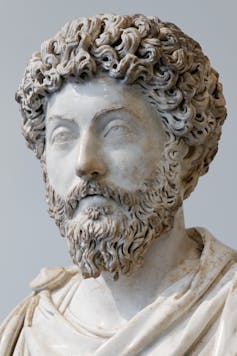
In 162 CE, Marcus Aurelius, then emperor of Rome, took four days of holiday at a resort in Alsium, a city on the coast of modern-day Italy.
According to his friend Marcus Cornelius Fronto (c. 95-166 CE), though, the emperor could not stop working. In a letter, Fronto criticises Marcus for continuing to work hard rather than sleeping in, exploring the seaside, rowing on the ocean, bathing and feasting on seafood.
Fronto amusingly says that Marcus, rather than enjoy his holiday, has instead “declared war on play, relaxation, good living, and pleasure”.
Going to the seaside
Relaxing by the coast was one of the things people in ancient Greece and Rome most enjoyed doing in the summer.
The rich built summer residences on the coast, while people of all walks of life flocked to seaside resorts to enjoy the fresh air and cool water.
The orator Libanius (314-393 CE) wrote that the people who really enjoy life the most are those who have the freedom to “drive to their estates, visit other towns, buy land, and visit the seaside”.
Health tourism was also a popular reason why people came to the seaside. Many ancient doctors recommended sea water and air as cures for all kinds of health problems, especially those related to the skin and respiratory system.
For example, the doctor Aretaeus of Cappadocia (c. 150-200 CE) recommended bathing in sea water, wrestling on sand and living by the sea as therapies for those who get frequent headaches.
Travelling abroad
Visiting foreign places was another of the things people in ancient Greece and Rome most enjoyed doing on their summer holidays.
For the Romans, trips to see Greece – and in particular Athens – were especially popular.
The Roman general Germanicus (15 BCE–19 CE) went on a tour of Greece in 18 CE, travelling from Athens eastward to Euboea, Lesbos, the coast of Asia Minor and then to Byzantium and Pontus.
According to the Roman historian Tacitus, Germanicus was motivated by a desire to see famous ancient sites. Like many Romans, he was fascinated by the old stories of the Greek past, so he was “eager to make the acquaintance of those ancient and storied regions”.
Another popular destination for ancient Greeks and Romans was Egypt, which had always been regarded as a land of wonder.
Roman tourists could catch regular boats from Puteoli to the great Egyptian city Alexandria. The trip took anywhere from one to two weeks, stopping along the way in Sicily and Malta.
Once there, the highlights were typically the great Nile River and Pyramids. Tourists marvelled at the immense temples and walls of hieroglyphic writing.
When Germanicus visited Egypt in 19 CE, he was so curious about the meaning of the hieroglyphics that he asked an old Egyptian priest to translate some for him.
In Alexandria, another attraction was the tomb of Alexander the Great (356-323 BCE). His body was stored in honey in a coffin made of glass. Ordinary tourists were not allowed to visit it, but VIPs like Roman emperors were.
Tourists might also have enjoyed the different vibe in Alexandria. According to the Greek orator Dio of Prusa (c. 40-110/120 CE), the atmosphere in the coastal city was relaxed, with plenty of music, chariot racing and good food.
Lazy summer days
We can probably all relate to what the writer Pliny the Younger (61/62-112 BCE) said about his summer break.
Writing on a holiday in Tuscany, he said he can only work “in the lazy way to be expected during a summer holiday”. Working any other way was simply not possible. Many of us will be able to relate to that!
Authors: Konstantine Panegyres, McKenzie Postdoctoral Fellow, researching Greco-Roman antiquity, The University of Melbourne
&media=https://www.modernaustralian.com/https://images.theconversation.com/files/638067/original/file-20241212-19-qjmgm0.jpg?ixlib=rb-4.1.0&q=45&auto=format&w=237&fit=clip&description=Summer%20holidays%20haven’t%20changed%20much%20since%20ancient%20Greece%20and%20Rome%20(except%20maybe%20the%20sand%20wrestling) "Pin It")

















